

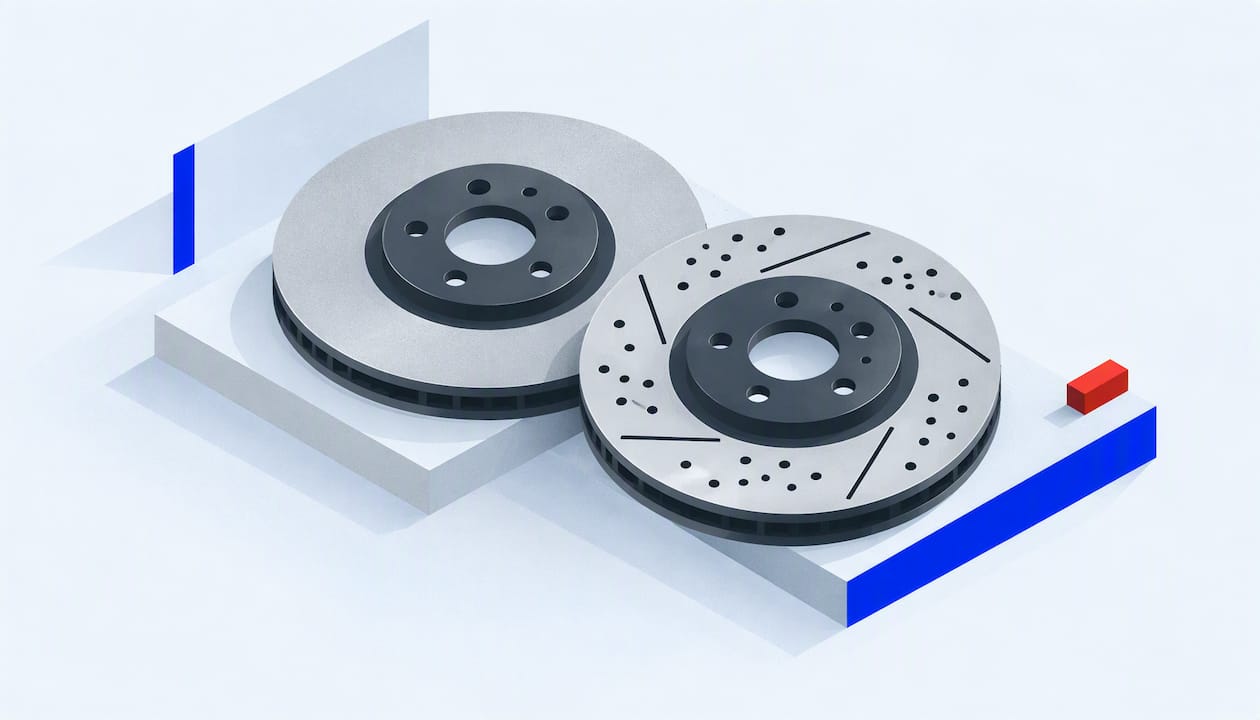
Yes, but less than the marketing suggests, and mostly in situations most drivers never create. Drilled holes and slots can improve cooling, clear gas and debris, and help shed water. They can also add noise, wear pads faster and, in the case of drilling, make the rotor more prone to cracking under hard use. For a daily commute, a matched set of quality pads and plain rotors usually serves you as well, and often better.
Below is what the testing and the engineers say, how each design behaves, and how to decide for your own vehicle.
TL;DR
- Drilled rotors have holes for gas, water and some heat release. Slotted rotors have grooves that sweep the pad surface clean. “Drilled and slotted” combines both.
- In controlled testing, cross-drilled rotors cooled better, and the gain grew with speed. That matters for towing, mountain descents and track days, not for most commutes.
- The most common reason street drivers pick them is looks. The performance case is real but narrow, and the trade-offs are noise, pad wear and cracking risk.
- For daily driving, rain and winter, the pad and rotor pairing, corrosion protection and a healthy caliper matter more than hole patterns.
- A vibrating brake pedal usually points to uneven rotor surfaces or wear, not a missing set of slots.
Table of Contents
- What drilled, slotted and plain rotors actually are
- What the testing shows
- Drilled vs. slotted vs. solid: the comparison
- Do they help in rain and snow?
- The downsides worth knowing
- Are they good for daily driving?
- My car vibrates when I brake. Will new rotors fix it?
- Our perspective: match the system, not the pattern
- Choosing a kit for your vehicle
- Before you buy any rotor
- FAQ
- Sources
What drilled, slotted and plain rotors actually are
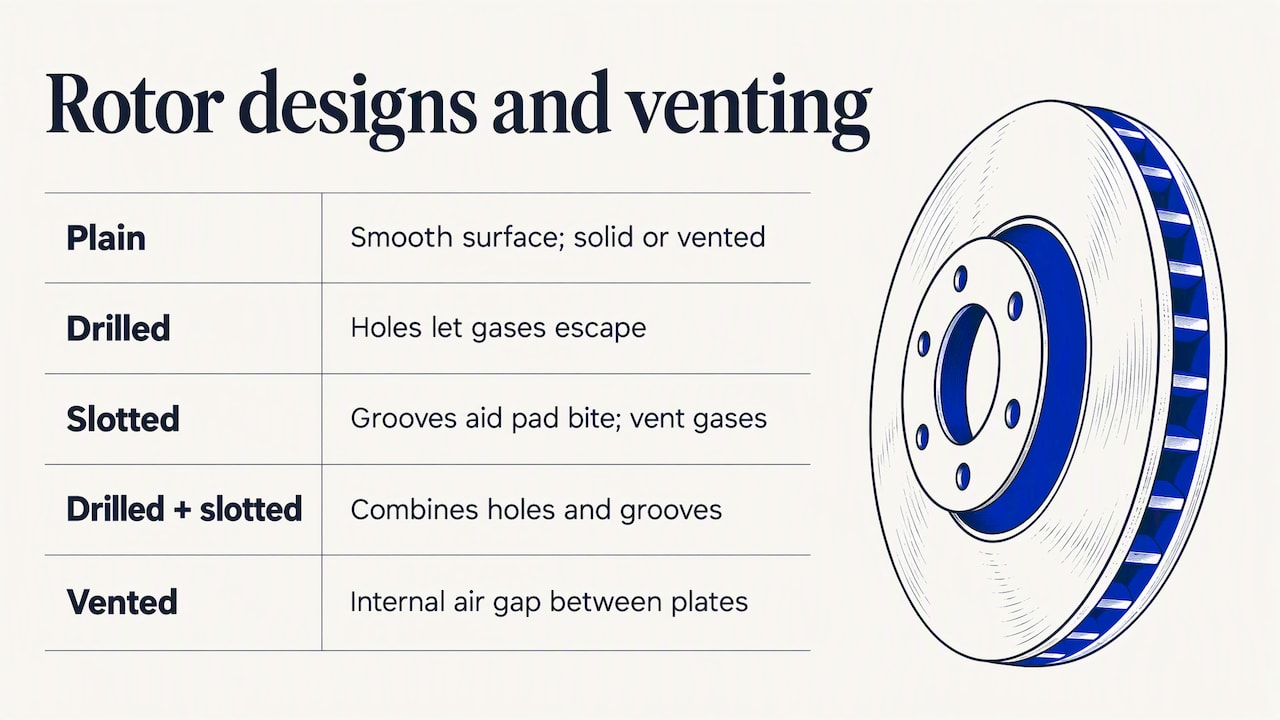
A plain (blank) rotor is a flat, smooth friction surface. It is either solid or vented, meaning it has internal fins that move air through the disc. Most passenger cars use vented rotors at the front.
Drilled rotors have holes through the friction surface. According to Brake & Front End, the holes give gases a path to escape and in some cases reduce weight and improve cooling.
Slotted rotors have shallow grooves cut across the face. The same source notes that slots provide leading edges for initial pad bite and a path for pad gases.
Drilled and slotted rotors combine the two patterns on one disc. You get the look of both, and some of the benefits and some of the drawbacks of each.
One point of confusion: “vented” is not the same as “drilled.” A vented rotor has an air gap between two friction plates. Drilling and slotting are surface treatments applied on top of either type.
What the testing shows
Cooling
The strongest evidence is for cooling. In an SAE study by Antanaitis and Rifici (paper 2006-01-0691), cross-drilled rotors improved front rotor cooling at every tested speed, and the improvement grew as speed rose. One system showed a 20.1% improvement at 160 kph (about 100 mph). The same synopsis reports that results varied with speed, brake system and pad material, so treat the figure as one data point, not a promise.
Slots are a different story. Motor Magazine notes that slots help clear debris and reduce dust buildup but do not cool the rotor.
Gas and debris
Older pad formulations released a layer of gas under hard braking, which could reduce grip. Road & Track reports that slots help prevent this “gassing out” and that they hold up better against thermal fatigue than drilling because they keep the rotor plate more intact.
Modern pads have far less of a gassing problem. A Brembo engineer quoted in Modified Magazine says that today the main benefit of drilling is refreshing the pad surface and evacuating water in wet conditions.
Looks
Be honest about why many people buy them. Motor Magazine states that appearance is the primary reason most street drivers choose drilled or slotted rotors, since the performance benefits are often debated. There is nothing wrong with wanting a car that looks sharp. Just do not expect a transformation in stopping distance.
What the academic literature says
A design study from the University of Sunderland found no consensus on the best rotor design. Drilling and slotting can help with heat dissipation or with gas and debris management, but both weaken the rotor.
Drilled vs. slotted vs. solid: the comparison
| Feature | Solid or plain vented | Slotted | Drilled | Drilled and slotted |
|---|---|---|---|---|
| Cooling | Baseline | No cooling gain | Can improve, more at high speed | Some gain from the holes |
| Gas and debris | Relies on pad design | Sweeps pad surface | Gas escape paths | Both |
| Wet braking | Fine with good pads | Edges help clear the surface | Water can leave through holes | Both |
| Pad wear | Lowest | Typically higher | Can be higher | Typically highest |
| Noise | Quietest | Can be louder | Can whistle | Can be louder |
| Cracking risk | Lowest | Low | Higher under extreme heat | Higher than slotted alone |
| Best fit | Daily driving, most vehicles | Towing, spirited driving | Performance use | Show and sport use |
The pad wear and noise rows reflect common shop experience rather than a single measured study, so how much you notice depends on the pad compound and driving style.
Do they help in rain and snow?
This is where the claims get stretched. Water on a rotor is pushed off by the pad within the first fraction of a revolution, and holes or slots give it extra places to go. That is the sensible reason both designs are described as helpful in the wet. The Brembo comment above supports the idea in modern applications.
What I could not find is independent testing showing a meaningful stopping-distance gain from holes or slots in rain or snow on a normal road car. In winter, the bigger problems are different: pads that grab unevenly when damp, rotors that rust overnight and leave a rough surface, and calipers that stick in the cold. Road salt also eats at exposed metal, and cut edges around holes and slots are extra surface to protect.
That is why we think about wet and cold braking as a system problem: pad compound, rotor surface protection and caliper movement, working together.
The downsides worth knowing
Cracking. Drilled rotors can crack around the holes under extreme thermal stress. Road & Track reports that on the street, rotor temperature spikes are brief (it cites about 500°F), and that cracking is generally not dangerous for road use. Track driving and repeated hard stops from high speed are a different matter, and that is where drilled rotors from a weak casting can fail.
Pad wear. Slots act like a gentle scraper on the pad. That is the reason they keep the surface fresh, and the reason pads can wear faster.
Noise. Some drivers hear a faint whir or whistle with slots or holes, especially at low speed.
Less material. Holes and slots remove metal, so there is less mass to absorb heat. Heat that stays in a thinner rotor can matter on long descents.
Are they good for daily driving?
For most people, not especially. A buyer’s guide from Autoguru, written for Australian drivers, makes the point that for roughly 90% of drivers standard vented and solid rotors are more than enough. It adds that frequent towing, mountain driving or track use may justify drilled or slotted designs.
Here is a simple way to decide.
- Commuter, school run, highway trips: plain rotors with a quality ceramic pad. You get quiet operation and long life.
- Towing, hauling, or a heavy SUV or truck on hills: heat is your enemy. Slotted rotors or a well-built plain vented rotor with high-temperature pads both make sense. Match the pad to the job.
- Rideshare, delivery and other high-mileage driving: you pay for pad wear every month. Skip the designs that wear pads faster unless you have a specific reason.
- Winter and wet climates: prioritize corrosion protection and consistent pad bite over hole patterns.
- Track days and aggressive canyon driving: this is where slots and holes earn their keep, ideally from a reputable casting and with track-rated pads.
My car vibrates when I brake. Will new rotors fix it?
Often, yes, but the cause matters. A shaking pedal or steering wheel usually comes from uneven rotor thickness. Patent literature describes how disc thickness variation causes brake torque variation: as the thicker part of the disc passes through the caliper, clamping force rises and falls, and you feel it as vibration.
Common causes include uneven pad material transfer, corrosion on the rotor face, a sticking caliper or slide pins, and poorly torqued wheel lug nuts. Cutting holes into a rotor does not cure any of these. If you feel a pulse, have the rotors measured and the calipers checked, then replace pads and rotors together. If the vibration comes with a pull to one side, a burning smell or a soft pedal, have a mechanic look at it before you drive further.
Our perspective: match the system, not the pattern
We build brake parts for drivers who see rain, humidity, snow, salt and big temperature swings. From that vantage point, the question we hear most is not “holes or slots?” but “why do my brakes feel different when the weather changes?”
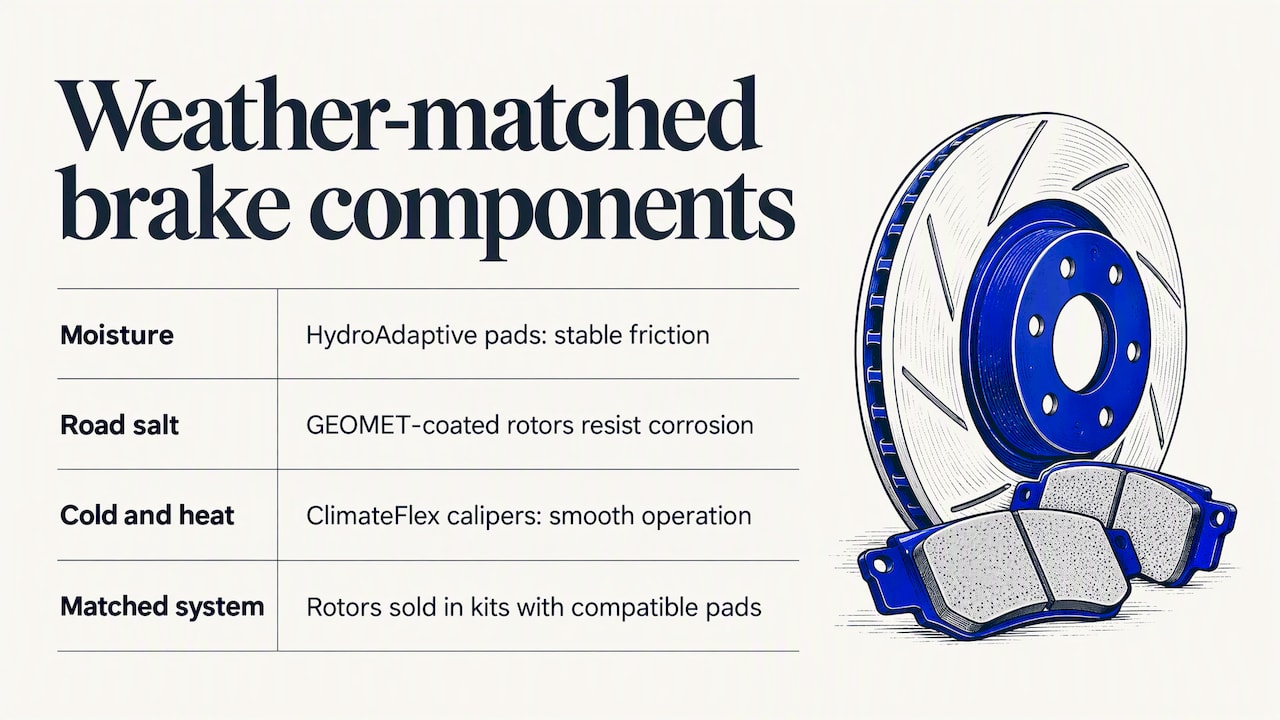
Our answer is that the weather attacks the whole system at once. Moisture changes how a pad grips. Salt eats rotor surfaces. Cold and heat change how freely a caliper moves. So each part of our range targets one of those: HydroAdaptive ceramic pads for moisture management and stable friction, GEOMET-coated rotors for protection against corrosion from moisture and road salt, and ClimateFlex calipers for smooth operation through winter cold and summer heat.
We also develop rotors and pads as a matched system, which is why our rotors are sold only as part of brake kits with compatible pads. A rotor and pad that were designed to work together will usually beat a trendy rotor paired with a pad nobody chose for it. That is the engineering decision we stand behind, and it is why we do not tell commuters that hole patterns are the upgrade they need.
— AAA
Choosing a kit for your vehicle
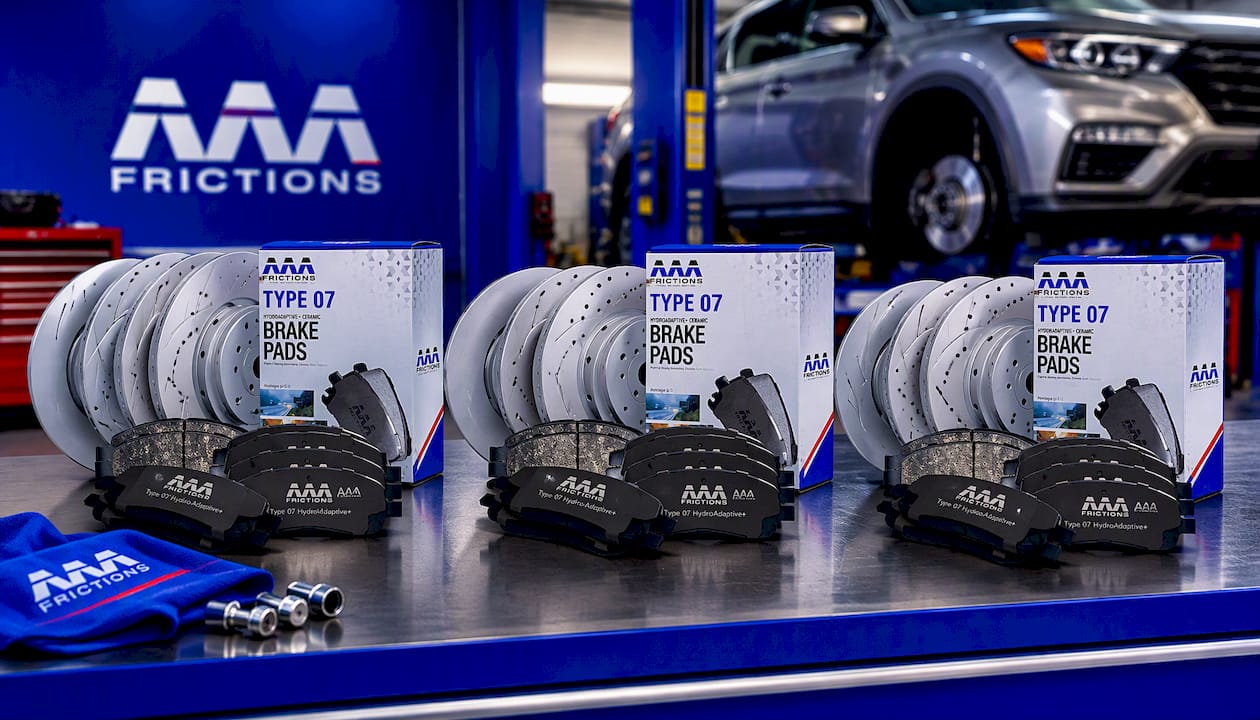
If you want brakes that feel the same on a dry July afternoon and a salted January morning, start with a matched kit. We offer Type 03 pads with SC Type rotors and Type 07 pads with SC Type rotors, and you can browse our GC Type GEOMET-coated rotors if corrosion from road salt is your main concern. Parts are matched by vehicle, so you enter your make, model and year and see what fits. Truck owners can look at kits such as the Type 07 rear brake kit for the Ram 1500 Classic 2019-2024, and the full range is on our main store page.
Before you buy any rotor
- Replace pads and rotors together. New pads on a worn, uneven rotor transfer the problem to the new pad.
- Check the calipers. A sticking caliper or slide pin will ruin any rotor, drilled or not.
- Bed in the new pads following the manufacturer’s instructions.
- Do not mix patterns across an axle. Rotors on the same axle should match.
- Keep the vehicle’s use in mind. A truck that tows is a different brake problem from a hatchback that commutes.
- Ask a mechanic about your specific situation if you tow heavy loads, drive steep grades or have had a brake failure before.
FAQ
Are slotted rotors better than plain rotors?
Slotted rotors clear debris and gas from the pad surface and give the pad a consistent bite. They do not cool the rotor, and they can wear pads faster. For daily driving, they are not clearly better than a good plain rotor.
Do drilled and slotted rotors stop a car faster?
Not meaningfully on a normal street car. Their advantages show up in repeated hard braking, where cooling and gas control help hold performance steady. In everyday stops, pad compound and tire grip decide stopping distance.
Are drilled and slotted rotors safe for daily driving?
Yes, from a reputable manufacturer, and Road & Track reports cracking is generally not dangerous for road use. Inspect them regularly for cracks around the holes. If you see one that runs to the edge of the rotor, replace it.
What do slotted rotors do?
They sweep away dust, debris and gas from between the pad and the rotor, and the slot edges help the pad bite. That helps keep braking consistent in hard use, but the effect is subtle in ordinary driving.
Is a vibrating brake pedal a sign I need drilled or slotted rotors?
No. It usually means uneven rotor thickness, corrosion or a sticking caliper. Have it inspected, then replace worn parts as a set.
Sources
- Drilled and Slotted Rotors, Brake & Front End
- Performance Perspectives: Brake Rotors, MOTOR Magazine
- Synopsis of SAE paper 2006-01-0691
- Cross-Drilled Brake Rotors Aren’t Just Form Over Function, Road & Track
- Rotor Education, Modified Magazine
- Design and Analysis of a Disc Brake Rotor, University of Sunderland
- Brake Rotors: Solid, Vented, Drilled or Slotted, Autoguru
- Disc thickness variation compensation, US patent