


The best brake pads for highway driving are pads that stay predictable: steady friction when they are hot, when they are wet, and when you need a hard stop from 70 mph. Long highway stretches are gentle on pads because you brake so rarely. The stops that do happen come at high speed, and the road is not always dry. So the pad matters most on the few braking events that count.
This guide explains how highway driving affects pad wear, what shortens pad life on high-mileage cars, which pad and rotor traits matter, and when to get your brakes checked.
TL;DR
- Highway miles cause little pad wear per mile. Wear is concentrated around braking events, and frequent, hard braking in urban traffic does the most damage.
- Speed, heat, extra weight, towing and hills raise wear rates, so a loaded SUV on a mountain interstate can wear pads faster than you expect.
- Rain, snow and road salt can corrode gray cast-iron rotors. That can cause stiction and rough braking, so rotor protection and pad friction stability both matter.
- Grinding, squealing, a soft pedal or pulling to one side means an inspection now, not next month.
- Replace pads and rotors as a matched set where you can. Parts designed to work together give the most predictable feel.
Table of Contents
- Why highway driving is easier on brake pads
- What actually wears pads on the highway
- High-mileage and rideshare cars: what to expect
- Weather: the part highway guides skip
- What to look for in highway brake pads
- Our perspective
- Habits that make pads last on long drives
- Signs your pads need attention
- If your brakes feel weak or fail on the highway
- Choosing parts for your vehicle
- Ready to match your brakes to your vehicle?
- FAQ
- Sources
Why highway driving is easier on brake pads
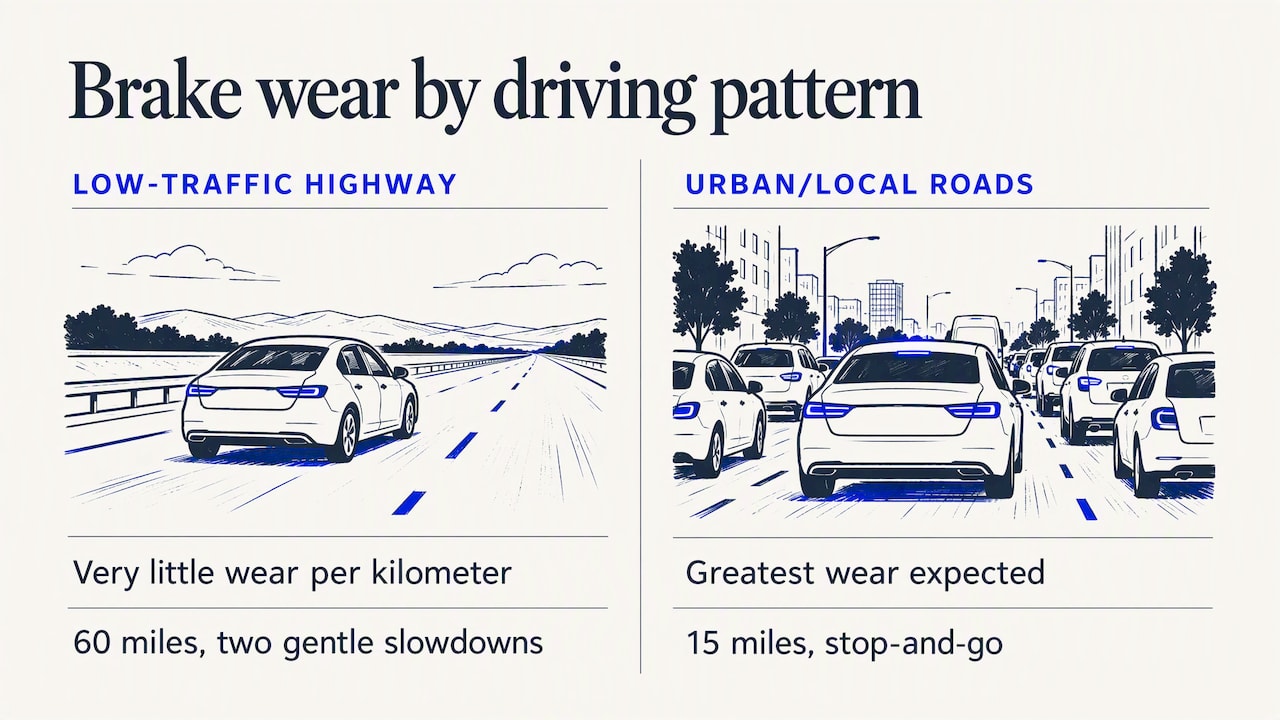
Pads wear when you press them against the rotor. A car cruising at a steady speed is not doing that. Research on brake wear from the Washington Department of Ecology found that low-traffic highway travel produces very little brake-pad wear per kilometer, while the greatest wear is expected on urbanized highways and local roads, where braking is more frequent and intense.
The same analysis makes a practical point. Brake wear is not like tire wear, which accumulates with every mile rolled. Brake wear gathers around braking events. A commuter who drives 60 highway miles with two gentle slowdowns asks far less of the pads than someone who drives 15 miles of stop-and-go.
That is why you sometimes see a car on its original pads at 100,000 miles or more. It is also why odometer mileage alone is a poor guide to when pads need replacing. Count the stops, not the miles.
When highway driving is not gentle
Highway driving is easy on pads only while traffic flows. Heavy braking is still part of it:
- Tailgating. Following closely means constant small corrections, and then hard stops when traffic bunches up.
- Congested interstates. A rush-hour commute on a crowded freeway is closer to city driving than to open-road cruising.
- Exit ramps and toll plazas. You scrub off a lot of speed in a short distance.
- Mountain grades. Long descents tempt drivers to hold the brakes on.
- Loads. Roof boxes, trailers, passengers and cargo all add mass the brakes must stop.
What actually wears pads on the highway
Three factors do most of the damage: speed, heat and weight.
Speed and temperature
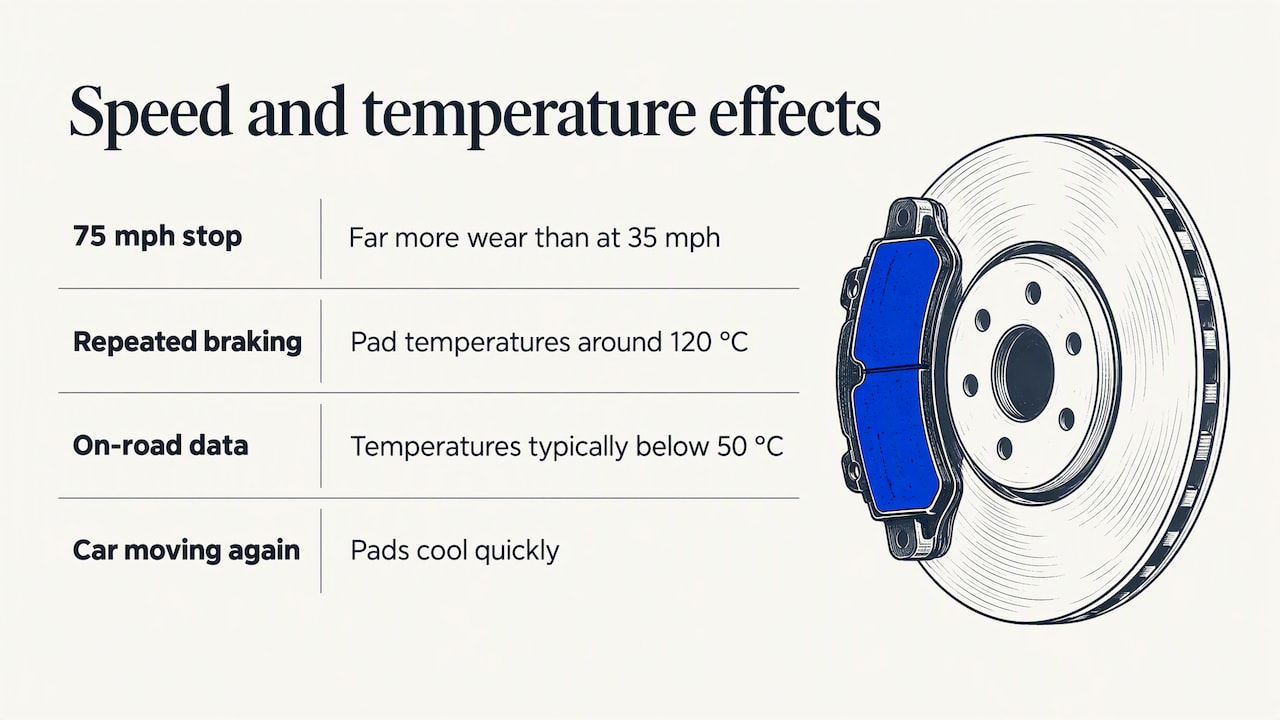
A National Institute of Justice evaluation of aftermarket pads, run with the Michigan State Police, reports that wear rates generally increase with braking speed and temperature. It also notes that results depend strongly on vehicle configuration, how brake force is split between axles, and thermal balance. In plain terms, a stop from 75 mph costs the pad far more than a stop from 35 mph, and the same pad can wear differently on different vehicles.
Heat is real but often brief. A 2025 study from the Technical University of Denmark found that repeated braking from highway speeds can raise pad temperatures to around 120 °C, and that the pads cool quickly once the car is moving again. Across the broader on-road data, temperatures typically stayed below 50 °C, and adding thermal effects changed the estimated wear only slightly. Most highway driving is cool for the pads. The problem is the occasional hot episode, such as a long descent or several hard stops in a row.
Sustained heat is where trouble starts. Academic work on brake corrosion and friction notes that thermal overloading can cause low friction output and fracture of the friction material. That is the fade you feel as a longer pedal and weaker bite.
Weight
A review of brake-pad wear research finds that additional vehicle load affects the wear rate. Larger vehicles, three-row SUVs and trucks start with more mass, and every passenger or bag adds to it. Danish researchers modeling wear from on-road data had to account for variable vehicle mass for this reason, and they validated their method on three passenger cars.
Terrain and towing
A 2019 General Motors service bulletin hosted by NHTSA, written to help technicians diagnose uneven pad wear, separates normal highway driving from heavy city driving, frequent elevation changes, towing and heavy loads. Even the manufacturer treats the driving environment as a major reason two cars on the same pads wear differently.
High-mileage and rideshare cars: what to expect
If you drive 30,000 or more miles a year, mostly on highways, your pads may last a long time in calendar terms and still need attention sooner than you think. Three reasons:
- Hours of exposure. More time on the road means more weather, more road salt and more temperature swings acting on rotors, calipers and hardware.
- Rotors age too. Pads can have material left while the rotor surface is rusted, grooved or uneven.
- Calipers and slides see more cycles. A sticking caliper can wear one pad faster than its partner, so regular inspection matters more than a fixed mileage interval.
Delivery and rideshare drivers mix both worlds: highway runs between pickups, then dense urban stop-and-go. That blend is the hardest on pads, because you get the speed of the highway and the stop frequency of the city. If that is you, inspect more often than the average commuter and watch for early warning signs.
For a deeper look at what drives pad life, see our guide to brake pad lifespan and what wears them.
Weather: the part highway guides skip
Most advice about highway pads stops at wear rate. But highway speeds make the first stop in bad weather the one that matters, and rain, snow and salt change what the brakes do.
Academic research on corrosion stiction explains the mechanism. In rain, snow and chloride environments, gray cast-iron rotors can corrode, and the friction material’s properties influence how much the pad sticks to the corroded surface. That sticking, called stiction or stick-slip, can affect braking performance and comfort. The same research notes that surface treatments can reduce a rotor’s susceptibility to corrosion.
This is easy to recognize in daily life. A car parked overnight in humid or salty conditions can develop a thin layer of rust on its rotors. The first few stops may feel rough, noisy or uneven. If that car then merges onto a highway, the brakes you rely on at speed are not yet at their best.
Two design goals follow from this:
- A pad whose friction stays stable when wet or cold.
- A rotor surface that resists corrosion from moisture and road salt.
What to look for in highway brake pads
Use these criteria when you compare options:
| What to check | Why it matters on the highway |
|---|---|
| Fit for your exact vehicle | Weight, axle brake balance and rotor size differ between models, so pads and rotors should be matched to your year, make and model. |
| Stable friction across temperature | A hard stop at speed heats the pad fast. Predictable bite from cold to hot is more useful than a high number on a spec sheet. |
| Wet and cold behavior | Rain and winter mornings are when highway stops are least forgiving. |
| Rotor corrosion protection | Salt and moisture attack bare cast iron, which can lead to stiction and rough braking. |
| Pad and rotor as a pair | Friction material and rotor surface work together. Mixing mismatched parts makes the result harder to predict. |
| Quiet, low-dust operation | On long trips, noise and dirty wheels are daily annoyances. Ceramic pads are generally chosen for these traits. |
Notice that “longest-lasting” is not the top criterion. On the highway, pad life is usually decided by your driving, not by the pad. What the pad can still control is how the car behaves in the moments that count.
Our perspective
We build brakes around one idea: the weather should not change how your car stops. A highway driver rarely thinks about the pedal until the moment it matters, and that moment is often a wet ramp, a cold morning or a sudden slowdown at speed.
That is why we do not treat the pad as a stand-alone part. Our HydroAdaptive ceramic pads are designed for moisture management and stable friction. Our GEOMET-coated rotors are designed to protect against corrosion from moisture and road salt. Our ClimateFlex calipers are designed to keep working smoothly through winter cold and summer heat. Each part answers a different problem that weather creates for your braking system.
We also develop rotors and pads as a matched system, and we sell rotors only as part of brake kits. For a high-mileage commuter, a delivery driver or a family hauling a full load down the interstate, that matching is the point: parts engineered to work together, selected for your vehicle, so the brake feel you get after a replacement is the one you can predict.
AAA
Habits that make pads last on long drives
You cannot change the road, but you can change how you use the brakes.
- Lift early. Coming off the accelerator sooner means the car sheds speed before the pedal is needed.
- Leave more room. A longer gap means smoother, lighter braking and fewer emergency stops.
- Do not ride the pedal downhill. Continuous low-level braking keeps the pad in constant contact with the rotor and builds heat. On long grades, shift to a lower gear and let engine braking share the work.
- Remove dead weight. Take off roof racks and empty the trunk of things you do not need.
- Inspect before trips. Colorado’s guidance for commercial drivers calls for pre-trip brake checks of lines, pad thickness and brake fluid. The habit works just as well for a family road trip or a rideshare shift.
- Wash off salt. After winter driving, rinsing the wheels and undercarriage helps limit corrosion on brake components.
Signs your pads need attention
These signs mean the brakes need to be looked at. How fast depends on the sign.
| Sign | What it can mean | What to do |
|---|---|---|
| Screeching or squealing | Pads may be worn down or hot | Schedule an inspection soon |
| Grinding | Pad material may be gone, with metal on metal | Do not drive. Have the brakes checked as soon as possible |
| Pulling to one side | Uneven braking, possibly a sticking caliper or uneven pad wear | Have it inspected promptly |
| Soft or spongy pedal | Overheated brakes or a hydraulic problem | Stop driving if it persists and get it checked |
| Longer stopping distance | Worn or faded friction material | Inspect before your next highway trip |
The guidance on grinding and pulling comes from the Colorado materials above: if you hear grinding, do not drive, and arrange a check as soon as possible. The same document lists squealing, a soft pedal and reduced stopping power among the signs of hot brakes.
If your brakes feel weak or fail on the highway
Stay calm and act in order. The Pennsylvania Driver and Vehicle Services emergency driving guidance says to:
- Shift to a lower gear.
- Pump the brake pedal quickly.
- If that does not work, apply the parking brake slowly, and be ready to control a skid.
- Steer toward a safe place to stop, such as an uphill road.
- Turn the ignition off only as a last resort, without moving it to the lock position.
- Call for help, and do not drive the vehicle afterward.
A car that has had a brake scare needs a full inspection by a qualified technician before it goes back on the highway.
Choosing parts for your vehicle
If you are replacing pads on a car that spends most of its time at highway speed, think in systems rather than single parts. Fresh pads on a corroded or worn rotor will not feel right, and a sticking caliper can ruin a new pad in a short time.
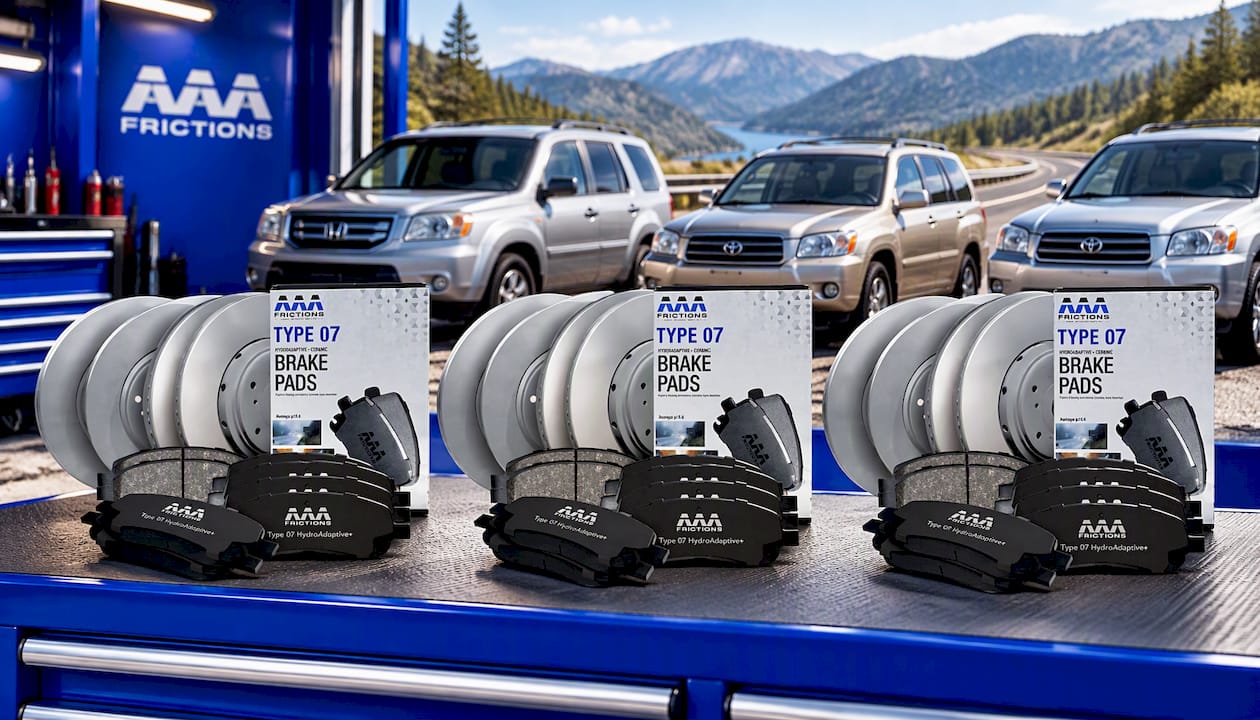
We offer Type 07 brake pads and Type 03 brake pads, along with SC Type rotors and GC Type rotors. Parts are matched by vehicle, and rotors come as part of a kit so the pairing is engineered rather than guessed.
Ready to match your brakes to your vehicle?
Our kits pair HydroAdaptive ceramic pads with rotors protected against moisture and road salt, selected for your year, make and model. Larger vehicles are covered too, for example the Honda Pilot front and rear brake kit with GC Type GEOMET coated rotors.
Browse the full range on our all-weather brake kits page and enter your vehicle to find the right fit.
FAQ
Do highway miles wear out brake pads quickly?
No. Pad wear is tied to braking events, not distance. Research from the Washington Department of Ecology found that low-traffic highway travel produces very little brake-pad wear per kilometer. Heavy traffic, tailgating, loads and mountain grades are what change that.
What type of brake pad is best for daily highway commuting?
Choose a pad matched to your vehicle that gives steady friction when cold, wet and hot, and runs quietly. Ceramic pads are a common choice for daily driving. Pair them with rotors that resist corrosion, and replace pads and rotors together where possible.
How often should I check the brakes on a high-mileage car?
By condition more than by mileage. Check pad thickness before long trips and whenever you notice noise, pulling or a softer pedal. If you drive in snow, road salt or heavy stop-and-go on top of highway miles, look more often.
What should I do if my brakes fail on the highway?
Shift to a lower gear, pump the pedal quickly, and if needed apply the parking brake slowly while ready to control a skid. Steer to a safe stopping place, then call for help. Do not drive the car again until a technician has inspected it.
Can I keep driving on grinding brakes?
No. Grinding is a sign to stop driving and arrange a brake check as soon as possible. Continued driving can damage rotors and other parts and reduce your stopping power.
Sources
- Copper and Zinc Loading Associated with Automotive Brake Pad Wear, Washington Department of Ecology
- Michigan State Police: 2010 Aftermarket Brake Pad Evaluation, National Institute of Justice
- Estimation of passenger car brake pad temperatures and wear, DTU, 2025
- Estimation of Passenger Car Brake Pad Wear and Remaining Useful Life, DTU, 2024
- Motor Vehicle Brake Pad Wear: A Review, 2025
- General Motors service bulletin 19-NA-116, NHTSA
- Corrosion Stiction in Automotive Braking Systems, 2023
- Hot Brakes and Runaway Truck Ramps of Colorado
- Emergency Driving Tactics, Pennsylvania Driver and Vehicle Services