

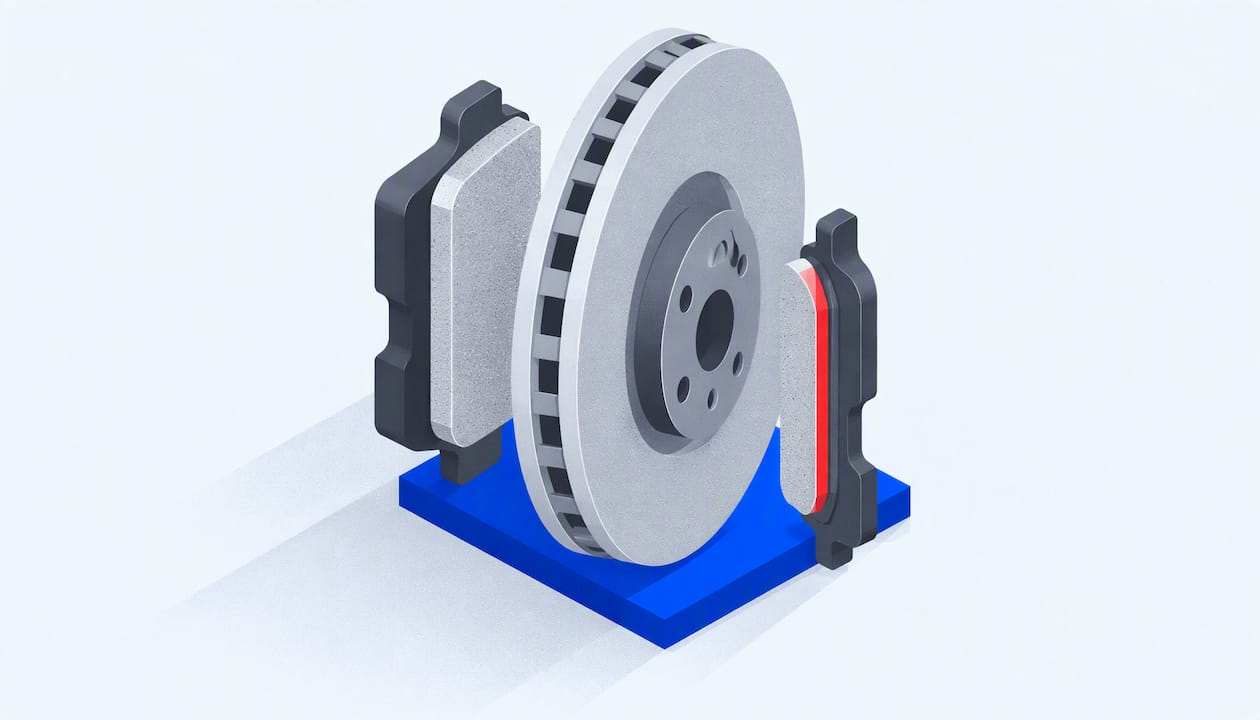
Uneven brake pad wear almost always points to a part that is not moving the way it should: a seized caliper slide pin, a sticking piston, a pad bound in its bracket, or a rotor problem. The pads are usually the symptom, not the cause. Replace only the pads and the same fault will chew through the new set. This guide shows how to tell normal wear from a real problem, how to find the cause, and how to fix it so the repair lasts.
TL;DR
- Inner-to-outer pad wear that differs by 3 mm or more is treated as uneven in normal driving. For heavy city driving, towing or hauling, the threshold is 6 mm.
- The usual culprits are seized caliper guide pins, pads stuck in their brackets, and piston or seal problems. Rotor thickness variation and runout add to it.
- Measure the pads, check that the pins and piston move freely, and measure the rotors before buying parts.
- Fix the cause (pins, hardware, caliper), then replace pads and any out-of-spec rotors together.
- Wet, salty and cold climates speed up corrosion, which is what makes hardware stick in the first place.
Table of Contents
- What counts as uneven brake pad wear
- Why brake pads wear unevenly
- How to diagnose it safely
- How to fix uneven brake pad wear
- Why weather makes uneven wear more likely
- Our perspective
- Choosing parts for the repair
- Promo: finish the job with a matched set
- FAQ
- Sources
What counts as uneven brake pad wear
Some difference in wear is normal. Front pads wear faster than rear pads on most cars because braking shifts weight forward. That is wear between axles, and it is not a fault. The problems are the patterns below.
Inner versus outer pad on the same caliper. This is the pattern most guides focus on. General Motors technical guidance from 2019 considers a 3 mm (0.118 in) inboard-to-outboard difference uneven for normal highway driving. The same document identifies a 6 mm (0.236 in) difference as uneven for heavy city driving, frequent elevation changes, towing or heavy loads. That is a GM bulletin, so treat the figures as a solid rule of thumb and check your own manufacturer’s specification.
Tapered wear. One end of the pad is thinner than the other, front to back along the pad. It can signal pads binding in their slots or a caliper not floating correctly. But tapered wear is normal on some vehicles, so look up the manufacturer’s wear specification before you decide anything is broken.
Side to side. The left and right pads on one axle should be in similar condition. When one wheel is down to the backing plate and the other looks nearly new, one caliper is dragging or the other is not clamping. This is the pattern that forum posts describe as metal on metal on one side only.
| Pattern | What you see | Most likely cause |
|---|---|---|
| Inner pad much thinner than outer (or reverse) | Difference past 3 mm (6 mm for heavy use) | Piston not retracting, seized slide pin |
| Tapered pad | One end thinner, front to back | Pad binding in bracket, worn hardware, or normal for the design |
| One wheel worn far more than the other | Left/right mismatch on an axle | Sticking caliper, collapsed hose, piston or seal problem |
| Grooves or ridges in the rotor | Visible scoring, uneven shine | Pad worn to metal, or a pad dragging unevenly |
Why brake pads wear unevenly
A disc brake is simple, but it depends on several parts sliding freely. Service literature lists the main faults as seized caliper guide pins or bushings, pads seized in their mounting brackets, piston or seal problems, or a master-cylinder problem. Here is how each one produces wear.
Seized slide pins or guide pins
Most floating calipers ride on two pins. When the brake is applied, the caliper slides so both pads squeeze the rotor equally. If a pin corrodes or its grease dries out, the caliper cannot float. One pad (usually the one the piston pushes directly) does most of the work while the other barely touches. You get inner-to-outer wear that keeps growing.
Pads stuck in the bracket
Pads sit in slots in the caliper bracket. Rust, rust scale and dirt build up there, and the pad stops moving freely. A pad that cannot retract stays lightly pressed on the rotor and wears faster, often in a taper. Worn or missing hardware clips make this worse.
Piston and seal problems
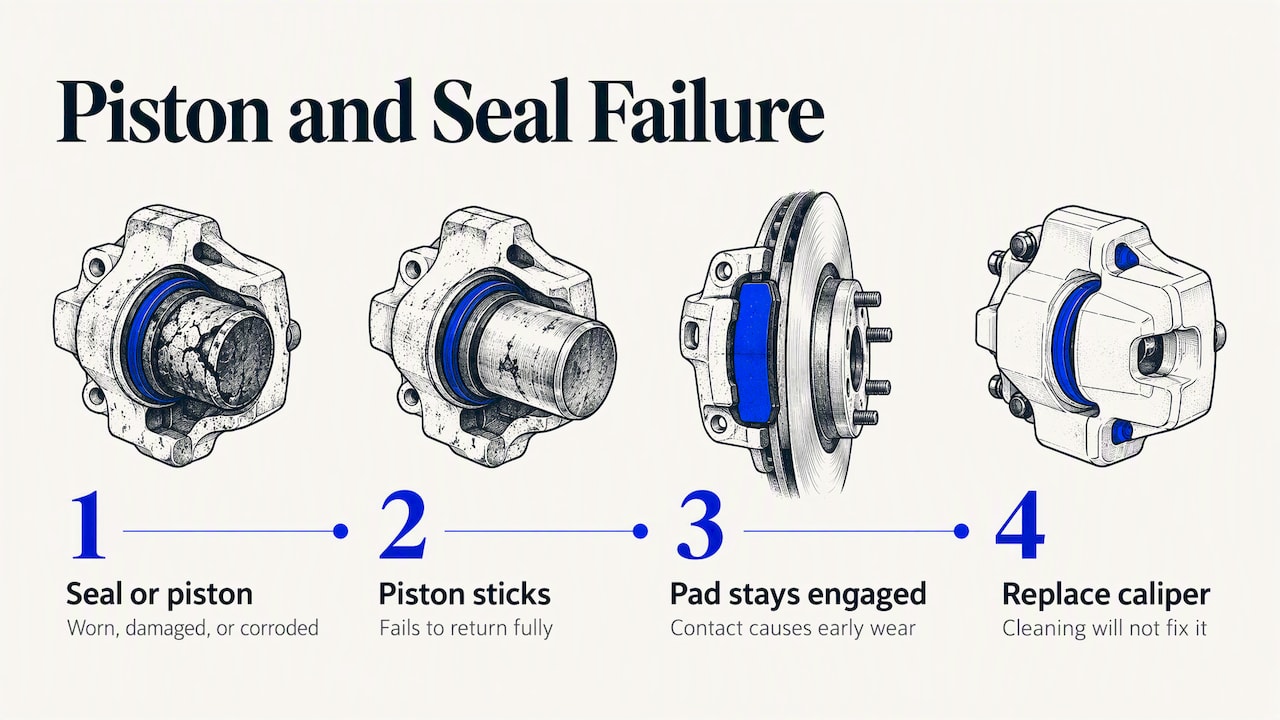
The piston seal does two jobs: it keeps fluid in, and it helps pull the piston back slightly when you release the pedal. When the seal is worn or the piston is damaged or corroded, the piston may not return to its rest position. The pad stays in contact and wears early. A caliper in this condition usually needs replacement, not cleaning. If you are heading that way, our guide to rear brake caliper replacement covers the steps, costs and pitfalls.
Debris packed around the caliper
Mud and grit can also hold pads against the rotor. Chevrolet and GMC published a bulletin for specified 2019 to 2025 Silverado and Sierra 1500 pickups noting that dirt, mud or debris packed in the rear calipers can hold the pads against the rotor. That is a specific model finding, but the mechanism applies to any vehicle driven on dirt roads, in slush, or through winter road spray.
Rotor condition
Rotors that vary in thickness or run out (wobble) as they spin push the pads back and forth and can wear them unevenly. Rotor problems often show up as pedal pulsation. They are measured, not guessed at, and we cover how below.
Hydraulic problems
A master-cylinder fault can keep pressure on one circuit after release. If all four corners show odd wear, or the same wheel keeps failing after a new caliper, have the hydraulic system checked by a technician.
How to diagnose it safely
Diagnosis is mostly measuring and moving things by hand. The 2019 GM guidance recommends measuring pad thickness and the wear difference, then using hand tools and C-clamps to check for binding before further normal diagnostics. In practice:
- Park on level ground, chock the wheels and support the car on jack stands. Never work under or beside a car held only by a jack.
- Remove the wheel and look first. Check for a pad worn to the backing plate, leaking fluid at the piston, a torn dust boot, or heavy rust at the bracket.
- Measure each pad. Use a caliper or a brake pad gauge on the inner and outer pad, and write down all four wheels. Compare to the 3 mm and 6 mm figures above.
- Check the pins and the piston. The recommended diagnosis involves checking for binding pins, slides and piston movement using hand tools and manual caliper compression. Slide pins should move in and out with light finger pressure. The caliper should slide on its pins without force. Pads should drop in and out of their slots freely.
- Measure the rotor. Thickness and runout should be measured at 8 points around the circumference, typically 5 to 10 mm inboard of the outer edge. Compare to the minimum thickness stamped on the rotor or listed by the manufacturer.
- Note the driving clues. A car that pulls to one side under braking, a hot wheel after a drive, a burning smell, or a pedal that pulses all point toward a dragging caliper or a rotor fault.
If the pedal feels soft, the car pulls hard, or a wheel is smoking hot, do not keep driving it. Have it inspected by a qualified technician. Brakes are a safety system, and a dragging or failing caliper can get worse quickly.
How to tell if a caliper is sticking
The signs are consistent: one wheel noticeably hotter than the others after a drive without hard braking, a pull toward one side, uneven pad thickness on that corner, and a caliper that will not slide by hand. A stuck slide pin and a seized piston feel different. A dry pin often frees up with cleaning and fresh high-temperature brake grease. A piston that will not retract, or leaks, means replacing the caliper.
How to fix uneven brake pad wear
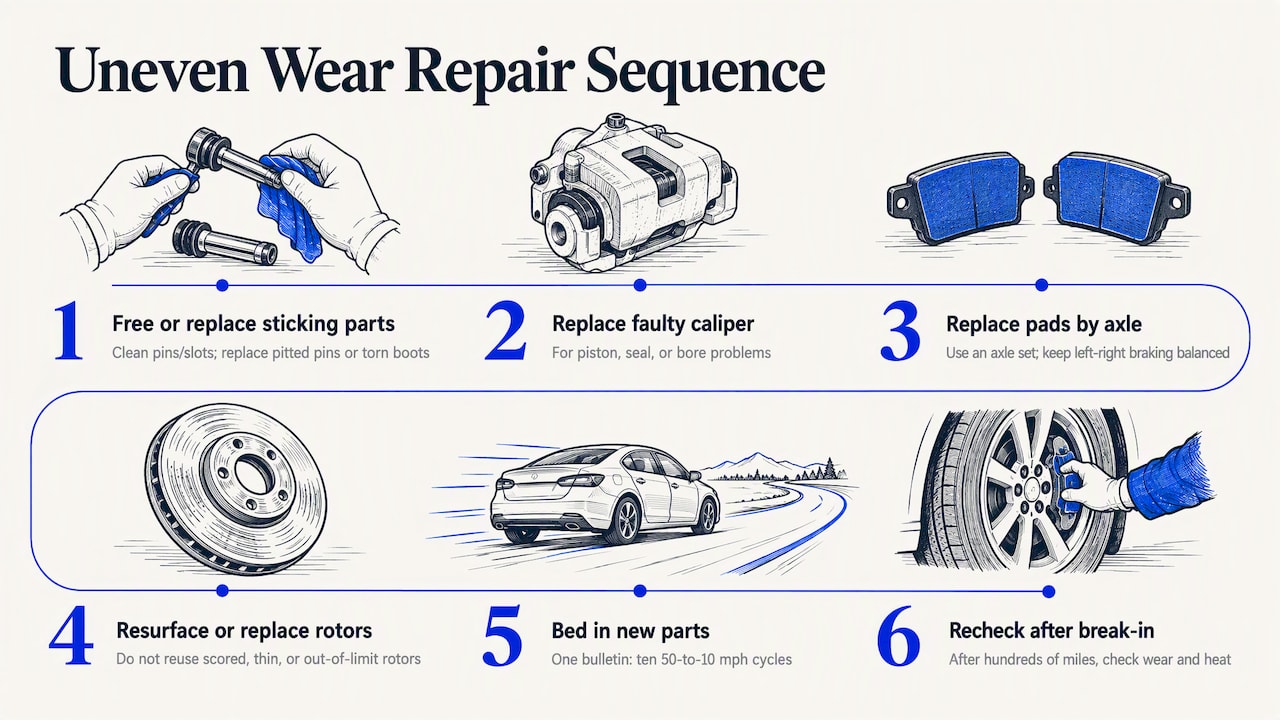
The order matters. Fix the cause first, then the wear parts.
1. Free or replace what is sticking. Clean and lubricate the slide pins, or replace them if they are pitted or the boots are torn. Clean rust from the bracket slots. Brake and Front End magazine’s coverage of wear patterns recommends renewing the hardware and servicing the guide pins whenever pads are replaced. It is cheap and it is the step most often skipped.
2. Replace the caliper if the piston or seal is the problem. A piston that will not return, a leaking seal or a corroded bore is not a pin-lubrication job.
3. Replace the pads as an axle set. A bulletin for the 2022 Acura MDX, for example, calls for replacing the front pad set, then inspecting and measuring the rotors and replacing them if they are out of specification. The principle holds in general: pads on both sides of an axle should be replaced together so braking force stays balanced from left to right. Many shops also recommend not mixing old and new pads across an axle for this reason.
4. Resurface or replace rotors. A rotor scored by a pad that wore down to metal, or one that is below minimum thickness or out of runout limits, should not be reused. Putting fresh pads on a damaged rotor wastes the pads.
5. Bed the new parts in. After installing machined or new rotors, one manufacturer bulletin calls for accelerating to 50 mph and braking to 10 mph, ten times. Follow the procedure printed in your pad and rotor instructions, in a safe, clear stretch of road.
6. Recheck after a few hundred miles. Look at the pad faces and confirm the wear is even and the wheels are not running hot.
Should you replace pads on all four wheels?
Always replace pads in axle sets: both fronts together, or both rears together. You do not have to replace all four at once, because front and rear pads wear at different rates. Replace the rear set when its own measurements say so. The exception is a rear axle where one side was already dragging: inspect both rear corners, because the other side may have been overworked.
Why weather makes uneven wear more likely
Moisture, road salt and temperature swings are what turn a healthy caliper into a sticky one. Corroded slide pins and rusted bracket slots let pads and calipers bind. A salted winter road coats the whole brake assembly, and a caliper that sits unused for a few weeks can seize at the pins. Surface rust on a rotor after rain is a different, usually harmless thing; our explanation of why brake rotors rust after rain shows what to ignore and what to act on.
The safety effect is practical. A pad dragging on one side loads that wheel more and runs it hotter, while the opposite wheel does less work. Braking force is no longer balanced, and a car can pull sideways under hard braking, which matters most on wet or icy roads. If you live in a snowy or humid climate, make a habit of checking pins and pad movement at every tire rotation. If you want a sense of how quickly pads normally wear, see our brake pad lifespan guide.
Our perspective
We built AAA Frictions around one idea: braking should stay consistent when the weather changes. Uneven wear is where that idea gets tested, because weather is the usual cause of the sticking and corrosion that produce it.
That is why we do not think of pads, rotors and calipers as separate purchases. Our HydroAdaptive ceramic pads are designed to manage moisture and keep friction stable. Our GEOMET-coated rotors are designed to resist the corrosion that moisture and road salt cause. Our ClimateFlex calipers are designed for smooth operation through winter cold and summer heat. Each part addresses a different way weather upsets a brake system.
We also develop rotors and pads as a matched system, and we sell rotors only as part of kits with compatible pads. A rotor and pad designed to work together give you a better chance of even, predictable contact across the whole pad face. If you have found uneven wear, fix the sticking part and replace the wear parts together.
AAA
Choosing parts for the repair
Once the sticking part is fixed, the wear parts should be replaced as a set so the new pads meet a good rotor surface. Parts are matched by vehicle, so enter your make, model and year when you order.
- Pads: Type 03 brake pads and Type 07 brake pads are our HydroAdaptive ceramic options.
- Rotors: GC type rotors carry a GEOMET coating against corrosion, and SC type rotors are the other option. Rotors are sold as part of brake kits.
- Kits: The Type 03 pads and GC rotors kit or the Type 07 pads and GC rotors kit replaces both wear parts together. If the caliper is the cause, the Type 03 pads and ClimateFlex calipers kit covers that too.
Promo: finish the job with a matched set
If your measurements show uneven wear and you have found the cause, replacing pads and rotors together is the cleanest way to restart with even contact. Our kits are matched by vehicle, with HydroAdaptive ceramic pads and GEOMET-coated rotors designed to work as a system through rain, snow and temperature swings.

Browse the range and enter your vehicle at aaafrictions.com, or go straight to the Type 07 pads and GC rotors kit.
FAQ
Is it normal for the inner brake pad to wear faster than the outer?
A small difference can be normal, and some designs wear in a taper. But a gap of 3 mm or more between inner and outer pad in normal driving is considered uneven under GM’s 2019 guidance, and 6 mm for heavy use. Past that, check the slide pins and the piston.
Can I just replace the one worn pad?
No. Replace pads in axle sets, both sides of the axle together, so braking force stays balanced. Replacing a single pad or a single wheel can make the car pull under braking. Also fix whatever caused the wear, or the new pads will wear unevenly too.
Do I need new rotors with new pads?
Not always, but you must measure them. Check thickness and runout against the manufacturer’s specification, and replace rotors that are out of spec or badly scored. Rotors with uneven wear patterns will wear new pads unevenly.
Can I drive with unevenly worn brake pads?
You can drive carefully to a repair, but do not put it off. A pad worn down to the backing plate damages the rotor, and a dragging caliper can overheat. If the car pulls hard, the pedal feels soft, or a wheel smells of burning, stop and have it checked by a technician.
How do I know if my caliper is sticking?
Look for a car that pulls to one side, one wheel much hotter than the others, and a pad that is much thinner on that corner. With the wheel off, a healthy caliper slides freely on its pins and the pads move in their slots by hand. If the piston will not retract or leaks, the caliper needs replacing.
Sources
- GM technical guidance on uneven brake wear, 2019 (NHTSA)
- Brake service article on uneven wear causes, MOTOR magazine
- Silverado and Sierra 1500 rear caliper bulletin, 2024 (NHTSA)
- Brake pad wear patterns, Brake and Front End
- Rotor measurement and burnishing bulletin, 2021 (NHTSA)
- 2022 MDX service news article, 2023 (NHTSA)