

Most brake pads last somewhere between 30,000 and 70,000 miles, and a few go past 100,000. That range is wide because the pads don’t wear by the calendar or the odometer alone. They wear by how often you brake, how hard, how heavy your vehicle is, and what the weather does to the whole brake assembly. This guide shows you how to estimate your own number, how to read the warning signs, and what actually helps pads last longer.
TL;DR
- A loosely agreed range for brake pads is 30,000 to 70,000 miles, though reported cases run from 100 to 100,000 miles.
- City stop-and-go, heavy loads, hard braking and salty winters shorten pad life. Smooth highway driving stretches it.
- Chevrolet says there is no universal mileage interval for brake service, so inspect pads on a schedule rather than waiting for a number.
- Squealing, grinding, a wear light, pulling to one side or longer stops all mean get them checked now.
Table of Contents
- How long brake pads last on average
- What shortens or extends brake pad life
- Weather, salt and moisture: the wear factor most charts skip
- Signs your brake pads are worn out
- Brake wear chart: how thick is too thin?
- Good brake pads versus bad ones
- Low-dust pads and what you trade for them
- How to make brake pads last longer
- Our perspective on pad life
- Replacing worn pads with weather-ready parts
- FAQ
- Sources
How long brake pads last on average
The figure you see on most shop pages, 30,000 to 70,000 miles, is a rule of thumb, not a promise. HowStuffWorks describes the range as loosely estimated and notes that reports run from as little as 100 miles to as much as 100,000. Those extremes usually come from a stuck caliper at one end and a long-distance highway commuter at the other.
Automakers are cautious about giving one number. Chevrolet’s brake guidance states that there is no universal mileage interval for brake service because wear depends on driving habits and conditions. It recommends inspecting pads or shoes, rotors, hoses, calipers and fluid lines during routine multipoint inspections.
So can pads last 100,000 miles? Sometimes. A driver who posted in a forum thread about a 2014 pad change describes mixed city and highway driving and still having a good share of lining left after roughly 130,000 miles. That is an anecdote, not a benchmark, but it shows how far the top end can go when braking is light and gentle.
Pads versus rotors
Rotors usually outlast pads, often by a factor of two or more, but not always. Pads that run down to the backing plate chew up rotors quickly, and corrosion can ruin a rotor long before the friction surface wears thin. That matters for anyone who drives where roads are salted, which we cover below.
What shortens or extends brake pad life
Researchers model pad wear using brake work: the braking force multiplied by the distance traveled while braking. A 2024 Elsevier study uses that approach, which means repeated braking, stronger deceleration and longer braking events generally increase wear. Everything on the list below is a way of changing that equation.
Driving style
Hard braking, sudden stops and tailgating wear pads faster, while smooth, gradual braking extends their life, according to RAC’s brake advice. Looking well ahead and lifting off the throttle early lets the car shed speed before the pedal is involved.
City versus highway
A Technical University of Denmark thesis points out that mileage alone is only a rough life estimate. Highway driving with infrequent braking generally wears pads more slowly than city driving with frequent stops. Hyundai’s U.S. owner guidance says the same about short-distance city driving versus long highway trips.
This is why a rideshare or delivery driver can burn through pads in a fraction of the miles a rural commuter would get, even in the same car.
Vehicle weight and loads
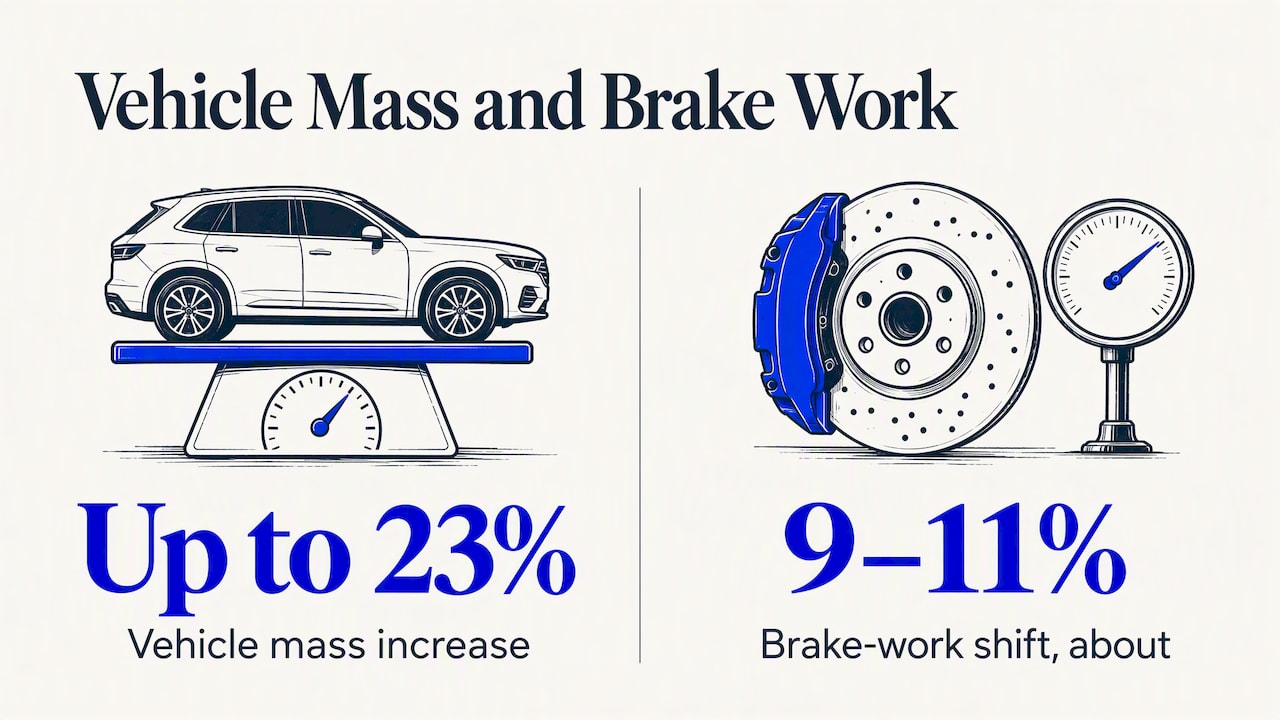
Heavier vehicles carry more momentum into every stop. The same Danish thesis finds road gradients and additional loads increase the wear rate. In the Elsevier study, vehicle mass was increased by up to 23%, and accounting for the changing mass shifted the estimated brake work by about 9% to 11% compared with assuming a constant mass. If you drive a full-size SUV or pickup, tow, or haul cargo, expect the lower end of the mileage range or below it.
Trucks carrying heavy loads show the same pattern: a 2024 study of trucks hauling oversize loads modeled wear using the number and intensity of brake applications and the load ranges.
Heat
A 2025 Technical University of Denmark study identifies frictional heating, material degradation and changing driving conditions as interacting influences on wear. Long mountain descents, towing and repeated hard stops all push pad temperature up. A 2025 review of brake pad wear adds that wear depends on the pad material and on operating conditions such as load, speed and temperature.
Electric and hybrid vehicles
Regenerative braking does part of the slowing, so friction pads can last much longer on an EV or hybrid. RAC lists it among the factors that change pad life. The catch is that rarely used brakes can corrode, which brings us to weather.
Weather, salt and moisture: the wear factor most charts skip
Most wear explanations stop at driving style. Weather matters as much for many drivers, and it hits the entire brake system, not just the pad.
A Tesla technical bulletin reproduced by NHTSA describes what extremely cold or wet conditions, road salt, snowmelt, prolonged parking, heavy rain, washing and limited friction-brake use can do. Pads can end up wet, rotors can pick up mild rust, and pads can stick to rotors. The first stops may need more pedal force or longer travel until the brakes dry and warm up.
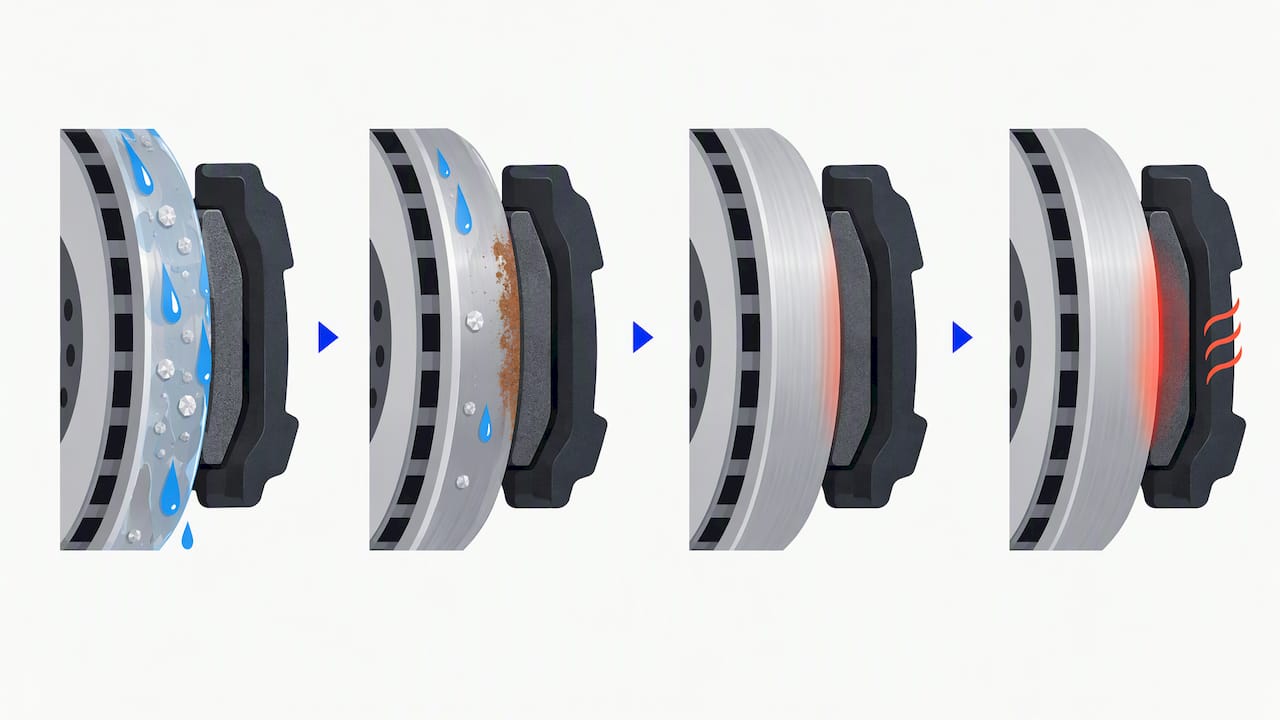
Tesla’s 2022 service note goes further for winter regions. Prolonged exposure to road salt and mud corrodes brake components and accelerates wear. It recommends washing salt and dirt from the wheel, brake, suspension and underbody areas, then making several firm brake applications to dry the pads and rotors. It also frames winter care as a job for the whole friction-brake assembly: salt and mud can corrode caliper components, and annual cleaning and lubrication helps preserve caliper function.
Practical takeaways for snowy or humid climates:
- Rinse the wheel wells and brake area after salty drives, then brake firmly a few times to dry things out.
- Don’t let a vehicle sit for weeks in wet conditions without moving it.
- Watch for uneven pad wear, which often points to a caliper that is not sliding freely.
- Treat rotors and calipers as part of pad life, not separate items.
Signs your brake pads are worn out
The pad won’t announce its remaining mileage, but it does send signals. RAC lists loud screeching or grinding, a dashboard wear-warning light, pulling to one side and longer braking times. Add to that:
- Vibration through the pedal or wheel, often a sign of rotor trouble rather than pads alone.
- A pedal that feels softer or sinks lower than it used to.
- Visible thin lining when you look through the wheel spokes.
- Fluid or dust patterns that show one wheel behaving differently from the others.
Grinding is the urgent one. It usually means the friction material is gone and metal is meeting metal. Stop driving and have a technician look at it before it damages the rotors or compromises stopping.
How often to check
Hyundai’s U.S. guidance recommends checking brakes whenever tires are rotated, which it puts at about every six months or 7,500 miles. That habit catches problems early and costs almost nothing, since the wheels are already off.
Brake wear chart: how thick is too thin?
A wear chart is simply a way of matching lining thickness to an action. Measure the friction material only, not the steel backing plate, and check both the inner and outer pad on each wheel because they can wear unevenly. Many technicians use thresholds along these lines, though your vehicle’s service manual is the final word:
| Remaining lining | What it usually means | What to do |
|---|---|---|
| Over about 6 mm (1/4 in) | Plenty of life left | Recheck at the next tire rotation |
| About 4 to 6 mm | Wearing, but fine for now | Check more often, start budgeting |
| About 3 mm (1/8 in) | Replacement window | Plan the job soon |
| 2 mm or less | Urgent | Replace now, before rotors are damaged |
These bands are common shop practice rather than a legal standard, and the minimum a pad can legally reach is lower than the point where you should replace it. Running pads thin leaves no margin for a long downhill or a hard stop. If a pad is thin, noisy or uneven, replace pads on the whole axle together, never just one side.
Good brake pads versus bad ones
Price and a brand name tell you little. A good pad shows its quality in how it behaves over time:
- Consistent bite. The first stop on a cold morning feels like the tenth stop in traffic.
- Quiet operation. Pads should not squeal or groan under normal braking after the bedding-in period.
- Even wear. Inner and outer pads, left and right sides, wear at similar rates.
- Rotor friendliness. Rotors keep a smooth surface instead of scoring, glazing or heat-spotting.
- Fit for the vehicle. The pad is matched to your make, model and year, including weight and typical use.
Bad pads tend to fail the opposite way: fade after repeated stops, noise at low speed, heavy dust coating the wheels, rapid wear, or crumbling edges. Mechanics also look for matching components. A premium pad on a corroded or warped rotor will not perform like it should, which is why pads and rotors are best treated as a system.
Low-dust pads and what you trade for them
Dust comes from the pad and rotor wearing against each other. Pad formulations differ in how much visible dust they leave on wheels, and drivers who dislike constantly cleaning their rims often look at ceramic formulations for that reason. The research on pad wear is clear that behavior depends on material properties and operating conditions, so no pad type wins in every situation. Expect trade-offs between dust, noise, bite, rotor wear and cost, and expect your driving to decide which matter most.
How to make brake pads last longer
- Anticipate traffic. Coast down early and brake gently instead of late and hard.
- Keep your following distance. Tailgating forces repeated hard stops.
- Shed unnecessary weight. Remove roof boxes and cargo you don’t need.
- Use engine braking or a lower gear on long descents so the pads don’t absorb all the heat.
- Wash salt off in winter and dry the brakes with a few firm stops afterward.
- Have calipers cleaned and lubricated annually in salty regions so pads can retract and wear evenly.
- Bed in new pads as the manufacturer instructs.
- Inspect at every tire rotation.
If your pads wear too fast, the cause is rarely the pad alone. Suspect a sticking caliper slide, a dragging parking brake, a worn rotor, or a driving pattern that is simply heavy on the brakes.
Our perspective on pad life
We build brake parts around one idea: weather, not just mileage, decides how predictable your braking feels. Moisture, road salt and temperature swings attack pads, rotors and calipers in different ways, so we treat each as its own engineering problem. Our HydroAdaptive ceramic pads are designed for moisture management and stable friction. Our GEOMET-coated rotors are designed to resist corrosion from moisture and road salt. Our ClimateFlex calipers are designed for smooth operation through winter cold and summer heat.
We also develop rotors and pads as a matched system, which is why we sell rotors as part of kits with compatible pads. We think that is the honest way to think about lifespan: a pad can only last as long as the parts around it let it. Whatever you install, measure it, inspect it twice a year and don’t ignore a noise.
— AAA
Replacing worn pads with weather-ready parts
If your pads are near the replacement window and you drive in rain, snow or salt, we’d suggest looking at a complete kit rather than pads alone. Our Type 07 brake pads pair with SC Type rotors or GC Type GEOMET-coated rotors, and our ClimateFlex calipers address the winter caliper problem described above. Parts are matched by vehicle, so you enter your make, model and year and get components that fit.
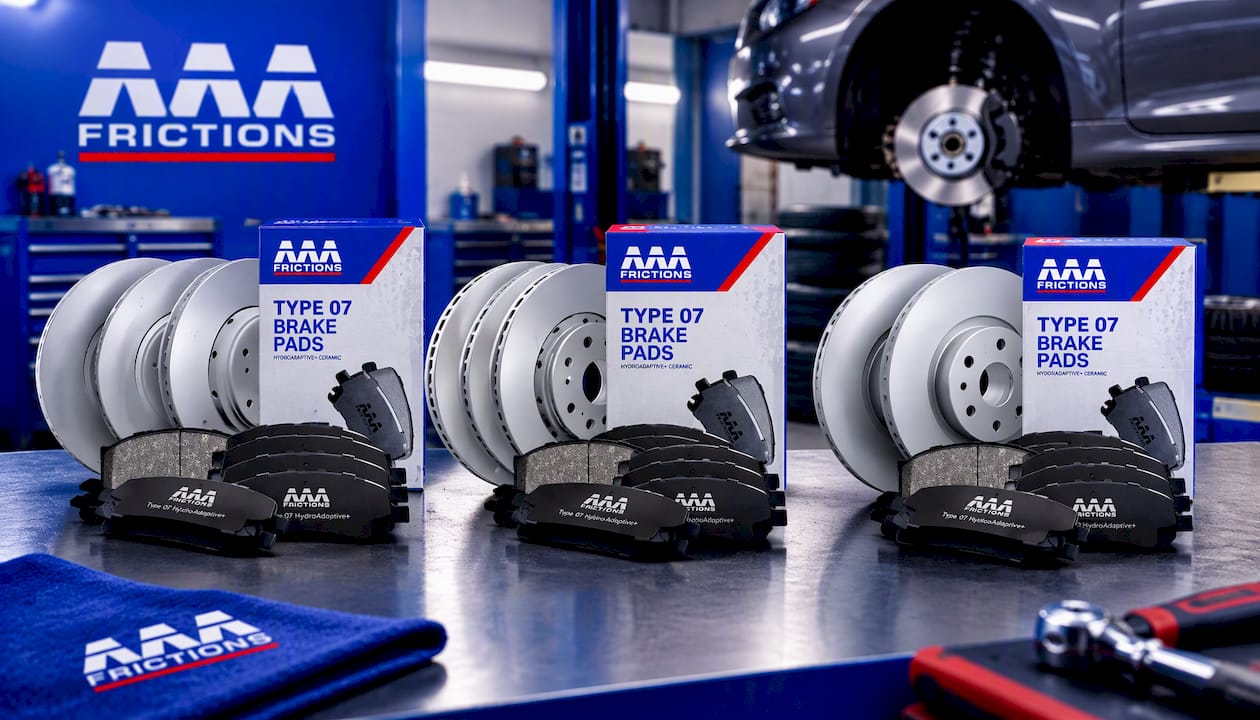
Prefer a ready-made set? Browse our front and rear brake kits, for example the Mazda 3 kit with GC Type rotors.
FAQ
How long do brake pads last?
Most last between 30,000 and 70,000 miles, according to the commonly cited range. City driving, heavy loads and salty or wet climates push toward the low end, while steady highway driving pushes toward the high end. Have them inspected at least every tire rotation.
Can brake pads last 100,000 miles?
Yes, in some cases, but it is not typical. It takes light, smooth braking, mostly highway miles and a vehicle that isn’t heavy. Even then, rotors and calipers still need inspection because corrosion can take them out before the lining wears thin.
How do I know when to replace my brake pads?
Replace them when you hear grinding or constant squealing, see a wear-warning light, notice pulling or longer stopping distances, or measure about 3 mm of lining or less. Do not wait for a hard number if the car feels wrong. A technician can measure both pads on every wheel in a few minutes.
Why are my brake pads wearing too fast?
Common causes are heavy stop-and-go driving, towing or hauling, aggressive braking and a sticking caliper. Salt and mud in winter regions can also corrode caliper parts and accelerate wear. Have the calipers and slides checked before you simply replace the pads again.
Sources
- How long do brake pads last? | HowStuffWorks
- The Brake System | Chevrolet Vehicle Support
- Prediction of brake pad wear and remaining useful life | Elsevier, 2024
- Brake pads and discs: everything you need to know | RAC
- Estimation of Passenger Car Brake Pad Wear and Remaining Useful Life | DTU, 2024
- Prediction of Brake Pad Wear of Trucks Transporting Oversize Loads | MDPI, 2024
- Estimation of passenger car brake pad temperatures and wear | DTU, 2025
- Motor Vehicle Brake Pad Wear: A Review | MDPI, 2025
- Tesla technical bulletin | NHTSA, 2016
- Tech Note: Clean and Lubricate Brake Calipers Exposed to Road Salt | Tesla Service, 2022
- Brake Maintenance & Safety Tips | MyHyundai