

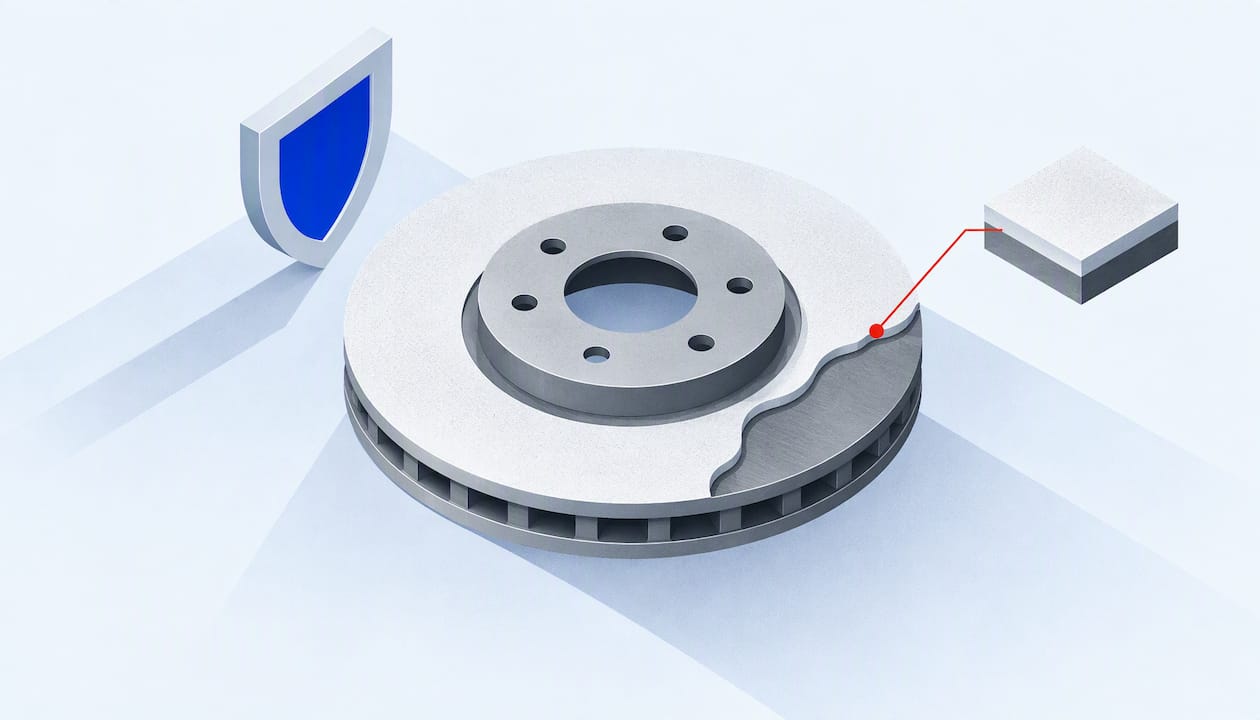
Zinc coated brake rotors have a thin layer of zinc on the iron, applied by plating or dipping. The layer keeps moisture and road salt off the metal and corrodes first, so the iron underneath stays protected. It is a barrier, not a permanent shield: the layer is thin and wears away faster in harsh conditions. Below, we explain how the coating works, what happens to it on the first few stops, how it compares with other coatings, and what to look for when you buy.
TL;DR
- Zinc is a common rotor coating. It forms a barrier against moisture and road salt, and it corrodes before the iron does.
- The layer is thin. It tends to disappear more quickly in extreme conditions, so a coated rotor is not rust-proof forever.
- The coating wears off the pad-contact surface within the first several stops. It protects the areas the pads never touch, such as the hat and edges.
- “Zinc plated” and “zinc flake” are different processes. Ask which one a rotor actually uses.
- For rain, humidity and salted winter roads, choose a rotor coating, pad and kit as a matched system, by vehicle.
Table of Contents
- What zinc coated brake rotors actually are
- How zinc protects against rain, humidity and road salt
- What happens to the coating on the braking surface
- How long does a zinc coating last?
- Zinc vs. other rotor coatings
- A buyer’s checklist for coated rotors
- Our perspective on weather, rotors and pads
- Choosing a coated rotor kit from AAA Frictions
- Maintenance habits that help any coated rotor
- Common mistakes with coated rotors
- FAQ
- Sources
What zinc coated brake rotors actually are
A brake rotor is cast iron. Bare cast iron begins to oxidize the moment it meets water, which is why a rotor can show a light orange film after a single rainy night. A coating is the manufacturer’s answer to that.
Zinc is one of the most common choices. According to Vehicle Service Pros, zinc is applied to rotors by electroplating or dipping. It works in two ways: it acts as a barrier against moisture and road salt, and it provides sacrificial protection by corroding before the iron does.
That second point is the key idea. Zinc is more reactive than iron. When both are exposed to moisture, the zinc gives itself up first, so the iron stays intact for as long as zinc remains nearby.
Zinc coated vs. zinc plated
Shoppers search for both phrases, and listings often use them interchangeably. Strictly, they can describe different processes.
- Zinc plating uses electrical current to deposit a zinc layer on the part.
- Zinc-flake coating is non-electrolytic. As Aalberts Surface Technologies describes it, zinc and aluminum flakes are applied by dip-spin, rack dip-spin or spraying.
Both deliver zinc-based protection, but the layer thickness, appearance and behavior differ. A listing that says “zinc coated” without naming the process tells you little. If the maker does not say how it is applied, treat that as a question to ask before you order.
How zinc protects against rain, humidity and road salt
Think of the coating as doing three jobs at once.
- It blocks contact. While the layer is intact, water and salt brine cannot reach the iron.
- It sacrifices itself. If the layer is scratched or thin in a spot, nearby zinc still corrodes ahead of the iron.
- It keeps the look clean. The hat (the center section) and the outer edge are the parts you see through the wheel. Coated areas stay neutral in color instead of turning brown.
This matters most where weather is hard on brakes: wet climates, humid summers, and regions that salt the roads in winter. In those places a rotor sits damp for days, and salt speeds up corrosion considerably.
The protection has limits. Vehicle Service Pros notes the zinc layer is relatively thin and, because it is sacrificial, tends to disappear more quickly in extreme conditions. That is not a flaw in the idea. It is simply how a sacrificial layer behaves: it protects by being consumed.
What happens to the coating on the braking surface
This is the question that worries buyers most, and the answer is reassuring once you know it.
The face of the rotor, where the pads clamp, is not meant to keep a coating. According to Magni’s brake-coating information, rotor coatings naturally release from the swept area during the first several brake stops. They continue to protect the non-swept areas from corrosion.
In practice that means:
- A new coated rotor looks uniform in the box. After the first stops, the pad track turns bare metal and shiny, while the hat, vanes’ edges and outer rim keep their coating.
- The shiny band is normal. It is the design working, not the coating failing.
- The same source notes that rotor coatings may be barrier-type or zinc-rich sacrificial systems, typically applied in one or two layers.
One caution from the same logic: the pad track is bare iron from that point on, so it can still develop a light surface film after rain. That film typically wipes off on the first stops. If you want more detail on that, see our guide on why brake rotors rust after rain.
Does the coating change braking feel, noise or vibration?
Some product pages claim coatings reduce noise and vibration. We could not find an independent, checked source that supports that claim, so we will not repeat it as fact. What the coating’s design does support is narrower: because it releases from the pad track in the first stops, it is not meant to sit between the pad and the rotor in normal use. What drives pedal feel, noise and fade is the whole system, meaning the pad compound, the rotor quality, the caliper’s ability to release and retract, and correct installation. That is why we look at them together.
How long does a zinc coating last?
There is no single number that holds across vehicles and climates. The honest answer is that it depends on exposure.
The only dependable statement from the research is that the layer is thin and tends to disappear quickly in extreme conditions. Several factors push the timeline one way or the other:
| Factor | Effect on coating life |
|---|---|
| Road salt and brine | Speeds up consumption of the zinc |
| Constant moisture (coastal, rainy regions) | Keeps the sacrificial reaction running |
| Stone chips and scratches | Expose iron, which the nearby zinc then has to protect |
| Garage storage vs. outdoor parking | Less time damp means slower wear |
| Driving frequency | Regular driving dries the rotor and cleans the pad track |
Be cautious with any listing that promises a specific distance. A mileage or kilometer figure on a product page is a marketing claim unless it states the test conditions behind it.
The practical conclusion: a coating buys you time and appearance on the non-braking surfaces. It does not replace inspecting your brakes at tire rotations or whenever you hear something new.
Zinc vs. other rotor coatings
Zinc is not the only option, and the right one depends on what you need.
Zinc plating or zinc dip. A familiar, widely used approach. It gives barrier and sacrificial protection in a thin layer.
Zinc-nickel. SAE International states that coating selection balances protection performance, appearance and economic considerations, and that zinc-nickel coatings offer high cathodic corrosion protection. In other words, there is a trade-off every time, and different alloys sit at different points on it.
Zinc-flake coatings such as GEOMET. A GEOMET technical sheet lists corrosion protection, resistance to mechanical damage, self-repairing properties and a thin dry film as its characteristics. A self-repairing, damage-resistant film is attractive on a rotor, where road debris and handling can chip a coating.
How to read this as a buyer:
- If the listing says only “zinc coated,” ask whether it is plated, dipped or flake-applied.
- Look at which surfaces are coated. Full coverage of the hat and edges matters more than anything you cannot see.
- Look at what the rotor is sold with. A rotor is only one part of the system.
If you want a wider view of preventing corrosion on the rest of your vehicle, rustproofing options for vehicles covers the body and underside side of the same problem. Note that it discusses Canadian conditions, where salt use is heavy, which is also relevant to many northern US states.
A buyer’s checklist for coated rotors
Before you order any coated rotor, run through these.
- Match it to the vehicle. Rotor diameter, thickness, vented or solid, and mounting must match your exact year, model and axle. A rotor that is close does not count.
- Ask about the process. Plating, dipping or flake coating each behave differently.
- Check the coating coverage. Hat, edges and non-swept areas should be covered.
- Plan the pads at the same time. New rotors with old or mismatched pads can leave you with uneven bedding and noise.
- Inspect the calipers. Sticking slide pins or a caliper that does not release will wear one pad and rotor face faster, no matter how good the coating.
- Bed the brakes in as the maker instructs. The first stops are when the coating clears from the pad track and the pad material transfers to the rotor.
- Expect the pad track to shine. Do not return a rotor because the swept area is bare after a few stops.
For DIY owners
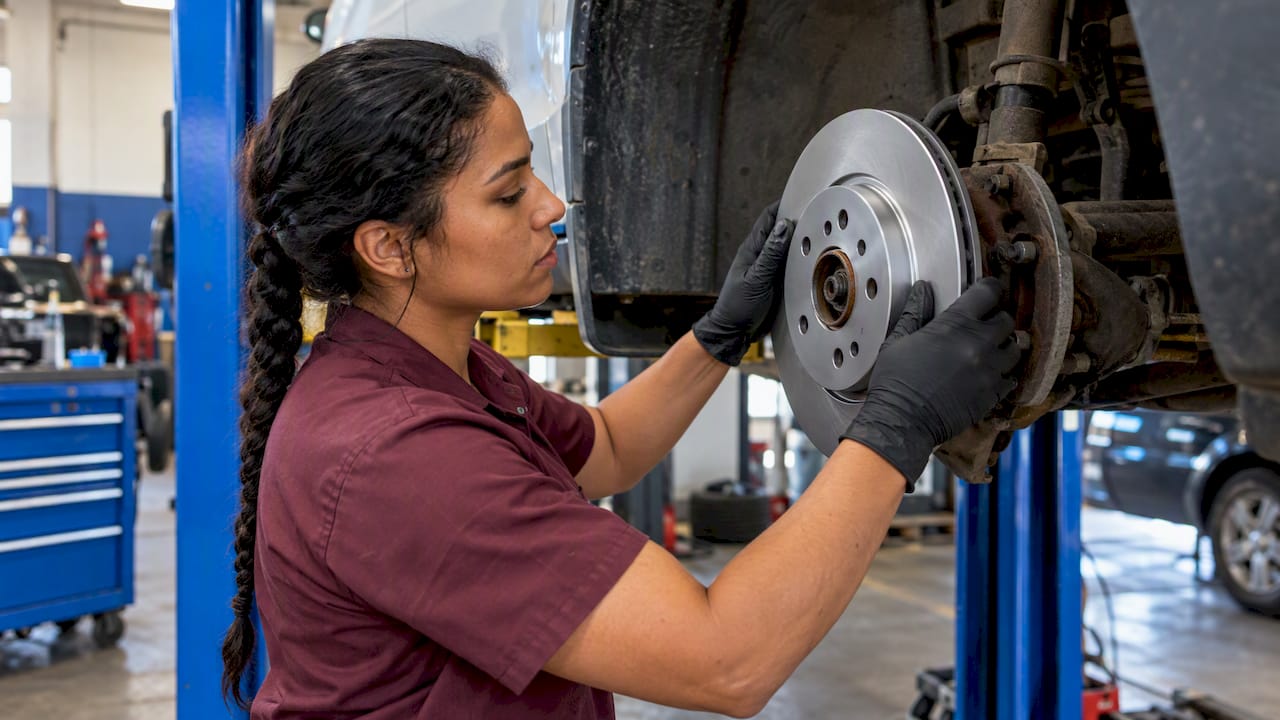
If you do your own brakes, keep the coating in mind during installation. Clean the hub face so the rotor sits flat, and avoid prying on the coated hat with metal tools where a scratch could expose iron. Follow the manufacturer’s torque specs and bedding instructions, and have a qualified technician check the work if you are unsure. Brakes are a safety system, and an error here is not worth saving an hour.
For high-mileage drivers
Rideshare, delivery and commuting vehicles stack up stops quickly. For them, the coating is most useful as protection during downtime, such as overnight parking in wet weather or a few days sitting between shifts. The pad track clears itself while you drive, and the coated hat stays clean.
Our perspective on weather, rotors and pads
We build brake parts around one idea: weather is the variable that changes how brakes behave, so the parts should be designed for it.
A coating on a rotor is only one piece of that. Rain and humidity get to the pad surface. Salt gets to the rotor. Cold and heat get to the caliper. If you solve only one of those, the other two still show up on your commute.
That is why we develop our rotors and pads as a matched system, and why our rotors are sold only as part of brake kits with compatible pads. We would rather you receive parts engineered to work together than a coating on a rotor that is paired with something you chose at random.
Our GC Type rotors use a GEOMET coating, chosen for protection against corrosion from moisture and road salt. Our SC Type rotors are semi-coated. Our Type 03 and Type 07 pads use HydroAdaptive technology for moisture management and stable friction, and our ClimateFlex calipers are designed for smooth operation through winter cold and summer heat.
Our aim is predictable braking response, in rain, snow, humidity and temperature swings. That is the standard we hold every part to.
AAA
Choosing a coated rotor kit from AAA Frictions
If you are shopping for corrosion protection and a complete, matched setup, our range is built for exactly that. Our GC Type rotors carry a GEOMET coating for protection from moisture and road salt, and they are sold in kits with our HydroAdaptive ceramic pads so rotor and pad are engineered to work together.
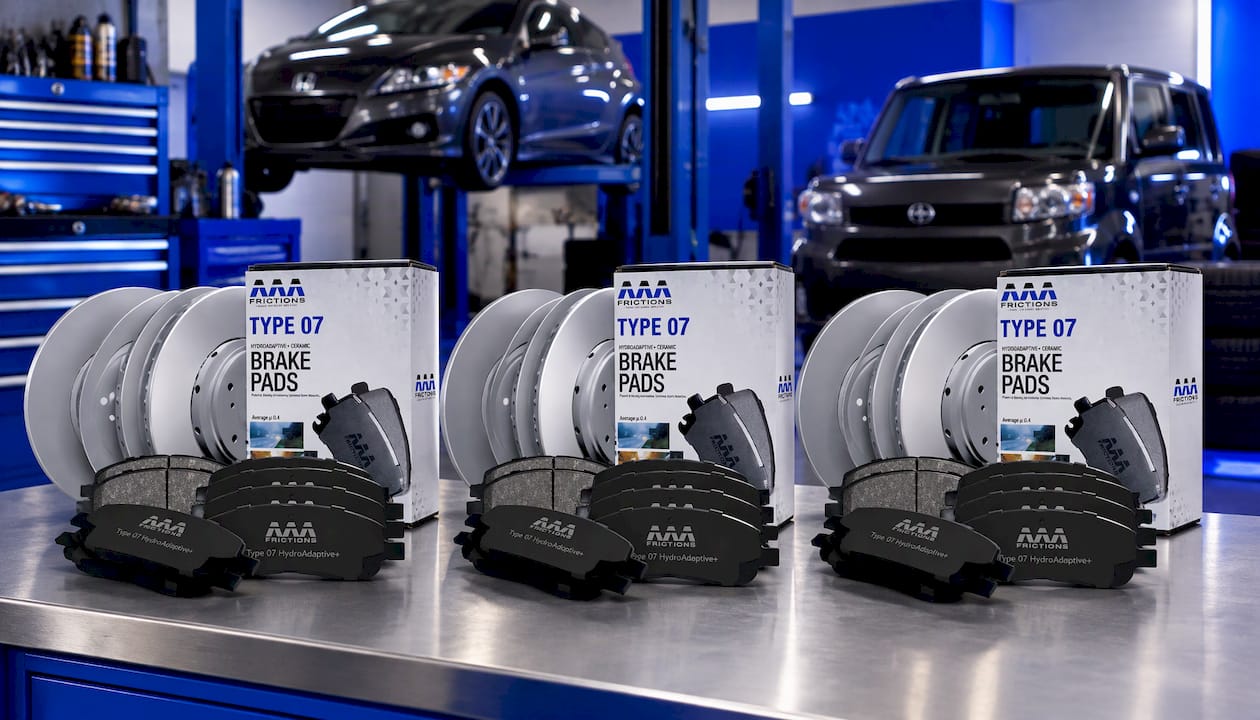
You can browse by vehicle, such as the Front and Rear Brake Kit for Honda CR-Z 2011-2015, or start from the Type 07 brake pads and SC Type rotors pages. Parts are matched by vehicle, so you can confirm fitment before checkout.
Maintenance habits that help any coated rotor
The coating is one layer of protection. Your habits supply the rest.
- Drive after wet weather. A few ordinary stops clear the film from the pad track and dry the rotor.
- Rinse off salt. In winter regions, rinse the wheels and undercarriage when temperatures allow. Salt left to sit keeps the sacrificial reaction running.
- Avoid long idle periods in the wet. A vehicle left for weeks will show surface rust on the pad track regardless of coating. Drive it and brake moderately before relying on it.
- Look at the hat and edges. Surface changes there tell you how much coating remains.
- Inspect pads and calipers at every tire rotation. Uneven pad wear points to a caliper that is not releasing.
- Pay attention to new sounds, pulling or a pedal that feels different. Have a qualified technician inspect the brakes promptly.
Common mistakes with coated rotors
Assuming coating means no maintenance. The layer is thin by nature, and it is sacrificial. Inspections still apply.
Mixing new rotors with worn pads. The rotor and pad wear into each other. Replacing one without the other can affect bedding and noise.
Expecting the pad track to stay coated. It will not, by design.
Paying for a coating on an ill-fitting rotor. The wrong size is wrong whether it is coated or not.
Judging by color alone. A silver or gold finish says nothing about the process or thickness. Ask what the coating is.
FAQ
Are zinc coated brake rotors good?
They are a reasonable choice if you drive in wet, humid or salted conditions. The zinc forms a barrier against moisture and road salt and corrodes before the iron does. The layer is thin, though, so think of it as extra protection on the non-braking surfaces rather than a lifetime guarantee.
Is it worth buying coated brake rotors?
It is worth it when corrosion is your main concern, for example if you live where roads are salted or your car sits outdoors in damp weather. The coating keeps the hat and edges cleaner and protects them while the vehicle is parked. Pick a rotor sold with matched pads and confirm it fits your exact vehicle.
What is the best coating for brake rotors?
There is no single best coating, since selection balances protection, appearance and cost. Zinc-nickel offers high cathodic protection, and zinc-flake coatings such as GEOMET are described as self-repairing and damage resistant, with a thin dry film. Choose based on the climate you drive in and ask the maker which process is used.
How long does zinc coating last?
There is no universal figure. The zinc layer is relatively thin and tends to disappear faster under extreme conditions such as heavy road salt or constant moisture. On the braking surface, the coating releases during the first several stops by design, and protection continues on the non-swept areas.
Sources
- Modern brake rotor design, Vehicle Service Pros
- Zinc flake coating for many base materials, Aalberts Surface Technologies
- Brake Rotor & Caliper Coatings, Anti-Corrosion Systems
- GEOMET technical sheet
- High Performance Corrosion Protection for Brake Components, SAE International
- Exploring the Best Rustproofing Options for Canadian Vehicles