

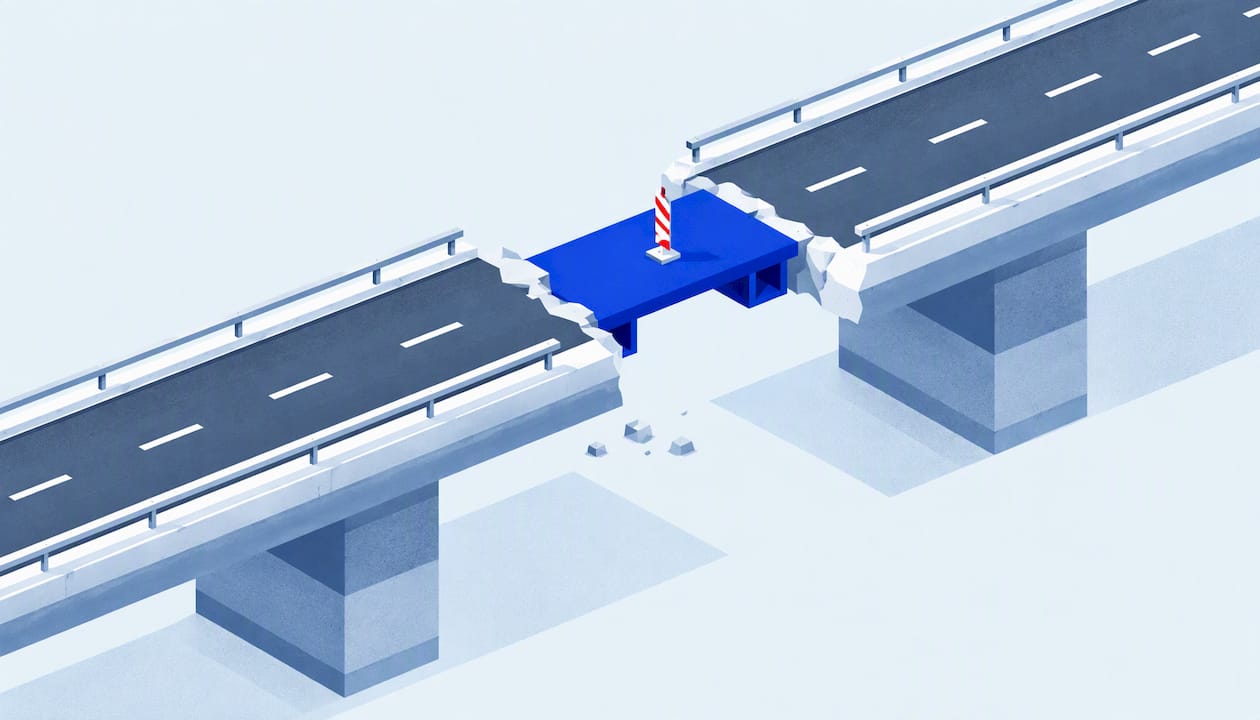
If your brakes fail while you are driving, take your foot off the accelerator, pump the brake pedal hard and fast, shift down to a lower gear, and then apply the parking brake gradually while you steer toward a safe place to slow down. Total failure is rare. Partial loss, such as a soft pedal, fade on a long hill or reduced stopping power, is far more common, and it nearly always gives you some warning first. This guide covers the emergency steps in order, the signs that come before a failure, what causes it and what keeps it from happening.
TL;DR
- In an emergency: lift off the gas, pump the pedal, downshift, then ease on the parking brake. Warn others with your hazard lights and horn.
- Total failure is rare, but gradual loss is not. A spongy pedal, grinding, pulling, vibration, a warning light or longer stopping distances are your cue to stop driving and get an inspection.
- Most causes are maintainable: worn pads, low or contaminated fluid, air in the lines, leaks, overheating on descents and corroded or seized parts.
- Prevention is routine: regular inspections, fluid checks, matched pads and rotors, and a safe following distance.
Table of Contents
- What to do the moment your brakes fail
- Can brakes fail without warning?
- Warning signs your brakes are going
- What causes brake failure
- What is the 30/30/30 rule for brakes?
- Our perspective: weather is the hidden variable
- How to prevent brake failure
- What to do after a brake scare
- Replacing worn parts with weather-ready brakes
- FAQ
- Sources
What to do the moment your brakes fail
Practice the sequence in your head now, because you will not have time to think later. The steps below combine guidance from state and provincial driver agencies and a major tire maker.
- Stay calm and keep both hands on the wheel. Panic causes collisions. Your steering still works, and steering is your main tool.
- Lift off the accelerator and turn on your hazard lights. Tap the horn and flash your headlights if traffic is close.
- Pump the brake pedal. The Ontario Ministry of Transportation’s driver handbook says pumping the pedal can temporarily restore hydraulic pressure. Do several firm, quick strokes rather than one long press.
- Downshift. Shifting to a lower gear uses engine braking to help slow the vehicle. In an automatic, use the manual or low gear selector, and step down one gear at a time instead of slamming into first. In an electric or hybrid vehicle, increase regenerative braking if your car lets you.
- Apply the parking brake gently but firmly. The same Ontario handbook advises holding the release button while you apply it, so that you can let it off if the rear wheels lock and the car begins to slide. Pulling it hard at highway speed can spin the car.
- Look for a way to scrub off speed. Uphill grades, gravel or a soft embankment can slow you when the brakes cannot. Choose these over a collision, and avoid steering toward people or oncoming traffic.
- As a last resort, use light contact. Rubbing the car against a guardrail or a barrier at a shallow angle can bleed off speed. This damages the car, so use it only to avoid something worse.
- Once stopped, turn off the engine and call for a tow. Do not drive the car again until a technician has inspected the braking system.
A few cautions that save lives
- Do not turn the ignition off while moving. You can lose power steering and, on many cars, the steering lock may engage. Shut the engine off only after the car has stopped. Check your owner’s manual for how your vehicle behaves.
- Do not shift into park. It can destroy the transmission and lock the drive wheels unpredictably.
- ABS changes the technique. The Pennsylvania Department of Transportation notes that emergency braking differs between standard and ABS systems. With ABS, press firmly and hold. A pulsing pedal is the system working, not a failure.
- Do not open the door and drag your foot. It is a common internet suggestion, and it is dangerous. It is not in any driver handbook cited here.
Can brakes fail without warning?
Sometimes, but usually not. Mechanics on public forums report sudden loss from a leaking line, a failed ABS module or fluid that boiled after heavy use, and these cases are real. Yet the Ontario Ministry of Transportation notes that total brake failure on modern vehicles is very rare. One reason is design: according to Haynes, vehicles have used redundant hydraulic systems since 1968, so a leak in one circuit does not normally take out all four wheels.
That does not make a partial failure harmless. A car that stops in 30% more distance is a car that hits something it would have missed last month. Brake problems can progress to total failure with little warning when ignored.
Warning signs your brakes are going
Treat each of these as a reason to book an inspection this week, and several as a reason to stop driving today.
| Sign | What it often points to | How urgent |
|---|---|---|
| Soft, spongy or sinking pedal | Air in the lines, low fluid, a leak or a failing master cylinder | Stop driving and have it towed |
| Pedal goes to the floor | Hydraulic pressure loss | Emergency: do not drive |
| Grinding | Pads worn to the backing plate, scoring the rotors | Same day |
| High-pitched squeal | Wear indicators, glazed pads or moisture and rust film | Soon, and if it persists |
| Pulling to one side | Stuck caliper, uneven pad wear or a collapsed hose | Within days |
| Vibration in the pedal or wheel | Warped or unevenly worn rotors, per The AA | Within days |
| Longer stopping distances | Worn pads, fade, fluid issues | Within days |
| Brake warning light | Low fluid, parking brake still on, or a system fault | Check immediately |
On the last row, the guidance is blunt: never ignore a brake warning light. Our guide on why your brake light is on walks through the common causes and what to check first. If the noise is your main symptom, read how to tell whether squeaking comes from pads or rotors.
What causes brake failure
Brakes work by hydraulic pressure pushing pads against rotors. Anything that weakens the pressure, the friction material or the metal surface can cut stopping power. The most common causes are below.
Worn pads and damaged rotors
Pads wear down by design. Once the friction material is gone, metal meets metal and stopping distances grow. Worn pads and damaged rotors sit on Haynes’ list of common brake problems. Wear varies a great deal with driving style, load and terrain, so there is no universal mileage interval for replacement. Our brake pad lifespan guide covers what wears them fastest.
Fluid leaks
According to Bumper’s guide, a fluid leak is the most common cause of progressive brake failure. Leaks at a caliper, wheel cylinder, brake line or master cylinder reduce pressure in the affected circuit. Look for wet spots near the wheels, a falling reservoir level or a pedal that slowly sinks under steady pressure. In the UK’s MOT inspection manual, a leaking master cylinder and leaking hydraulic pipes or hoses are classed as dangerous defects. The US has no national equivalent, but the engineering logic is the same.
Air or contaminated fluid
Air can enter from low fluid, a poorly bled repair or a leaking fitting. Because air compresses and brake fluid does not, the pedal feels spongy. Old fluid also absorbs moisture over time, which lowers its boiling point. That is the “moisture in the lines boiled” scenario mechanics mention: under hard use, vapor forms and the pedal goes soft.
Brake fade from overheating
Fade happens when brakes overheat, most commonly during prolonged braking on steep descents. The pedal may feel normal while the car simply stops less. Research on heavy trucks found that high service-brake temperatures during downhill braking can lead to braking failure and heat fade. The same physics applies to a loaded SUV or a van towing a trailer. On a long grade, use a lower gear and let the engine carry part of the load rather than riding the pedal.
Weather, moisture and corrosion
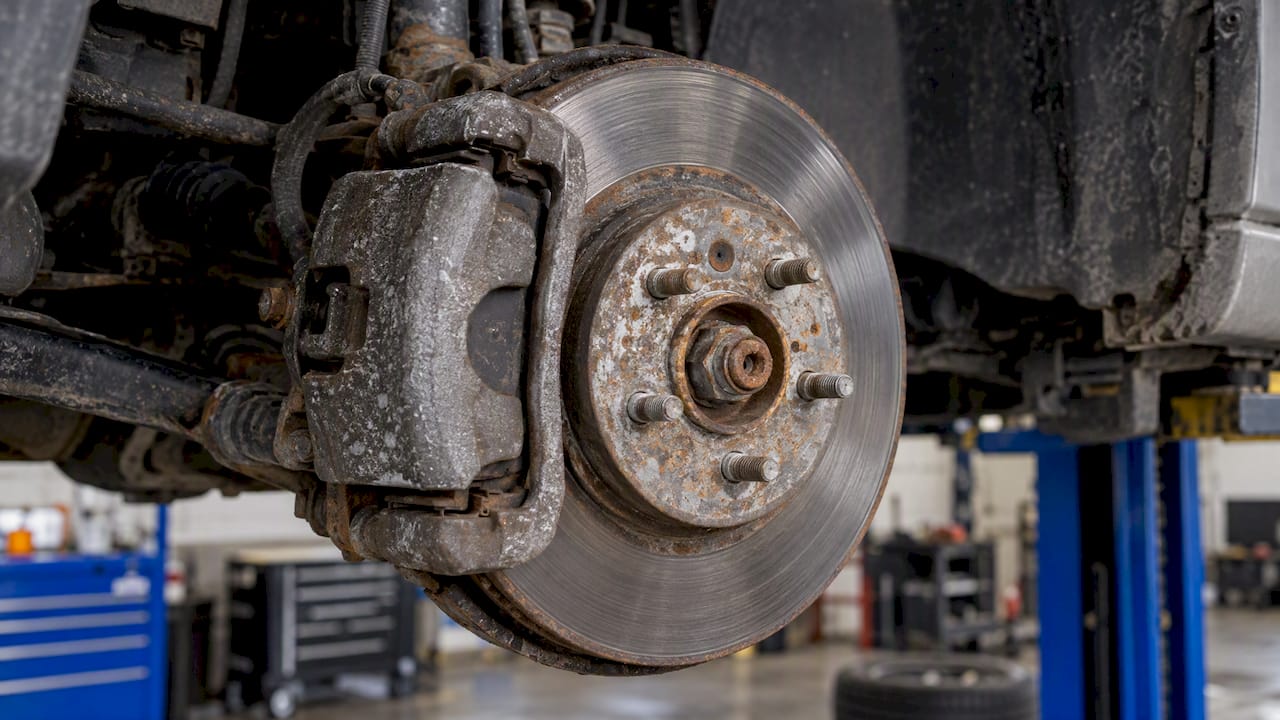
Water, road salt and cold affect more than comfort. Wet pads can lose bite for the first few stops. Salt attacks the rotor surface and hardware, and corroded or seized calipers can drag or fail to release. This is the part of the problem we think about most, and it is covered in our perspective below.
What is the 30/30/30 rule for brakes?
It is not a regulation or an engineering standard, and no official source defines it. The phrase circulates among enthusiasts and parts sellers as a rule of thumb for bedding in new pads and rotors: a series of controlled stops from moderate speed, with no coming to a full stop and holding the pedal, followed by a cooling drive. Bedding builds a thin, even layer of pad material on the rotor for consistent friction. Procedures differ between manufacturers, and some pads need none at all, so follow the instructions that come with your pads. It is not a rule about when brakes fail, and it is not a substitute for inspection.
Our perspective: weather is the hidden variable
Most brake advice talks about pads and fluid. We would add a third factor that drivers feel but rarely name: weather. Rain films the rotor and pad. Humidity feeds surface rust overnight. Salt eats away at metal. Cold stiffens moving parts, and summer heat tests every seal and slide.
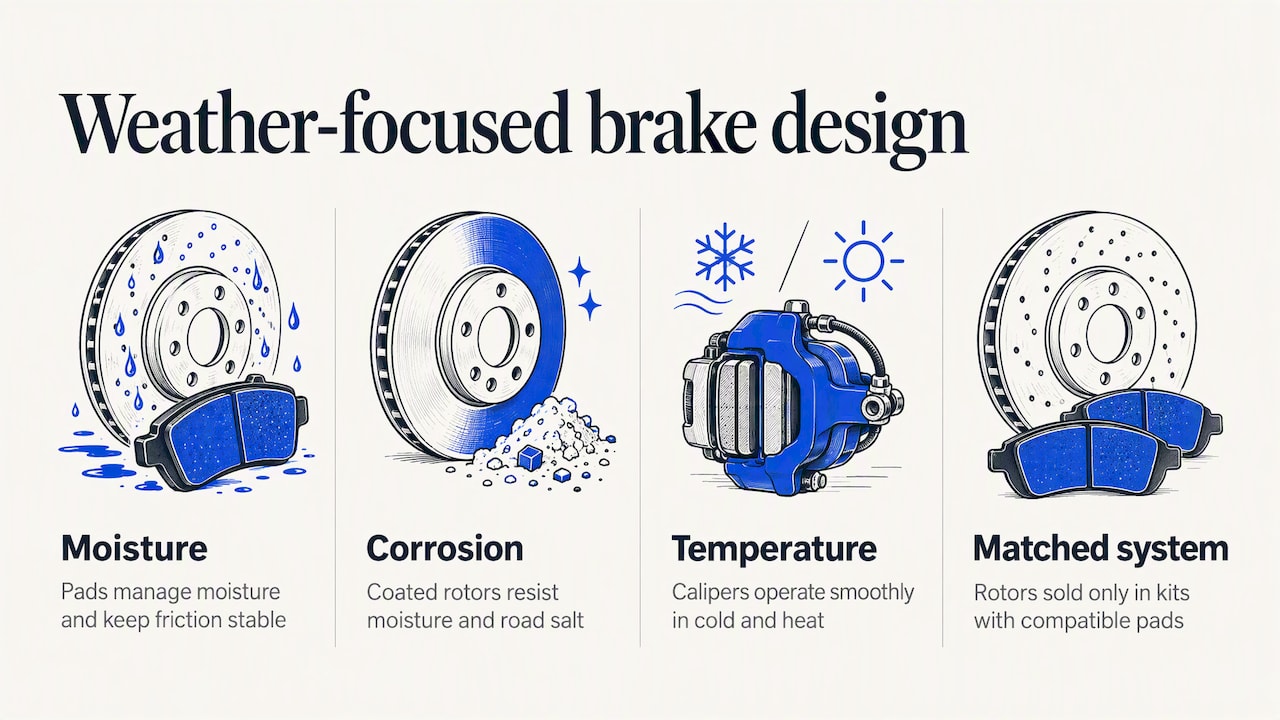
That is why we build around the problem rather than around a single part. HydroAdaptive pads are designed to manage moisture and keep friction stable. GEOMET-coated rotors are designed to resist corrosion from moisture and road salt. ClimateFlex calipers are designed for smooth operation through winter cold and summer heat. We develop rotors and pads as a matched system, which is why our rotors are sold only as part of brake kits with compatible pads.
We do not claim any part makes a failure impossible. Hydraulic leaks, worn components and overheating still need an inspection and honest maintenance. What we aim for is predictable response, so that the pedal feels the same on a freezing morning and a humid afternoon, and so the first sign of a problem is noticeable rather than masked.
— AAA
How to prevent brake failure
Prevention is mostly boring, and it works.
Inspect on a schedule
A proper brake inspection covers more than pad thickness. The UK MOT manual, one clear public checklist, looks at fluid levels, pipes and hoses, pads, discs and warning lights. The AA suggests an annual service with a thorough brake inspection and clean can help spot problems early. If you drive in winter, check after the salt season ends. If you drive for work, check more often.
Do a monthly driveway check
- Look at the fluid reservoir level and color. Dark or low fluid needs attention.
- Look under the car and at each wheel for wet spots.
- Look through the wheel spokes at pad thickness and rotor surface.
- Note any change in pedal height or feel, and any new noise.
Replace parts as a set
Mismatched or cheap components cause uneven wear and vibration. Replacing pads with fresh rotors, as a matched kit, keeps surfaces consistent. If you do your own work, bleed the system carefully, because an improperly bled repair is a known source of air in the lines.
Drive to protect your brakes
eDriving’s braking guide stresses that safe following distance and avoiding aggressive braking help prevent emergency situations. In practice that means:
- Leave extra distance in rain, snow and when loaded.
- Downshift on long descents.
- Do not ride the pedal with your left foot.
- Avoid hauling more than your vehicle is rated for.
High-mileage and heavy vehicles
Rideshare, delivery and fleet drivers, and anyone in a large SUV, van or truck, stop more often and with more mass. Their pads and rotors wear faster, and there is no single mileage that fits all of them. Inspect by condition and by how you use the vehicle, not only by the odometer.
What to do after a brake scare
If the pedal went soft, a warning light came on or the car felt wrong in a stop, do not assume it was a one-off.
- Stop driving the vehicle if the pedal sinks, goes to the floor or the warning light stays on.
- Have it towed to a shop, or have a mobile mechanic come to you.
- Ask for a full hydraulic inspection: lines, hoses, calipers, master cylinder, fluid condition, pads and rotors.
- Replace worn pads and rotors together, and replace fluid if it is dark or old.
- Test the car at low speed in a safe place before returning to traffic.
If the car is a recent purchase, or the pedal problem started right after brake work, tell the shop that. Air from an improper bleed is a classic cause.
Replacing worn parts with weather-ready brakes
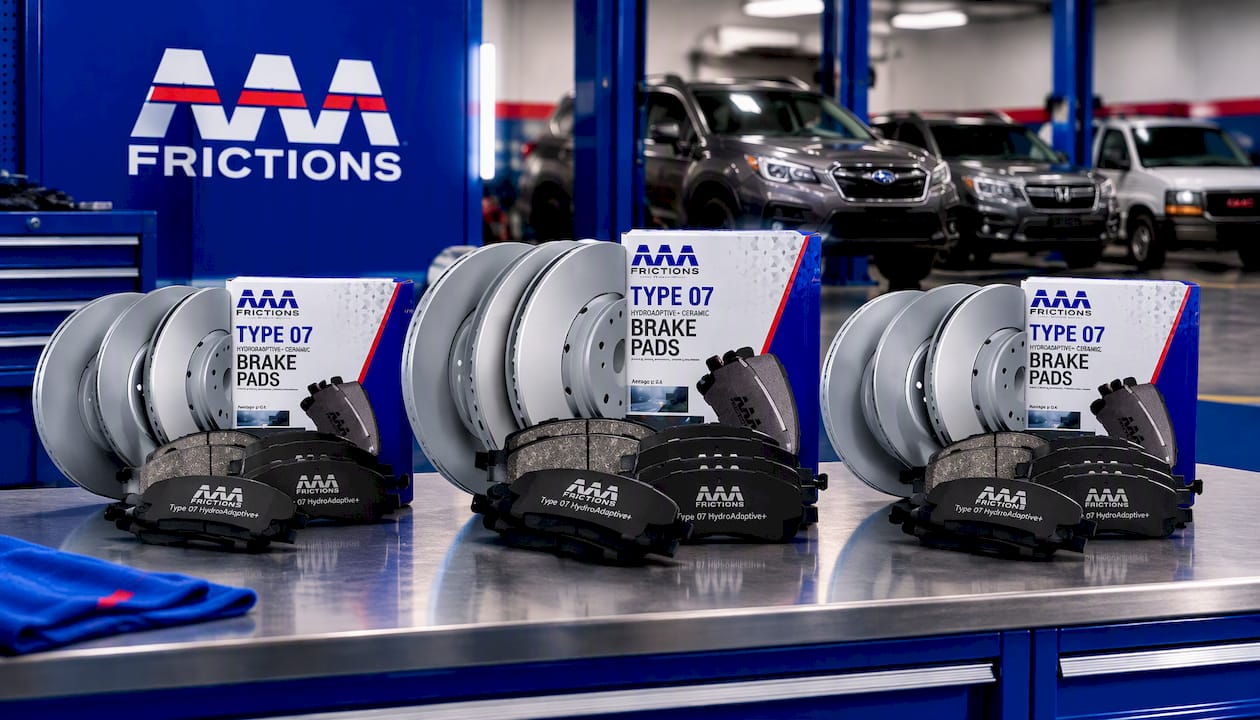
If an inspection shows worn pads or corroded rotors, we make complete kits that are matched by vehicle. Our HydroAdaptive ceramic pads come as Type 03 and Type 07, paired with SC Type or GC Type GEOMET-coated rotors, and ClimateFlex calipers are available too. Kits are available for cars, SUVs and vans, for example the front and rear kit for the Honda Pilot 2003-2008 and the GMC Savana 2500 2006-2017. Enter your vehicle on our store to find the match, and browse more in our library of brake guides.
If you are not sure which parts your car needs, have a technician inspect it first. We would rather you replace the right parts than the wrong ones.
FAQ
How do you know when your brakes are about to fail?
Look for a soft or spongy pedal, grinding or screeching, pulling to one side, vibration, a brake warning light and longer stopping distances. Any one of these deserves an inspection soon. A pedal that sinks or goes to the floor means stop driving immediately.
What should I do first if my brakes fail on the highway?
Lift off the gas, turn on your hazards and pump the pedal hard. Then downshift and apply the parking brake gradually while holding its release. Steer toward a long runout, an uphill grade or a soft shoulder if you cannot stop in the lane.
How long do truck brakes last?
There is no single number. Wear depends on load, towing, terrain, climate and driving habits, so pads can last much longer in one truck than another. Have the brakes inspected on a regular schedule and replace them based on thickness and condition, not only mileage. Our brake pad lifespan guide explains the factors.
Can brake fluid really cause brake failure?
Yes. Low fluid from a leak lets air in and reduces pressure, and old fluid that has absorbed moisture can boil under heavy use. Either way the pedal goes soft. Check the reservoir monthly and follow your vehicle manufacturer’s replacement interval.
Is brake failure common in modern cars?
Total failure is very rare because of dual hydraulic circuits and better engineering. Partial loss from wear, leaks, fade or neglect is much more common, which is why warning signs matter.
Sources
- Dealing with emergencies, Ontario MTO Driver’s Handbook
- Driving Emergencies: If Your Brakes Stop Working, Michelin
- Emergency Driving Tactics, Pennsylvania DMV
- How to tell if your brakes need replacing, The AA
- When should I get my brakes checked, The AA
- Troubleshooting: Common Brake Issues and Causes, Haynes
- What to Do If Your Brakes Fail, Bumper
- MOT inspection manual: brakes, GOV.UK
- Research on a Brake Temperature Model of Heavy-duty Trucks
- Best Practice Guide: Braking, eDriving