


Brake fade happens when your brakes make more heat than they can shed. The friction material or the brake fluid then stops doing its job, and the pedal gives you less stopping power than it did a minute earlier. Long downhill grades, heavy loads, dragging brakes and repeated hard stops are the usual triggers, and each one can be managed with driving technique, fluid maintenance and parts suited to the way you drive.
This guide explains each cause in plain terms, how to tell one type of fade from another by pedal feel, why rotors get blamed for problems that are really something else, and what to do about it. It is written for commuters, high-mileage drivers, truck and SUV owners, DIY owners and the mechanics who service them.
TL;DR
- Brake fade is a temporary loss of braking power caused by heat building up faster than the brakes can dissipate it, according to Brake & Frontend.
- Two main forms: pad fade (the lining loses friction, the pedal stays firm) and fluid fade (boiling fluid makes vapor, the pedal goes soft or long).
- The classic triggers are long descents, heavy loads, dragging pads and riding the brakes.
- Prevention comes down to engine braking on grades, fresh brake fluid, properly bedded pads and friction material matched to your duty cycle.
- Rotor “warping” is a different problem from fade: it shows up as a pulsing pedal, not a fading one.
Table of Contents
- What brake fade actually is
- The main causes of brake fade
- When brake fade is most likely to happen
- How to tell the types of fade apart by pedal feel
- Brake pad friction and friction material: why the compound matters
- Rotor warping from heat: a different problem
- How to prevent brake fade: a practical routine
- Where AAA Frictions parts fit
- Our perspective
- FAQ
- Sources
What brake fade actually is
Every time you brake, the system turns your car’s motion into heat. The pads clamp the rotors, friction slows the wheel, and the energy of a moving vehicle ends up as temperature in the pads, rotors, calipers and fluid. Normally that heat leaves into the air between stops.
Fade starts when heat goes in faster than it goes out. Brake & Frontend describes the sources as prolonged braking, steep descents, dragging pads or shoes, and high-speed, heavy braking, with the result that the linings may lose friction or the fluid may boil. The driver may need more and more pedal effort, and eventually the vehicle may not stop the way it should.
Two points matter for everyday drivers:
- Fade is temporary. Once the system cools, braking usually returns, which is why it is easy to dismiss. It is still dangerous, because it happens exactly when you need to stop.
- Fade is about heat, not wear. Brand-new pads can fade just as old ones can, if the demand is high enough.
The main causes of brake fade
Pad fade: the friction material overheats
Pad fade is the form most people mean. The pad compound has a working temperature range. Push it past that range and the friction coefficient drops. The SCCA’s technical feature describes the result: a firm pedal while the pads lose friction and the car no longer slows properly.
Why does friction fall? Pads contain resins that bind the material together. When the pad gets hot enough, those binders can release gas at the pad-to-rotor interface, which acts like a thin lubricating layer. Heat that cannot escape between brake applications makes it worse, because the pad never gets a chance to recover.
Fluid fade: the brake fluid boils
Brake fluid transmits your foot’s force to the calipers. Heat travels from the pads into the caliper and into the fluid. If the fluid gets hot enough to boil, it produces vapor, and vapor compresses where liquid does not. Brake & Frontend notes that boiling fluid can cause loss of pedal: the pedal feels soft, sinks, or travels much farther than normal.
This is why the age and condition of the fluid matter. Fluid that has been in the car for years is a maintenance item in its own right, and your owner’s manual gives the interval for your vehicle.
Dragging pads and riding the brakes
A pad that does not fully release, from a sticking caliper or slide pin, creates heat all the time, even when you are not braking. The same happens when a driver rests a foot on the pedal on a long grade. Both feed heat into a system that has no time to cool. If one wheel runs hotter than the others, or you smell a burning odor after a drive, a dragging brake is a likely cause and worth inspecting before the next long trip.
Heavy loads and high speeds
A heavier vehicle carries more energy at the same speed, so each stop converts more energy to heat. Ford’s owner guidance for exhaust braking makes the link directly: using it on downhill driving and with heavy loads lowers brake temperature and reduces brake fade. Larger SUVs and trucks, vehicles that tow, and cars loaded to the limit with passengers and cargo all sit at the top of the heat-risk list.
New pads that have not been bedded
Bedding is the process of depositing an even layer of pad material on the rotor surface. Brake & Frontend explains that ceramic and some NAO pads build a bonded transfer layer on the rotor, so correct rotor finish and bedding matter for stable friction and for avoiding uneven deposits. Skipping the bed-in procedure on new pads is a common DIY mistake that makes the first hard stops less predictable.
When brake fade is most likely to happen
Fade is a duty-cycle problem. It shows up when the demand placed on the brakes outruns their ability to cool. These are the situations to watch:
| Situation | Why heat builds | What helps |
|---|---|---|
| Long mountain descents | Gravity adds energy; brakes work continuously | Low gear and engine braking |
| Towing or a fully loaded vehicle | More mass means more energy per stop | Stay within load capacity, use engine braking |
| Repeated hard stops in a short time | No cooling gap between applications | Space out stops, leave following distance |
| Resting a foot on the pedal | Constant light drag heats pads and rotors | Lift off, brake firmly then release |
| Stuck caliper or slide pin | Pad stays in contact | Inspect and service the caliper |
| Old or moisture-laden fluid | Lower boiling point | Replace on the manufacturer’s schedule |
Drivers in rideshare, delivery and other high-mileage work face a version of this every day: hundreds of stops, often with a full vehicle, and little time for the system to cool. For them, the friction material and the condition of the calipers and fluid are working equipment, not an afterthought.
Weather does not create heat, but it changes how a brake system behaves. Rain, humidity, road salt and freezing mornings all test the parts around the pads: rotor surfaces, caliper sliders and pistons. When those parts work smoothly, the pad releases cleanly and the brake does not carry unnecessary drag heat.
How to tell the types of fade apart by pedal feel
Pedal feel is the most useful clue you have. The SCCA piece treats it as diagnostic: a firm pedal with poor deceleration points toward pad fade, while a soft or long pedal points more toward fluid boiling.
| What you feel | Likely cause |
|---|---|
| Pedal is firm but the car slows less than normal | Pad fade (friction material overheated) |
| Pedal feels soft, spongy or sinks | Fluid fade (boiling fluid, vapor in the lines) |
| Pedal pulses or the steering wheel shakes when braking | Rotor thickness variation or uneven pad deposits, not fade |
| Burning smell, one wheel hot after driving | Dragging pad or sticking caliper |
If you feel fade on the road, ease off, lower your speed with engine braking, leave extra distance and pull over safely to let the brakes cool. Then have the system inspected before the next descent. A brake system that has faded badly may have overheated pads or fluid that need replacing, and a technician can check them.
If you are shopping for a used vehicle, a pedal that feels soft or pulsing on a test drive deserves attention. This test drive checklist for brake faults walks through what to listen and feel for.
Brake pad friction and friction material: why the compound matters
The friction material is where fade begins, so it is worth understanding what pads are made of and what each type is good at.
Brake & Frontend’s comparison puts ordinary street friction materials as generally stable to about 600 to 700°F, while high-temperature materials can operate to roughly 1,200°F, with trade-offs such as weaker cold bite and more rotor wear. In other words, no single compound is ideal for every use. It is a decision about how you drive.
The common families:
- NAO (non-asbestos organic): quiet and predictable at low temperatures, but they wear faster and lose capacity as temperature climbs. A 2026 materials study in IOP Publishing describes NAO pads as low in wear and noise but limited at high temperature.
- Low-metallic: designed to keep braking capacity at high temperature.
- Semi-metallic: high thermal conductivity, so they carry heat away well, generally with more noise and rotor wear.
- Ceramic: form a bonded transfer layer on the rotor rather than relying mainly on abrasion, which is why bedding and rotor finish matter so much.
The practical takeaway is to match the pad to the demand. A commuter in stop-and-go traffic needs quiet, consistent response from the first press. A driver who crosses mountain passes with a loaded vehicle needs a material and a cooling path that hold up under sustained heat. For a deeper look at two of the main families, see our comparison of ceramic versus semi-metallic brake pads.
The federal safety standard for air-braked vehicles shows how seriously fade is treated: the Oak Ridge National Laboratory describes FMVSS 121 testing as evaluating effectiveness, fade and recovery, with fade assessed through repeated applications.
Rotor warping from heat: a different problem
Searches for fade often lead to rotor warping, and the two get mixed up. They are related by heat, but they feel different.
What drivers call a warped rotor is usually disc thickness variation, meaning the friction surfaces are not perfectly parallel. Brake & Frontend explains that this produces piston movement and pedal pulsation. Judder can also come from brake-torque variation caused by inconsistent surface finish, metallurgy, or uneven friction-material deposits on the rotor.
The SCCA feature notes that rotor distortion can result from brake mass, alloy metallurgy, and casting uniformity and quality, and that better-quality rotors or improved heat management may help. A rotor design study in IJERT adds that inadequate cooling can lead to thermo-mechanical stress, fade, warping, cracking and judder, and that vented rotors help because their internal vanes improve heat dissipation.
How to help prevent rotor problems
- Bed new pads and rotors properly. Even deposits protect against judder.
- Avoid holding the pedal down at a stop right after hard braking. Hot pads pressed against a stationary rotor can leave uneven deposits.
- Use quality rotors with a consistent casting and finish.
- Fit rotors and pads that were designed to work together. A matched set gives you a consistent transfer layer and surface.
- Keep sliders and calipers moving freely so pads release fully.
If you also care about the look of your wheels, dust that builds up from braking is easy to manage. Here is a guide to removing brake dust safely from wheels without harming the finish.
How to prevent brake fade: a practical routine
This is the routine for any driver, from commuters to people who tow.
1. Use engine braking on grades
Select a low gear before you start down a hill. A California and Nevada driver training guide advises using engine braking as the main way to control speed and applying the brakes just hard enough to feel a definite slowdown, then releasing at about 5 mph below your safe speed. Engine braking reduces the work the service brakes must convert into heat. In an automatic, use the manual or low-gear mode your owner’s manual describes.
2. Do not ride the brakes
Firm application, then full release, gives the pads and rotors time to shed heat. A constant light press does the opposite.
3. Respect load limits
Do not exceed the vehicle’s load capacity. The brakes were sized for it, and heat rises with mass.
4. Replace brake fluid on schedule
Follow the interval in your owner’s manual. Fluid is the second half of the fade story, and it is easy to forget because it is hidden.
5. Bed in new pads
Follow the bedding steps for the pads you install. This sets up the transfer layer that keeps friction stable.
6. Choose parts for your duty cycle
Select pads and rotors that suit how you drive: daily commute, loaded work vehicle, winter roads, or a mix. Choose parts that come as a matched pair, so the pad material and rotor surface were designed to work together.
7. Have the system inspected regularly
Check pad thickness, caliper movement, rotor surfaces and fluid condition at every tire rotation or service visit. A stuck slider caught early prevents dragging heat later.
Where AAA Frictions parts fit
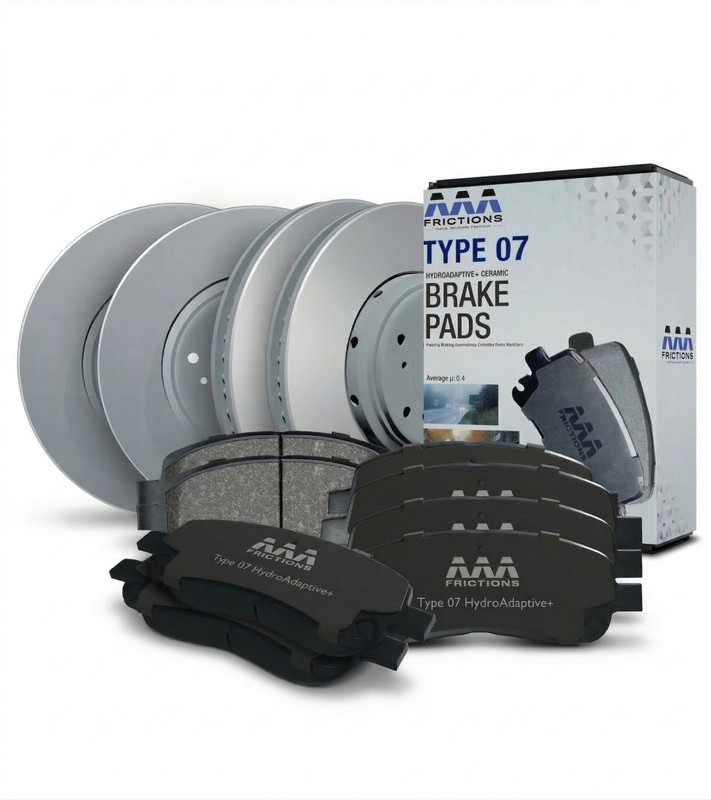
If you are replacing pads and rotors, a matched set is the cleanest way to put the routine above into practice. Our Type 07 brake pads and Type 03 brake pads are HydroAdaptive ceramic pads designed for moisture management and stable friction. Our GC Type rotors carry a GEOMET coating designed to protect against corrosion from moisture and road salt, and our SC Type rotors are available in matching kits.
Rotors are sold only as part of brake kits, matched by vehicle and paired with compatible pads, so the surface your pads bed into is the one they were engineered for. You can see complete front and rear kits, for example the Honda Ridgeline kit with GC Type rotors, or enter your vehicle on our site to find the matching set.

Our perspective
Most fade stories we hear about start the same way: a long grade, a full vehicle, and a brake system that was a collection of parts rather than one system.
We design with the idea that braking has to stay consistent when the weather changes. Rain, humidity, road salt, freezing mornings and summer heat each put a different demand on the pads, the rotors and the calipers. Our HydroAdaptive pads are designed for moisture management and stable friction. Our GEOMET-coated rotors are designed to protect against corrosion from moisture and road salt. Our ClimateFlex calipers are designed for smooth operation through winter cold and summer heat.
We develop rotors and pads as a matched system, which is why rotors are sold only as part of kits with compatible pads. A pad bedding into a rotor it was engineered for gives you the even transfer layer that keeps friction predictable, and that predictability is what we think drivers, from daily commuters to delivery drivers, should expect from their brakes.
Good technique, fresh fluid and parts built to work together are a better answer to fade than hoping for the best on the next hill.
AAA
FAQ
How do you fix brake fade?
First, let the brakes cool: slow with engine braking, leave extra space and pull over safely if the pedal feels weak. Brakes often recover once cool, but overheated pads or boiled fluid should be inspected. Replace worn pads, flush old fluid on the manufacturer’s schedule, and service any sticking caliper.
What are the main types of brake fade?
The two most commonly described are pad fade, where the friction material loses grip and the pedal stays firm, and fluid fade, where boiling fluid creates vapor and the pedal feels soft or long. Dragging brakes are a frequent cause of both because they create heat continuously.
Can rotors warp from heat and cause fade?
Heat and poor cooling are linked to rotor distortion, but what drivers feel as warping is usually thickness variation or uneven pad deposits, which shows up as a pulsing pedal. Fade is a loss of stopping power. They can occur together, but they are separate problems.
Does weather cause brake fade?
Heat causes fade, not weather. But moisture, road salt and temperature swings affect rotors, calipers and pads, and a brake that releases cleanly and holds stable friction is less likely to build unnecessary heat.
Sources
- Preventing Brake Fade: Maximizing How Friction Materials Handle Heat, Brake & Frontend
- SportsCar Feature: Braking Bad, Sports Car Club of America
- Warped Brake Rotors, Brake & Frontend
- Diesel Engine Exhaust Brake, Ford owner manual
- Select the Right Gear Before Starting Down the Grade, downhill driving guide
- Compositions, Functions, and Testing of Friction Brake Materials, Oak Ridge National Laboratory
- Impact of Design Factors of Disc Brake Rotor on Braking Performance, IJERT
- Improved friction and wear properties of resin friction materials, IOP Publishing
- Test drive checklist for brake faults
- Removing brake dust safely