


A brake pedal that feels soft or spongy on a cold morning is a hydraulic warning, not a winter quirk. Cold does not create the fault. It exposes one that is already there: air or vapor in the lines, tired or wet fluid, a leak, a swollen hose or a caliper that is not moving freely. Treat a pedal that sinks as a stop-driving problem, then work through the causes below in order, from cheapest to check to most serious.
TL;DR
- A spongy pedal usually means air, moisture or contamination in the brake fluid, or a leak. Cold weather makes the symptom easier to notice and leaves you less margin on wet or icy roads.
- If the pedal sinks while you hold it, goes to the floor, or the red brake light is on, stop driving and arrange a tow.
- The standard repair is finding the cause, then bleeding or flushing the system. A fluid flush with full bleed runs about $110 to $160 at independent shops, according to Jerry’s 2026 cost guide.
- Sticking calipers, rusted rotors and pads that suffer in damp, salty conditions are the weather-related parts of the problem, and they are the ones you can prevent with the right components.
Table of Contents
- Is it safe to drive with a soft brake pedal?
- Why cold weather exposes a spongy pedal
- What the pedal feel tells you
- How to diagnose a spongy brake pedal
- How to fix a spongy brake pedal
- Where the weather-related parts come in
- Keeping the pedal firm all winter
- Ready to replace worn parts?
- Our view: weather is a system problem
- FAQ
- Sources
Is it safe to drive with a soft brake pedal?
No. Michelin’s emergency guidance calls a soft or spongy pedal a serious warning sign that can lead to total brake failure with little warning. Its advice is to pull over safely, not restart the vehicle and call for assistance. If the brakes feel soft while you are moving, Michelin’s US safety page says to pump the pedal quickly to build hydraulic pressure, look for a safe place to exit right away, and use the parking brake gradually only as a last resort.
Treat any of these as a tow-it situation:
- The pedal sinks slowly toward the floor while you hold steady pressure.
- The pedal drops to the floor or you have to pump it to stop.
- The red BRAKE light stays on with the parking brake released.
- You can see fluid at a wheel or the reservoir is low.
- Stopping distance suddenly gets longer.
A pedal that is merely a little softer than usual but holds firm under steady pressure still needs prompt attention. Do not wait for the next cold snap to see if it gets worse. Short, low-speed trips to a nearby repair shop are a judgment call for a qualified technician, and when in doubt, a tow is the safe choice.
Why cold weather exposes a spongy pedal
A hydraulic brake system works because fluid barely compresses. According to the technical trade publication TABPI’s pedal diagnosis article, fluid transmits pressure to every part of the system, while air is highly compressible and acts like a cushion that ruins solid hydraulic pressure. Even a very small amount of trapped air changes pedal feel noticeably.
So why winter? Several things stack up:
Less margin. Wet roads, ice and snow lengthen stopping distances. A pedal that felt acceptable on dry pavement now feels like a problem because you are leaning on it harder and more often.
Moisture in the fluid. Brake fluid absorbs water over time. Kelley Blue Book, citing an ASE-certified master technician, explains that heat travelling up the brake lines can vaporize water in the fluid, and vapor compresses the way air does. A caliper that drags and generates extra heat makes this worse. Water in the fluid also promotes corrosion inside the system.
Air that was already in there. The same source names air in the line as the most common cause of a spongy pedal. It can enter through a failed seal, or when pad wear lets the reservoir level drop too far.
Hardware that stops moving freely. Corrosion and cold can leave a caliper slow to release or a flexible hose weak. Road salt and slush get to these parts first.
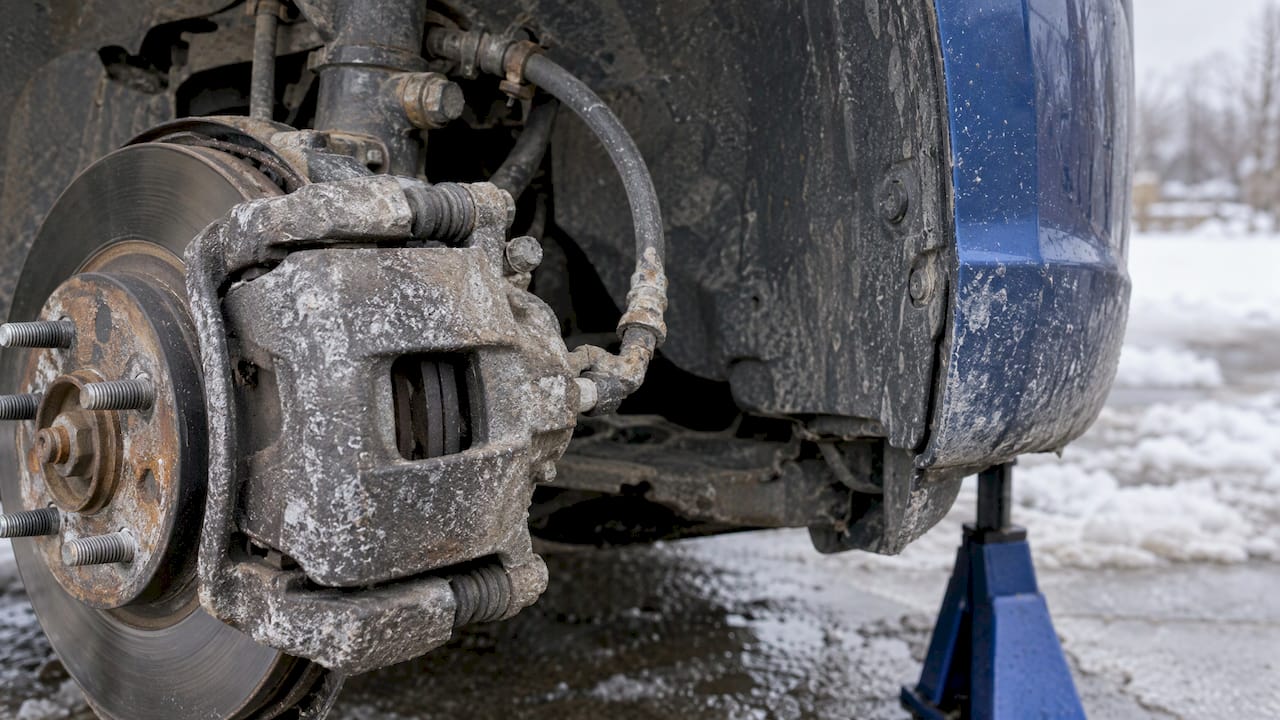
None of this means your brakes are worn out because it is cold. It means winter is a stress test, and a soft pedal is the result telling you something needs attention.
What the pedal feel tells you
Pedal feel is the first diagnostic clue. TABPI sorts it into two broad groups:
| What you feel | Likely cause | What to do |
|---|---|---|
| Soft, spongy or mushy but holds under steady pressure | Air intrusion, contaminated fluid, or a component moving beyond its designed range | Inspect and bleed or flush promptly |
| Pedal keeps creeping toward the floor | Loss of hydraulic pressure from an external leak or an internally leaking part | Stop driving, tow |
| Pedal hard and heavy | A different problem, often in the power assist | Have it inspected before driving much |
The first two rows come from the TABPI article. The third is a different symptom, so do not confuse a stiff pedal on a frosty morning with a spongy one. They have different causes and different fixes.
The list of possible culprits is longer than most drivers expect. Beyond air and leaks, professionals look at old flexible hoses that balloon under pressure, air trapped in the ABS unit after a service, rear drum brakes that are out of adjustment, a failing master cylinder (the pump at the pedal end of the system) and leaking calipers.
How to diagnose a spongy brake pedal
Work from the simplest check to the most involved. Anything beyond the first two steps belongs in the hands of someone with the tools and training for hydraulic brake work.
1. Note the history
When did the pedal change? Did it follow a brake job, a fluid top-up, a pothole or a cold snap? Is any warning light on? A pedal that went soft right after service points to air that was never fully bled out, including air trapped in the ABS valves.
2. Check the fluid
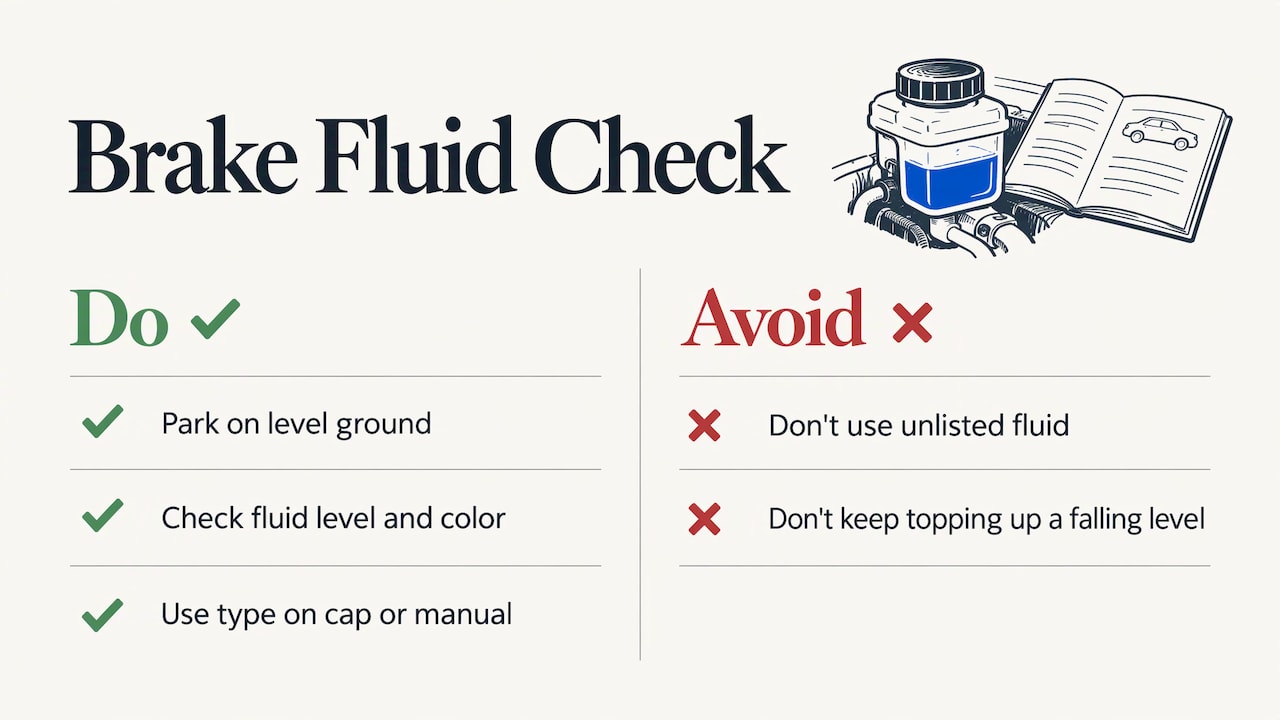
With the car on level ground, look at the reservoir level and the color of the fluid. A level that has dropped means the fluid went somewhere, either into a leak or into the space left by worn pads. Dark, dirty fluid suggests contamination or age. Top up only with the fluid type printed on the reservoir cap or in your owner’s manual, and treat a falling level as a reason to find the leak, not to keep topping up.
3. Look for seepage
TABPI recommends inspecting the calipers and hoses while an assistant pumps the pedal, checking meticulously for seepage. Tomorrow’s Technician adds that even a little weeping at a fitting is unacceptable and can cause a fading pedal. Look at hoses for bulges and cracks, and at each wheel for dampness around the caliper and line fittings.
4. Separate air from a bad master cylinder
This is the professional test. Tomorrow’s Technician describes blocking the master cylinder ports: the pedal should then feel rock hard. If it still moves, the master cylinder is leaking internally, there is a pushrod issue, or the fluid is contaminated. It is a job for a technician with the right plugs and a safe workspace.
5. Scan the ABS system
If the ABS light is on, or the pedal stays soft after a normal bleed, a scan tool can cycle the ABS valves to push trapped air out. A standard wheel-by-wheel bleed is sometimes not enough.
If you want to rule out other mechanical faults that show up on a cold start, a test drive checklist for brake faults walks through what to feel and listen for.
How to fix a spongy brake pedal
The fix follows the cause:
- Air in the system: bleed the brakes, opening each bleeder screw in the right order while fresh fluid is pushed through until no air bubbles appear. Find out why air got in, otherwise it returns.
- Old or wet fluid: flush the system with the fluid grade your vehicle specifies, usually DOT 3, DOT 4 or DOT 5.1. Never mix DOT 5 silicone fluid with glycol-based fluid.
- Leaking caliper, hose or line: replace the leaking part, then bleed.
- Failing master cylinder: replace it and bleed the whole system.
- Trapped ABS air: bleed using a scan tool that cycles the valves.
- Worn pads letting the reservoir run low: replace pads, then check the level and bleed if air entered.
DIY owners comfortable with a bleeder kit can do a basic bleed or pad swap. Brake fluid damages paint, so wash any spill off immediately with plenty of water. A leak, a master cylinder or an ABS fault is not a driveway job. Have a qualified technician handle it, and have the car towed if the pedal is sinking.
What it costs
Jerry’s 2026 guide gives these US ranges:
| Item | Typical cost |
|---|---|
| Brake fluid flush with full bleed, independent shop | $110 to $160 |
| Same service at a dealership | $140 to $220 |
| ABS scan-tool bleed, added labor | $30 to $120 |
| DOT 4 or 5.1 fluid | $10 to $30 |
| Corroded fittings or lines | $100 to $400 |
Labor rates in the same guide run $90 to $180 per hour. Leaks and master cylinder work are priced after diagnosis, so expect a higher bill if parts have to be replaced.
Where the weather-related parts come in
A bleed fixes air. It does not stop road salt from corroding a rotor or a caliper from stiffening in the cold. The parts that live outside the hydraulic line face the weather directly, and they are where our range is focused:
- Calipers. They squeeze the pads against the rotors, and when they move smoothly, brakes release and apply evenly. Our ClimateFlex calipers are designed for smooth operation through winter cold and summer heat.
- Rotors. Our GEOMET-coated rotors are designed to protect against corrosion from moisture and road salt. Rotors are sold as part of brake kits, matched to the pads so the two work as a system.
- Pads. Our HydroAdaptive ceramic pads are designed for moisture management and stable friction when it is wet and cold.
Parts are matched by vehicle, so you pick your make, model and year and get components that fit. That matters for larger vehicles and high-mileage work such as rideshare and delivery, where brakes get heavy use in all conditions.
Keeping the pedal firm all winter
Prevention is a short list:
- Have the fluid checked before cold weather. Ask a technician to test it, and replace it at the interval in your owner’s manual. Do it sooner if you drive in humid climates or in heavy stop-and-go traffic.
- Inspect hoses and fittings each season. Look for bulges, cracks and damp spots.
- Watch the reservoir level. A dropping level means a leak or very worn pads.
- Replace worn pads and rusted rotors as a set. Mismatched, aging parts are what winter finds first.
- Do a slow-speed brake test. In an empty lot, press the pedal firmly at low speed. It should feel the same each time.
- Act on the first change. A pedal that feels different today will not improve with the next freeze.
Ready to replace worn parts?
If an inspection shows tired pads, rusted rotors or a sticking caliper, replace them with parts built for the conditions you drive in. Our Type 07 brake pads, GC Type GEOMET-coated rotors and ClimateFlex calipers are sold individually or as complete front and rear kits matched to your vehicle.

Browse AAA Frictions to find the kit that fits your vehicle.
Our view: weather is a system problem
Drivers tend to blame the pedal. We look at the whole chain between your foot and the road. Fluid and lines carry the force, but the caliper, the rotor and the pad decide what happens once it arrives, and each of them meets rain, salt and cold first.
That is why we build around weather. HydroAdaptive pads are designed for moisture management and stable friction. GEOMET-coated rotors are designed to protect against corrosion from moisture and road salt. ClimateFlex calipers are designed for smooth operation in winter cold and summer heat. Rotors and pads are developed as a matched system, which is why rotors are sold only as part of brake kits.
A soft pedal still deserves a proper diagnosis of the hydraulic system first. Once that is sorted, the components that carry the load should be ones you can trust when the temperature drops. Our focus is predictable braking, any weather.
AAA
FAQ
Why are my brakes only spongy when it is cold?
Cold usually reveals a fault that was already there. Air, water-contaminated fluid, a weakening hose or a sticking caliper can all feel worse in winter, when the system is working harder and stopping distances are longer. Have the fluid and the hardware inspected rather than waiting for warmer weather.
Why do my brakes squeak when it is cold?
Light noise on the first stops of a frosty morning often comes from moisture or surface rust on the rotors and usually fades after a few stops. A squeal or grinding that persists, or that comes with a softer pedal, longer stopping distances or a vibration, is a reason to have the pads, rotors and calipers inspected.
How much does it cost to fix spongy brakes?
If the cause is old fluid or air, a flush and bleed typically costs about $110 to $160 at independent shops and $140 to $220 at dealerships, per Jerry’s 2026 guide. Corroded lines or fittings can add $100 to $400. Leaks and master cylinder replacement are priced after diagnosis.
Why does my brake pedal go to the floor but the car still stops?
That means the system is losing hydraulic pressure, often from an external leak or a failing master cylinder, and the remaining pressure is only just enough to stop you. TABPI describes this as a pedal that keeps moving toward the floor. Do not drive the car. Have it towed and inspected.
Sources
- Michelin Canada: Driving emergencies, if your brakes stop working
- Michelin USA: Brake problems, safe driving tips
- TABPI: Pedal diagnosis
- Kelley Blue Book: Why do my brakes feel spongy?
- Tomorrow’s Technician: Diagnosing brake pedal problems
- Jerry: How much does a brake fluid replacement cost?
- Test drive checklist: cold start and brake faults