

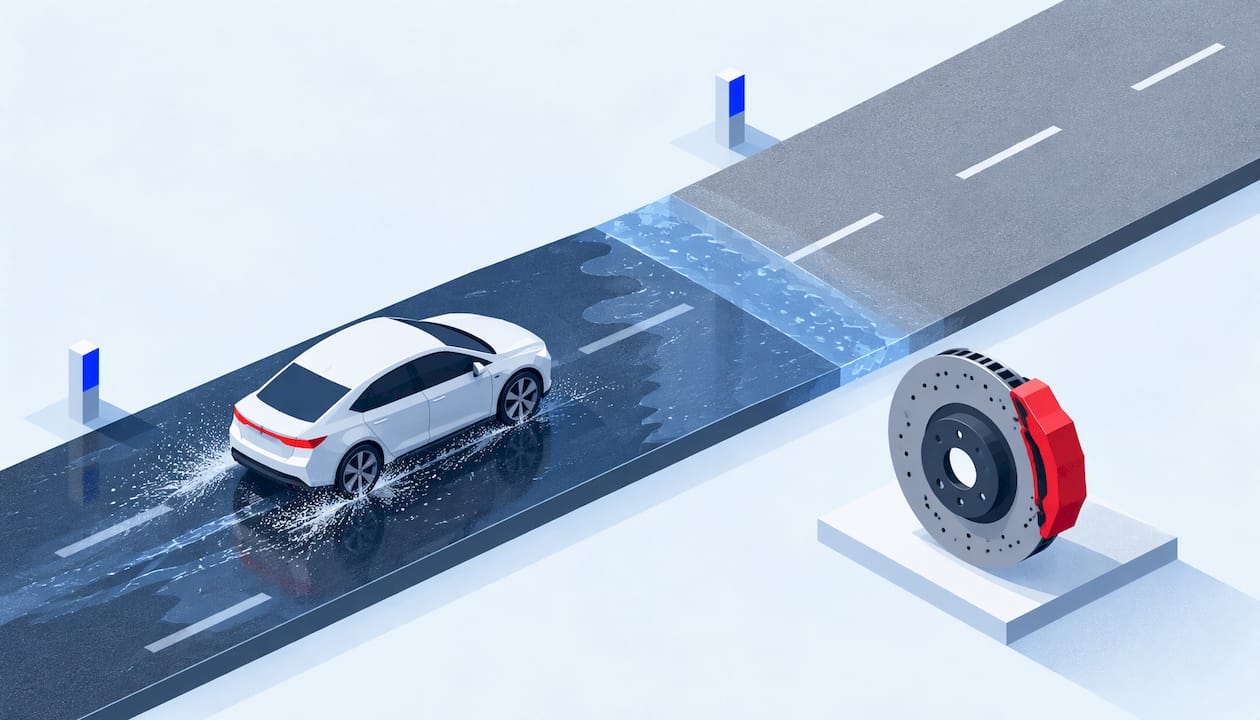
If your brakes feel like they are slipping in the rain, one of three things is usually going on: a thin film of water and surface rust on the rotors on the first stops, tires that cannot grip a wet road, or a worn or glazed brake part that wet weather exposes. The first clears in a few stops. The other two do not, and the lasting fix is brake parts built to hold steady when moisture is present. That is the idea behind our HydroAdaptive pads and GEOMET-coated rotors.
This guide shows how to tell the harmless cause from the serious one, what to do on the road right now, and what to change so wet-weather braking stops being a worry.
TL;DR
- A brief delay, a squeal or a slightly rough first stop after rain or an overnight park is usually water and a light rust film on the rotors. It wears off within a few stops.
- Rain itself makes every vehicle take longer to stop, because road grip drops. Leave more space and brake earlier.
- A soft pedal, a pedal that sinks, pulling to one side, grinding, or slipping that continues after the brakes are dry is not a rain effect. Get the brakes inspected before more driving.
- Worn pads, glazed or rusted rotors and sticking calipers make wet-weather braking worse. Matched pads and rotors, with corrosion-resistant coating, address this at the source.
Table of Contents
- Why brakes feel different in the rain
- Normal wet-weather behavior or a real problem?
- What to do right now when the brakes feel slippery
- The parts that make wet weather worse
- Who feels this most
- How brake parts can reduce wet-weather problems
- Choosing the right kit
- Our view on wet-weather braking
- Ready to replace worn or rusted brake parts?
- FAQ
- Sources
Why brakes feel different in the rain
Two separate things change when it rains, and drivers often blame the brakes for both.
The road gets slipperier
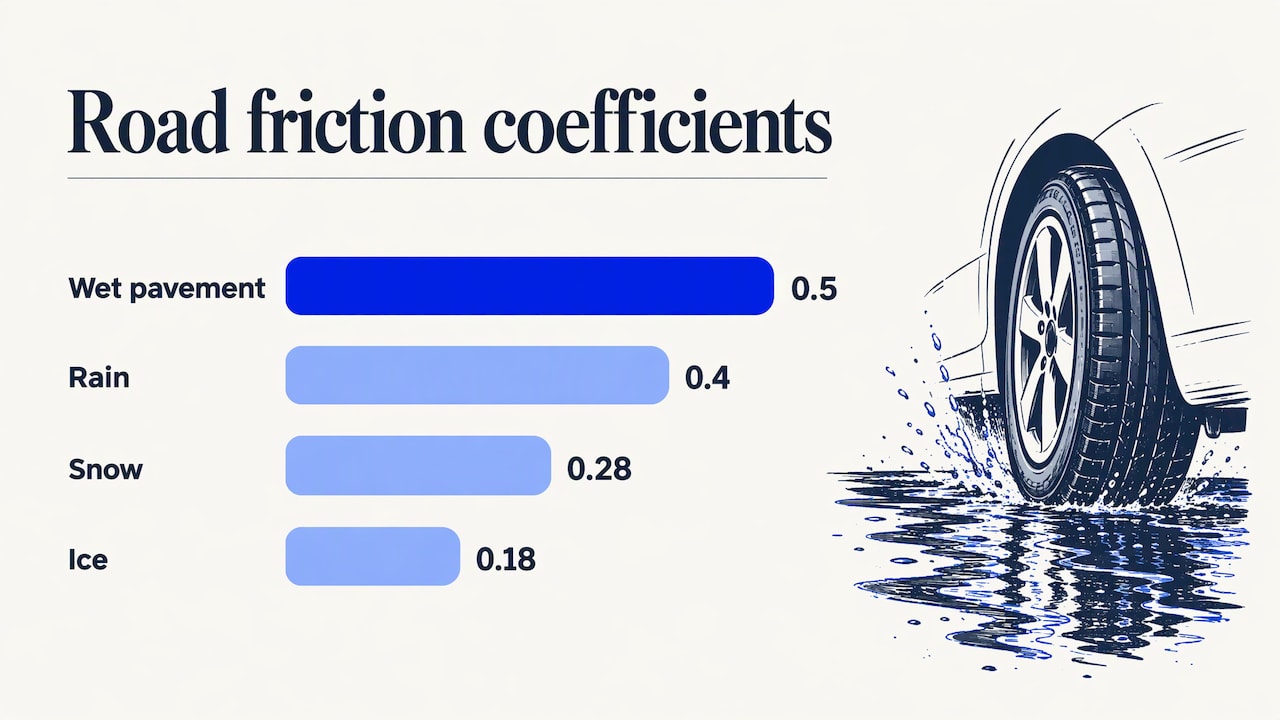
Your brakes slow the wheels. Your tires slow the car. When water sits between tire and asphalt, the tires have less to grip, so the same pedal pressure stops you over a longer distance. A study of adverse weather and braking distance reports friction coefficients of about 0.5 for wet pavement and 0.4 in rain, against 0.28 for snow and 0.18 for ice. Lower friction means a longer stop, even with perfect brakes. The same paper, citing NHTSA data, notes that 73% of weather-related crashes happen on wet pavement and 46% during rainfall.
That is why many drivers describe a car that “slides” when braking in the rain: the wheels are slowing, but the tires are losing the contest with the road. Tire tread depth and inflation matter as much as the brakes here.
Water gets between the pad and the rotor
A disc brake works by squeezing pads against a spinning iron rotor. After driving through rain, a puddle or a wash, a film of water can sit on the rotor. On the first press or two, the pad has to wipe it away before it bites fully. You feel this as a slight delay, a softer first stop, or a faint hiss and squeal.

Bare iron rusts fast
Cast iron starts to oxidize within hours of getting wet. Park the car overnight in humid air or rain and the rotor face carries a light orange film by morning. The first stops scrape it off, sometimes with a grinding or scraping noise and a slightly rough pedal. If you want the detail, our guide explains why brake rotors rust after rain and when it stops being cosmetic.
Normal wet-weather behavior or a real problem?
Use this table to sort what you feel.
| What you notice | Likely cause | What to do |
|---|---|---|
| Slight delay or squeal on the first one to three stops after rain or overnight | Water film and light surface rust on the rotors | Drive gently and brake lightly a few times. It should clear |
| Longer stopping distance in a downpour, but the pedal feels normal | Reduced tire grip on a wet road | Slow down, add following distance, check tire tread and pressure |
| Pedal stiff after the car sat in rain | Common after a parked, wet vehicle. Often clears once driving | If it persists once dry, have it checked |
| Soft, spongy pedal or pedal sinking toward the floor | Hydraulic issue such as air or fluid problems | Stop driving it and get it inspected |
| Car pulls to one side when braking | Uneven pad wear, sticking caliper or a tire problem | Inspect the pads, calipers and tires |
| Slipping, weak braking that continues after the brakes are dry | Worn or glazed pads, glazed rotors, contamination | Inspect and replace the worn parts |
| Constant grinding | Pads worn to the backing plate | Replace pads, and rotors if scored |
The split is simple. A rain effect appears at the start of a trip or in a downpour, then fades. A mechanical fault shows up in every condition and gets worse in the wet. For help recognizing the second kind, this explanation of what a soft brake pedal means lists the common symptoms.
What to do right now when the brakes feel slippery
These steps are about safe driving, not repair.
- Ease off the throttle and increase your following distance. In rain, aim for noticeably more space than you would use on dry roads. Brake earlier and more smoothly.
- Check your surroundings, then dry the brakes. After a deep puddle or a car wash, when the road behind and ahead is clear, press the brake pedal lightly for a few seconds while driving slowly. The heat from light friction pushes the water off the surfaces.
- Avoid hard, late braking until the pedal feels normal. Do not test the brakes with a hard stop in traffic.
- Do not pump the pedal on an ABS car in an emergency. If your car has anti-lock brakes, press firmly and steadily. The system pulses the pedal on purpose to keep the wheels from locking. The pulsing is normal.
- If the pedal sinks, goes to the floor or the car will not slow, downshift if you can, use the parking brake gradually and look for a safe place to stop. Then arrange a tow rather than driving on. Our article on what to do when brakes fail covers this in more detail.
If you are unsure whether what you feel is normal, treat it as a reason to have the brakes looked at before the next long or wet drive. A shop can confirm pad thickness, rotor condition, caliper movement and brake fluid, and this guide to signs it is time for new rotors explains when symptoms point to a replacement.
The parts that make wet weather worse
Wet roads do not create weak brakes. They reveal them. When rain makes a brake system feel poor, the cause is usually one of these.
Worn pads
Thin pads have less friction material to clear water and less mass to absorb heat. Slow response under light pedal pressure is a common sign. Look for a squealing wear indicator, a visible thin pad or a grinding noise, and see our guide to brake pad wear signs.
Uneven pad wear
If one pad is thinner than its partner, braking becomes inconsistent and the car may pull. A sticking caliper or slide pin is a common reason. Our guide to uneven brake pad wear covers diagnosis and fixes.
Glazed rotors and pads
Excess heat can leave a hard, shiny surface that grips poorly. Moisture on top of that makes the problem more obvious. The signs and the right correction are in our article on glazed brake rotors.
Corroded rotors
Surface rust that clears in a few stops is normal. Rotors that stay pitted, flaky or rusted because they sit wet, or because road salt keeps attacking them, give the pad an uneven surface. Braking feels rough and the pad wears faster. In snow country, salt speeds this up.
Calipers that do not move freely
The caliper pushes the pad onto the rotor and must release it afterward. Cold, wet weather and corrosion can make a caliper slow to move, which leads to dragging, uneven wear or a weak response.
Brake fluid and tires
A spongy pedal points to the hydraulic system, and weak grip points to tires. Neither is a pad or rotor issue, but both feel worse in rain. Check them while you are looking at everything else.
Who feels this most
The drivers who notice rain-related brake issues first are those who use the brakes the most or leave the car outside.
- Daily commuters brake in stop-and-go traffic on wet mornings, often after the car sat out overnight.
- Rideshare and delivery drivers and other high-mileage drivers wear pads quickly and rarely get a dry day off.
- Drivers of larger cars, SUVs and trucks have more weight to stop, so a small loss of friction is easier to feel.
- Drivers in winter and variable climates deal with moisture, freezing mornings and road salt in the same week.
- DIY owners and mechanics want parts that are matched and consistent so a brake job does not have to be redone after the first wet season.
For all of them, the question is the same: will the brakes respond the same way on the first stop of a wet morning as on a dry afternoon?
How brake parts can reduce wet-weather problems
You cannot change the weather, but you can choose parts engineered for it. Our range splits the job by what each component faces.
- Pads. Our HydroAdaptive ceramic pads are designed for moisture management and stable friction, so the response stays predictable when water is present.
- Rotors. Our GEOMET-coated rotors are designed to protect against corrosion from moisture and road salt, which targets the surface rust and pitting behind rough, delayed wet stops.
- Calipers. Our ClimateFlex calipers are designed for smooth operation through winter cold and summer heat.
We develop rotors and pads as a matched system, which is why rotors are sold only as part of brake kits with compatible pads. The parts are matched by vehicle, so you enter your car and get a set that fits. If you want to know how ceramic pads behave in a downpour, see ceramic brakes in rain for what to expect and how to drive.
A fresh set of matched pads and rotors also removes the usual culprits at once: worn friction material, glazed surfaces and rusted faces. Replace them as a set rather than one at a time.
Choosing the right kit
Start with the problem you have, then match it to the parts.
- Pads are worn or glazed: choose a pad set for your vehicle. We offer Type 03 brake pads and Type 07 brake pads.
- Rotors are rusted, pitted or glazed: replace them together with pads. Our rotors come in SC Type and GC Type, and the GC Type is the GEOMET-coated version.
- You want the whole job done once: a complete front and rear kit keeps every part matched.
- You drive in rain, snow or salt often: a coated rotor and moisture-managing pad pairing is where our design focus sits.
Before ordering, confirm your vehicle’s year, make, model and trim. Parts are matched by vehicle, so the fit is checked for you. If you are fitting the parts yourself, replace pads and rotors on the same axle together and follow the torque and bedding instructions for your vehicle.
Our view on wet-weather braking
Most advice about brakes in the rain stops at “drive slower.” That is correct, but it treats the brake system as a fixed thing and the weather as the only variable. We start from the opposite end: the weather is a given, so every part has to be designed for it.
Water, road salt and temperature swings do different damage to different parts. Moisture changes how a pad grips. Salt and humidity corrode the rotor face. Cold and heat change how freely a caliper moves. That is why we build three answers, HydroAdaptive pads, GEOMET-coated rotors and ClimateFlex calipers, rather than one product with a weather label.
We also develop pads and rotors as a matched system. A rotor and pad that are engineered for each other give a more predictable response than two parts chosen separately, and that predictability is what a driver feels on a wet commute. It is why our rotors are sold only as part of brake kits.
Our goal is simple: when the weather changes, your braking should not.
AAA
Ready to replace worn or rusted brake parts?
If your brakes feel weak in the rain and the pads or rotors are worn, glazed or corroded, a matched set is the cleanest fix. Our kits pair HydroAdaptive ceramic pads with GEOMET-coated GC Type rotors, and the parts are matched to your vehicle. Browse the AAA Frictions brake kits, pads and rotors and select your vehicle to see what fits.

If you drive a Honda CR-V, we list kits by generation, such as the 2012-2016 Type 07 HydroAdaptive+ kit with GC Type rotors. For other vehicles, the Type 03 pads with SC rotors kit and Type 07 pads with SC rotors kit are good places to start.
FAQ
Why are my brakes more touchy in the rain?
Water on the rotors and a light rust film change how the pads grab on the first stops, so the pedal can feel grabbier, rougher or delayed. It usually clears once the rotor surface is wiped clean. If it keeps happening on every wet drive, have the pads, rotors and calipers inspected.
How do I stop my car from sliding in the rain?
Slow down before the corner or stop, brake earlier and press the pedal smoothly rather than stabbing it. Keep your tires in good shape, because tread depth and correct pressure give you the grip. If the car pulls or the pedal feels soft even in light rain, the brakes need attention.
Is it safe to drive in heavy rain?
It is safe when you adjust: lower speed, more following distance, headlights on and smooth inputs. Stopping takes longer on wet pavement, so leave extra room. If visibility drops or water covers the road, pull over somewhere safe and wait.
Do ceramic brake pads work in the rain?
Yes. Ceramic pads are a common choice for everyday driving, and ours are designed with moisture management and stable friction in mind. As with any pad, expect the first stop after a puddle or an overnight park to feel slightly different, and drive gently until it clears.
Should I replace pads and rotors together?
For the most consistent wet-weather braking, yes. New pads on a rusted or glazed rotor do not get a clean surface to work against. That is why we sell rotors as part of matched brake kits.
Sources
- Effect of Adverse Weather Conditions on Vehicle Braking Distance of Highways
- What a Soft Brake Pedal Means and What to Do Right Now
- Signs It’s Time for New Brake Rotors