


Most brake rotors last somewhere between 30,000 and 70,000 miles, and well-treated ones on a highway-heavy car can pass 100,000. The number on the calendar matters less than three things: how you drive, how much moisture and road salt your rotors see, and whether the rotor is still thicker than the minimum stamped on it. If you live where it rains often or where roads are salted, corrosion is the factor most likely to end a rotor’s life early, which is why we build our rotors with a GEOMET coating and sell them as a matched set with compatible pads.
TL;DR
- Typical rotor life is 50,000 to 70,000 miles, with a realistic range of roughly 30,000 to 75,000 depending on driving style and conditions.
- Thin orange surface rust after rain or a night parked is normal and usually wipes off in a few stops. Pitting, flaking or rust that returns with vibration is not.
- The real end-of-life test is thickness: every rotor has a minimum figure marked on it, and below that it must be replaced.
- Salt, humidity and stop-and-go driving shorten life; coated rotors, matched pads and gentle braking extend it.
- Replace rotors in pairs across an axle, and treat a pad change as the moment to measure them.
Table of Contents
- How long brake rotors last, in miles and years
- Rotors versus pads: why they don’t wear at the same pace
- What shortens rotor life
- Rust on brake rotors: normal, or a warning?
- How to clear light surface rust
- How to tell when a rotor is finished
- How to make rotors last longer
- What we do differently
- Choosing replacement rotors for your vehicle
- Ready to replace your rotors?
- FAQ
- Sources
How long brake rotors last, in miles and years
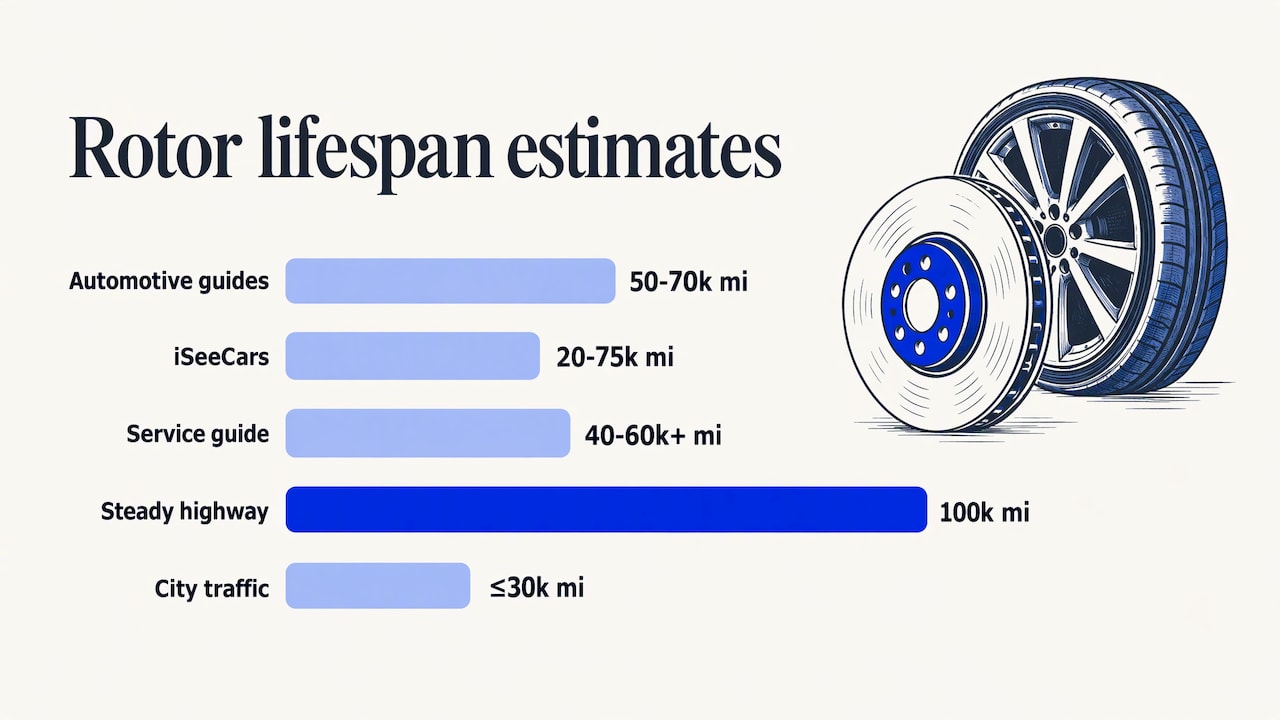
The most common answer from automotive guides is 50,000 to 70,000 miles. The Drive’s brake guide gives that range and notes that actual life depends on driving habits, road conditions and rotor quality. A wider consumer-facing estimate from iSeeCars puts pads and rotors at 20,000 to 75,000 miles depending on driving style. A parts-industry service guide says proper brake repairs should last 40,000 to 60,000-plus miles, depending on how the vehicle is driven.
That spread is the honest answer. Here is how to read it:
| Driving pattern | What to expect |
|---|---|
| Mostly steady highway miles, gentle braking | The top of the range; 100,000 miles is possible |
| Mixed commuting | The middle: roughly 50,000 to 70,000 miles |
| Stop-and-go city traffic, heavy loads, towing, hills | The low end, sometimes 30,000 miles or less |
| Winter roads with salt, or humid coastal air | Corrosion can end rotor life before friction wear does |
In years, a driver covering 12,000 miles annually would see a rotor last roughly four to six years on the middle of that range. A rideshare or delivery driver covering three times that distance may be shopping for rotors every year or two, and for that driver, a rotor’s resistance to heat cycles and corrosion pays back quickly.
Brake discs and brake rotors are the same part. Different manufacturers and countries use different names, and the lifespan guidance is identical.
Rotors versus pads: why they don’t wear at the same pace
Pads are the sacrificial part. They press against the rotor and wear down faster, so most vehicles go through two sets of pads for each set of rotors. That does not mean the second pad change is optional for the rotor: the service guidance above says rotors should be checked at every pad replacement, and in rust-belt regions sometimes serviced for rust alone.
If you want the pad side of the picture, our guides on brake pad lifespan and brake pad wear signs cover it. For rotors, the point is that a worn-out pad can wreck a rotor. When the friction material is gone, the metal backing plate scrapes the rotor surface and scores it, which shortens rotor life dramatically.
Front and rear rotors also age differently. Front brakes do most of the stopping, so front rotors normally wear out first. We explain the split in front and rear brakes: how they differ.
What shortens rotor life
Driving style and load
Hard, late braking creates heat, and heat is what warps, glazes and cracks rotors. Stop-and-go traffic multiplies the number of braking events per mile. Larger vehicles, SUVs and trucks carry more mass, and the brakes must absorb more energy at every stop. Towing and mountain descents add to the load. Gentle, early braking with plenty of following distance is the cheapest way to add miles.
Hybrids and electric vehicles are the exception that runs the other way: regenerative braking can reduce rotor and pad wear. The catch is that rotors on those vehicles can sit unused for long stretches, which is exactly when rust builds.
Moisture, humidity and road salt
A brake rotor is bare cast iron on its friction surface. Left in moisture, iron oxidizes. Overnight dew, a rainy commute or a car sitting in a humid garage is enough to put an orange film on the swept area. Salt makes it worse. Manufacturer guidance acknowledges this: a BMW service bulletin describes surface rust on exposed friction surfaces as normal when a vehicle is stationary and exposed to moisture, salt and dirt.
The film is not the problem. Repeated cycles of wet, rust, partial scrub-off, then wet again slowly roughen the surface and eat into the edges and hat (the center section that sits against the hub). A Volkswagen service bulletin lists rust and corrosion among conditions not covered under rotor warranty, which tells you how seriously manufacturers take it as a wear factor.

Salted winter roads are the toughest case. Brine clings to the underbody and wheels long after the road dries. Washing the wheels and undercarriage during winter helps, and so does protecting the car’s exterior from road salt, which reduces the amount of salty film that ends up around the brakes.
Worn pads, sticking hardware and uneven wear
If one pad wears faster than the other, or a caliper doesn’t release fully, one rotor runs hot and wears in a pattern. Our guide to uneven brake pad wear covers the causes. Calipers that stick in winter cold or summer heat are a common reason one side of the car goes through rotors faster, which is why we pair our rotors and pads with ClimateFlex calipers designed for smooth operation across temperature extremes.
Old brake fluid
Moisture does not only attack the outside. Brake fluid absorbs water over time, and aged fluid affects braking feel and hydraulic parts. Our brake fluid change interval guide covers when to replace it.
Rust on brake rotors: normal, or a warning?
This is where most drivers worry unnecessarily, and a few worry too little.
Normal: a uniform orange-brown film across the swept surface after rain, a car wash or a night outside. The BMW bulletin says it diminishes with everyday use without affecting braking performance. You may hear a light scraping or feel a mild grab on the first stop or two. Our article on why brake rotors rust after rain goes deeper on the cause.
Worth an inspection:
- Rust that does not wipe off after a day or two of normal driving
- Pitting, meaning small craters in the friction surface
- Flaking metal or a raised rusty lip on the outer edge
- Steering wheel or pedal pulsation, new noise or weaker braking
- A car that has sat for weeks, especially with rust only where the pads rest
Brake-parts service guidance says rotors with thinned cooling fins, extreme rust buildup or overheating cracks should be discarded rather than resurfaced. Corrosion also reaches the mounting side: rust between rotor and hub can hold a rotor slightly off true, which can show up as pulsation. A mechanic should clean the hub face during every rotor change.
How to clear light surface rust
For a thin film, drive normally and brake normally. Brake-care guidance advises against braking harshly just to clean the rotors; the pads usually wipe the surface after a few ordinary stops. Choose a quiet road and brake in a measured way, leaving plenty of distance.
If rust returns right away, or you feel vibration, hear grinding or notice weaker braking, normal driving will not fix it. Have the brakes inspected by a qualified mechanic, who can measure the rotor and tell you whether it is serviceable.
To keep rust from building in the first place:
- Avoid leaving the vehicle parked wet for days. Drive it, even briefly, every week.
- Rinse wheels and undercarriage after salted roads.
- Keep pads fresh, so that the swept area is cleaned on each stop.
- Choose rotors with a corrosion-resistant coating on the non-friction areas, as described below.
How to tell when a rotor is finished
Visual checks tell you something, but the deciding factor is thickness.
Minimum thickness. Every rotor has a minimum thickness figure marked on it. Below it, the rotor cannot safely dissipate heat and must be replaced. Rotor wear measurements are taken with a caliper or micrometer; the Volkswagen bulletin calls for measuring in four locations, because a rotor can wear unevenly. BMW’s service bulletin defines a general-inspection minimum as the new disc thickness minus 2.4 mm for standard discs, and says discs are always replaced in pairs per axle.
Resurfacing. Machining a rotor removes material, so the margin matters. A MINI guideline says discs at or below minimum must be replaced, and only those more than 0.5 mm above minimum should be resurfaced. In practice, a rotor that is already close to the limit when you replace pads has almost no life left to cut.
Signs you will notice while driving:
- Pulsing through the brake pedal or steering wheel
- Squealing or grinding that does not stop
- A visible lip at the rotor edge or deep grooves
- Blue or dark heat discoloration
- Pads wearing unevenly
Any pulsation or grinding is a safety matter. Have it inspected by a qualified mechanic before the next long drive.
How to make rotors last longer
- Brake early and smoothly. Less heat, less wear.
- Replace pads before the backing plate shows. Metal on metal scores the rotor.
- Fit pads and rotors that were designed to work together. Friction material and rotor surface wear in together; mismatching them can cause noise and uneven wear.
- Keep calipers moving freely. Sticking is a hidden cause of one-sided wear.
- Fight corrosion. Wash off salt, and choose a rotor with a protective coating.
- Do not carry unnecessary load, and downshift on long descents.
What we do differently
We designed our range around the weather problem. Our GEOMET-coated rotors are made for protection against corrosion from moisture and road salt, and our HydroAdaptive ceramic pads are designed for moisture management and stable friction. ClimateFlex calipers are built for smooth operation through winter cold and summer heat. Our rotors and pads are developed as a matched system, and we sell rotors only as part of brake kits with compatible pads, so the pair you install were engineered to work together. For more on coatings, see zinc coated brake rotors: how they work.
Our view: rotor life is decided by weather, not only mileage
We hear the mileage question constantly, and the honest answer is that two cars with the same odometer reading can have rotors in completely different shape. One spent its life on dry highways. The other sat in wet driveways and drove through salted slush. The second car’s rotors can be in worse condition at half the mileage.
That is why we do not treat the rotor as a standalone disc. We design the pad, rotor and caliper to deal with what weather does to each: moisture at the friction surface, salt on the metal, cold and heat at the moving parts. Our rotors and pads are developed as a matched system, and that is the reason we sell rotors only in kits with compatible pads.
If you drive in rain, humidity or winter conditions every day, a coated rotor paired with the right pad is the sensible way to buy brakes. It is built for the exact conditions that cut rotor life short.
AAA
Choosing replacement rotors for your vehicle
Our parts are matched by vehicle, so you start by selecting your make, model and year. Our SC Type rotors and GC Type rotors come in kits with our Type 03 or Type 07 HydroAdaptive ceramic pads. Complete front and rear kits are available for trucks and SUVs, such as our Honda Ridgeline kit with GC Type GEOMET-coated rotors.
If you are a mechanic, a matched kit means you fit the pad and rotor in one job without guessing at compatibility. If you are a DIY owner, it takes a decision off your list.
Ready to replace your rotors?
If your rotors are near their minimum thickness, pitted from winter salt or worn through years of wet commutes, a weather-ready kit is the practical fix. Browse AAA Frictions brake kits, pads and rotors and find the match for your vehicle.

Rotors, pads and calipers are sold individually or as complete front and rear kits, and rotors come only with compatible pads.
FAQ
How long do brake rotors last?
Most last between 30,000 and 70,000 miles, and The Drive puts the typical range at 50,000 to 70,000. Gentle highway drivers can pass 100,000 miles, while stop-and-go driving, heavy loads and salted roads shorten life. Measure thickness at each pad change.
Is rust on brake rotors bad?
A thin orange film after rain or a night parked is normal and usually disappears after a few normal stops. Pitting, flaking, rust that keeps coming back or vibration while braking calls for an inspection by a qualified mechanic.
Can I just replace the rotors without pads?
New rotors should get new pads, since old pads have worn to the shape of the old rotor surface. Rotors are also replaced in pairs on an axle. Our rotors are sold as part of kits with compatible pads for exactly that reason.
Do front and rear rotors wear out at the same time?
No. Front brakes do most of the stopping, so front rotors normally wear out first. Check both axles at every pad replacement.
Can rotors be resurfaced instead of replaced?
Sometimes, if the rotor is comfortably above minimum thickness. One manufacturer guideline allows resurfacing only when thickness is more than 0.5 mm above minimum. Rotors that are rusted, cracked or thin are replaced.
Sources
- How Long Do Car Brakes Last? (The Drive)
- What does it cost to replace brake pads and rotors? (WATE)
- Brake Rotor Service Tips (Know Your Parts)
- BMW service bulletin on brake disc surface rust (NHTSA, 2013)
- Volkswagen Technical Service Bulletin 2015173/34 (NHTSA)
- MINI brake disc resurfacing guideline SI-M34-04-16
- How to Easily Remove Rust on Brake Rotors
- Road salt protection for cars