

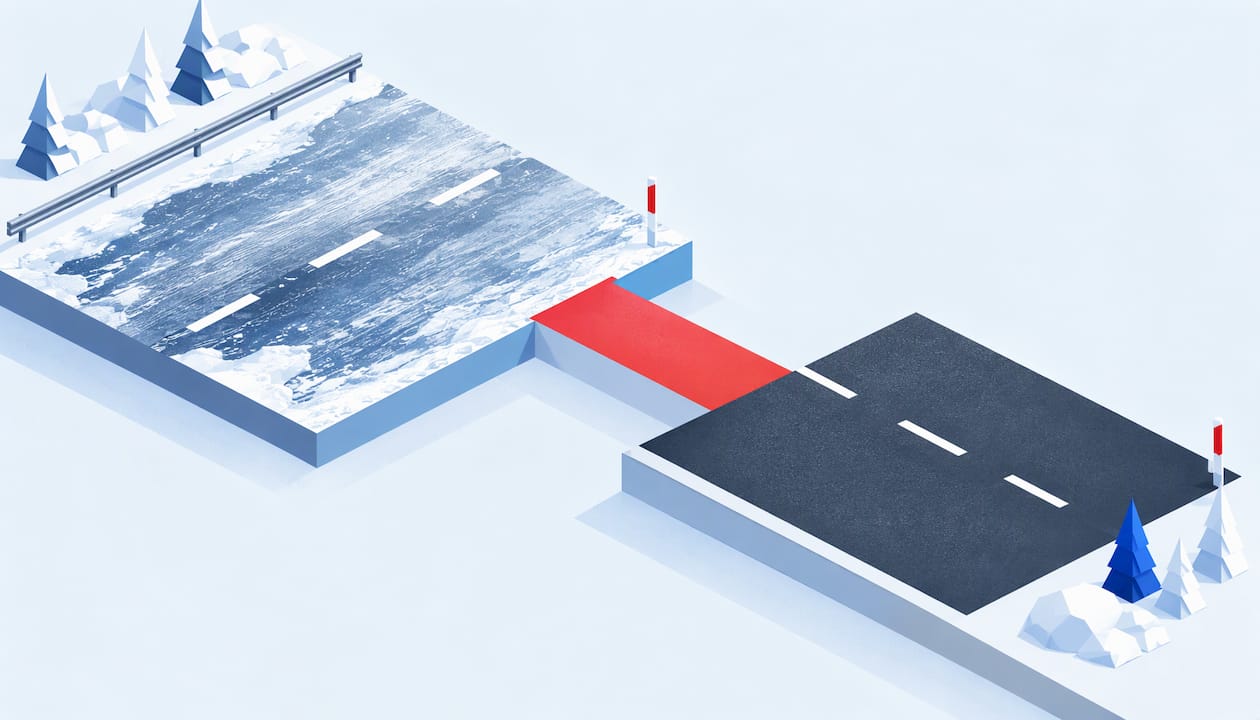
Winter brake performance comes down to two separate problems. The first is the road: snow and ice give your tires far less grip, so every stop takes longer. The second is the hardware: moisture, freezing nights and road salt act on pads, rotors and calipers week after week. You can’t change the first, but you can control the second. A braking system built to handle moisture, salt and temperature swings as one matched set is how we approach it at AAA Frictions, with HydroAdaptive pads, GEOMET-coated rotors and ClimateFlex calipers.
TL;DR
- Most of the extra stopping distance in winter comes from the road surface, not the brakes. Leave more room and brake earlier and more gently.
- Cold-morning noise and a rough first stop are usually moisture and ice on the pads and rotors, and they fade once the brakes warm up.
- Road salt is the slow threat: it corrodes rotors, seizes caliper slides and damages brake lines over weeks and months.
- With ABS, press the pedal firmly and keep the pressure steady. Don’t pump it.
- Pads, rotors and calipers designed for moisture and temperature swings keep the response predictable from the first cold stop of the day.
Table of Contents
- What actually changes when it gets cold
- Do brake pads need to warm up in winter?
- Frozen and sticking brakes: what is happening
- Road salt: the slow winter threat
- How to brake on snow and ice
- A pre-winter brake checklist
- Noises and pedal feel: normal or not?
- Why a matched system matters in winter
- Getting your brakes ready for the season
- FAQ
- Sources
What actually changes when it gets cold
It helps to separate what the road does from what the brakes do.
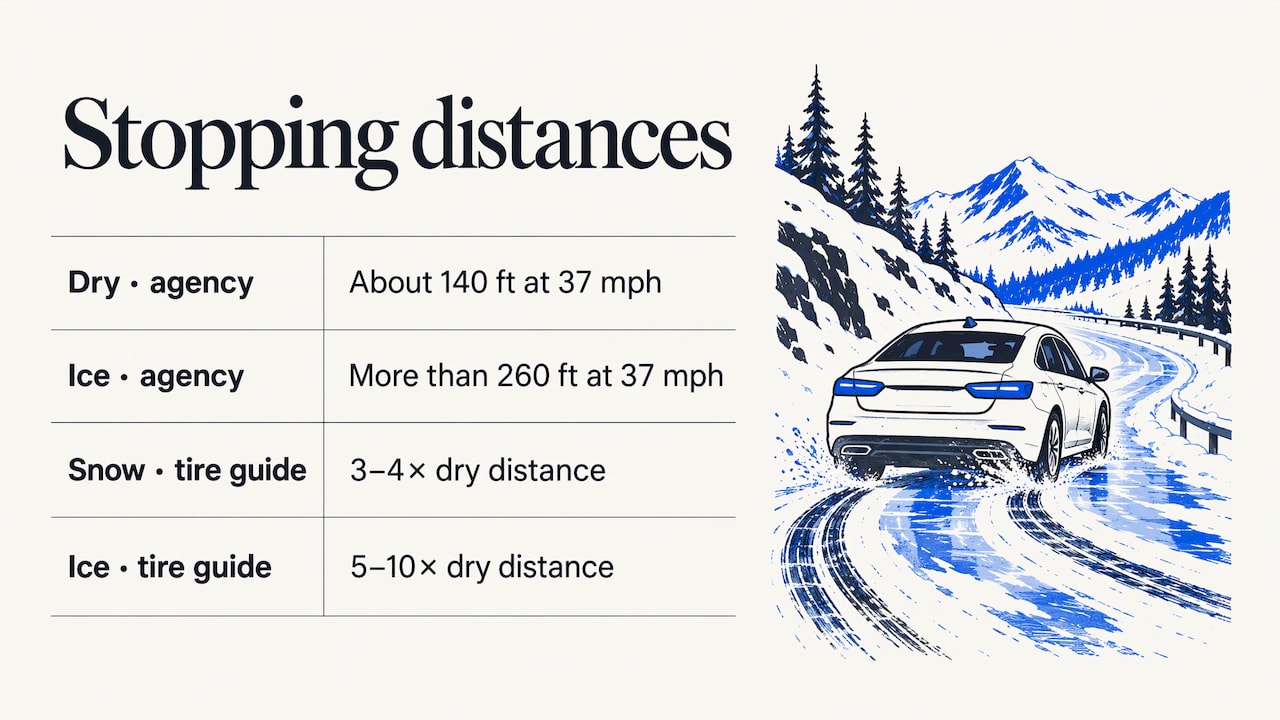
The road. Canada’s occupational safety agency states that stopping distance on an icy road is double that on a dry road: from about 140 ft at 37 mph (60 km/h) to more than 260 ft on ice. A tire maker’s braking guide puts snow at three to four times the dry distance and ice at five to ten times, and notes that ABS helps you keep control but does not necessarily shorten the stop. The numbers vary with surface, speed and tires, but the lesson is the same: your brakes can only use the grip the tires have.
The brakes. Overnight, condensation settles on rotors and pads. In freezing temperatures it can turn into a thin film of ice or surface rust. Toyota Canada explains that snow and water can get into the pads and rotors and freeze overnight below zero, causing grinding and squealing that usually clears as the brakes heat up. That matches what most drivers notice: the first stop of the morning feels rough or loud, and the second feels normal.
The salt. Toyota’s guidance also notes that road salt speeds up rusting, especially underneath the vehicle and around the wheels, which includes the brakes. Salt doesn’t fail a brake in a day. It builds up quietly, and by February the rotor surface, caliper slides and fasteners are carrying a season of it.
So winter braking is partly about technique and partly about how well your parts resist moisture, corrosion and cold. The rest of this guide covers both.
Do brake pads need to warm up in winter?
All friction materials work best inside a temperature window. Cold pads and rotors have a little less bite for the first few applications, and that is true of any pad compound. In ordinary driving, a few gentle stops in the first minutes of a trip bring the system up to temperature. Moisture is the other part of the story: a damp or frosted pad surface doesn’t grip evenly until it dries.
That second part is what our HydroAdaptive pads are designed for. They are built for moisture management and stable friction, so the response stays predictable when the surface is wet, humid or frosted. Our Type 07 and Type 03 pads are the two pad lines in the range, matched by vehicle. You can see both on the Type 07 brake pads and Type 03 brake pads pages.
A practical routine for any pad on a freezing morning:
- Pull away gently and leave extra space ahead for the first few minutes.
- Apply the brakes lightly a couple of times on a clear stretch to dry and warm the surfaces.
- Brake earlier and more smoothly than you would in summer until the pedal feels the same as it does on a normal day.
Frozen and sticking brakes: what is happening
Moisture finds its way into places that were never meant to hold water. Three spots matter most.
- Pads and rotors. Ice or rust film causes the grinding or scraping on the first stops. If it fades within a few brake applications, that is the film wearing off.
- Calipers. Water in the slides or around the piston boots can freeze and leave a caliper slow to release. Symptoms are a car that pulls to one side, a burning smell after a short drive, or uneven pad wear. Our guides on a brake caliper frozen overnight and the symptoms of a bad brake caliper walk through the signs and safe next steps.
- Parking brake. A cable that has taken on water can freeze solid. After slush and a hard frost, the car may not want to move when you release the handle. Park in a garage or covered spot when you can, since keeping ice from forming on components is simpler than thawing it.
The ClimateFlex caliper is our answer to the middle item. It is designed for smooth operation through winter cold and summer heat, so the caliper keeps releasing and applying as temperatures swing. See the ClimateFlex brake calipers page for details.
If your pedal also feels soft on cold mornings, read our guide to spongy brakes in cold weather. Brake fluid is the usual place to start. Fluid that is old and has absorbed moisture performs worse in the cold than fresh fluid, which is why it belongs on a pre-winter checklist.
Road salt: the slow winter threat
Rotors take the most visible punishment. Salty slush sits on the rotor face and hub, and the cast iron starts to pit. Pitted rotors can mean vibration through the pedal and uneven braking, and the pits are hard to get rid of once they start. Rust on a rotor after a rainy night is normal and usually wipes off in the first stop, as we explain in why brake rotors rust after rain. Winter-long salt exposure is a different matter, because the surface never fully gets a chance to recover.
That is why our rotors carry a GEOMET coating. GEOMET is a coating applied to protect against corrosion from moisture and road salt. It is part of the GC Type line, and the principle behind coated rotors is covered in our guide to zinc coated brake rotors. Our rotors are developed as a matched system with our pads, which is why rotors are sold only as part of brake kits. You can see the two rotor lines on the GC Type rotors and SC Type rotors pages.
Coated or not, a few habits cut salt damage. Rinsing the wheels, wheel wells and underbody after salted roads helps wash off the residue, and if you want more detail on what works against salt on a vehicle, this piece on road salt protection for cars covers cleaning and protection. A rinse is not an inspection, though. Salt builds up where you can’t see it, so a technician or a careful DIYer should pull a wheel and look at the rotor faces, slides, clips and brake lines at least once before and once during winter.
How to brake on snow and ice
Technique matters as much as hardware once the surface is slick. The advice from official and tire-industry sources agrees on the core points.
If your car has ABS (nearly every modern car does): NHTSA says to apply firm, continuous pressure to the brake pedal. You may feel the pedal pulse or hear a buzzing noise. That is the system working, so keep your foot down. Pumping the pedal on an ABS car can make the system disengage and lengthen the stop, as one 2026 safety article explains.
If your car has no ABS: NHTSA’s advice is to pump the brakes if the wheels start to lock. A tire maker’s tips describe the refinement: brake as hard as you can without locking the wheels, known as threshold braking.
The same tire guide adds habits that apply to everyone:
- Brake earlier and more gently than on dry roads.
- Do your braking in a straight line, before the corner, not while turning.
- Increase your following distance to 8 to 10 seconds.
- Fit winter tires marked with the Three-Peak Mountain Snowflake symbol before the first major freeze.
On glare ice the margin is smaller still. We cover that situation in braking on black ice: what to do and what to avoid.
A pre-winter brake checklist
The Canadian safety agency recommends a complete winter vehicle checkup that includes checking and adjusting the brakes so braking is equal. Here is what that looks like in practice, whether you do it yourself or hand it to a mechanic.
| Check | What you are looking for | Why it matters in winter |
|---|---|---|
| Pad thickness | Even wear, material well above the backing plate | Thin pads heat and cool unevenly and grind when moisture is present |
| Rotor faces | Smooth surface, no deep pitting or heavy edge rust | Salt pitting causes vibration and uneven braking |
| Caliper slides and pistons | Free movement, intact boots | Seized slides cause pulling and uneven pad wear |
| Brake fluid | Fresh, correct level and grade | Aged fluid holds moisture and feels worse in the cold |
| Brake lines and hoses | No external rust, cracks or seepage | Freeze-thaw cycles and salt can lead to leaks |
| Parking brake | Releases fully, cable sheath intact | Water in a cracked sheath can freeze the cable |
| Brake warning light | Off after start-up | Investigate right away if it stays on |
If you drive for a living, the cadence changes. Rideshare, delivery and frequent-travel drivers who rack up high mileage go through pads and rotors faster, and winter adds corrosion on top of wear. For you, inspecting at the start of the season and again in midwinter is a sensible rhythm.
Noises and pedal feel: normal or not?
A few things are usually harmless in the cold:
- Light grinding or squeal on the first one to three stops of a frosty morning that disappears as the brakes warm.
- A bit of surface rust sheen on the rotors after the car sits.
Things that need a look soon:
- Grinding that continues or gets louder after the brakes are warm. That can mean pads worn down to the backing plate.
- A pedal that feels spongy or sinks, or the car pulling to one side under braking.
- A burning smell after a short drive, or one wheel much hotter than the others.
- Vibration through the pedal that wasn’t there before the salt season.
- Any brake warning light that stays on.
If you notice any of these, have the brakes inspected before your next long drive. A soft pedal or a pulling car is a safety issue, so don’t wait for spring.
Why a matched system matters in winter
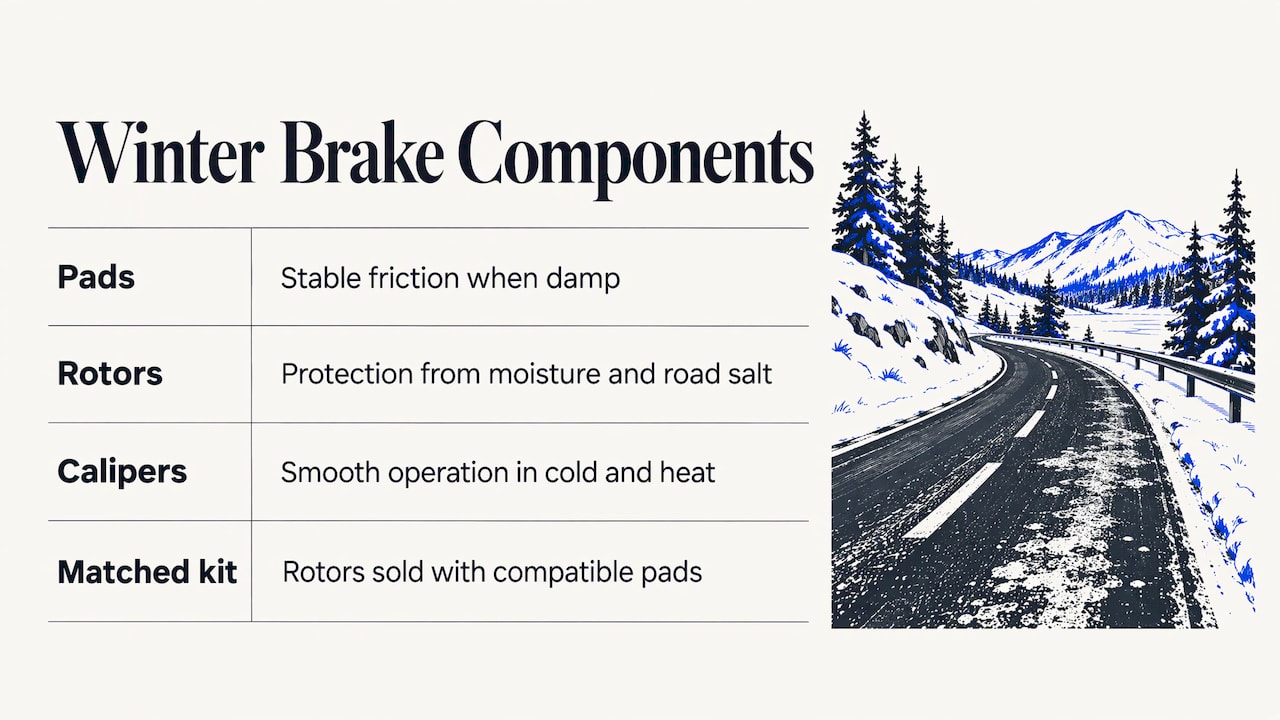
Pads, rotors and calipers each face a different winter problem, and they work as a team. A pad that handles moisture well still depends on a rotor surface that isn’t pitted. A coated rotor still depends on a caliper that releases cleanly. That is why we develop rotors and pads as a matched system and sell rotors only with compatible pads in kits matched to your vehicle.
For a DIY owner, that removes a guessing game: you order by vehicle and receive parts that were designed to work together. For a mechanic, it means one set of dependable components for the job instead of mixing pieces.
Our perspective
Weather is the one variable a braking system can never control, so we design around it. Moisture, road salt and temperature swings hit different parts in different ways: pads need stable friction when they are damp, rotors need protection against salt, and calipers need to move freely whether it is freezing or hot.
That is why our range is built as three answers to three weather problems. HydroAdaptive pads handle moisture and keep friction stable. GEOMET-coated rotors protect against corrosion from moisture and road salt. ClimateFlex calipers are designed for smooth operation through winter cold and summer heat. We develop pads and rotors together and sell rotors only with compatible pads, because a matched system is how you get predictable braking from the first stop on a cold morning to the last stop of a wet commute.
Good brakes won’t create grip that the tires and the road don’t have, so slow down and leave room. But when you do press the pedal, the response should be the same in January as in July. That is the standard we build to.
AAA
Getting your brakes ready for the season
If your pads are worn, your rotors are pitted or your calipers are slow to release, the fall is the time to replace them, before the first hard freeze and the first salt trucks. Our brake kits pair HydroAdaptive ceramic pads with coated rotors and are matched to your vehicle, so you pick your car and get the right set. Pads are also sold on their own, as are our calipers.

Browse the Type 07 brake pads or look at a complete kit, for example the front and rear brake kit for the Hyundai Santa Fe 2021-2023. To see how the three technologies fit together, read our technology page, or start from the AAA Frictions home page and search by vehicle.
FAQ
Do brakes work worse in cold weather?
Brakes need a few applications to dry and warm up, so the first stop of a freezing morning can feel rougher and louder than usual. The bigger loss comes from the road: stopping distance on ice is double that on dry pavement and can be much more on glare ice. Brake gently, early and in a straight line.
Can brakes freeze?
Yes. Moisture in pads, rotors, calipers or a parking brake cable can freeze overnight below zero and cause grinding, sticking or a car that won’t roll after you release the handle. It usually clears as the brakes warm up. Parking in a garage or covered space helps keep ice from forming.
Should I pump the brakes on ice?
Not if your car has ABS. NHTSA advises firm, continuous pressure, and the pedal pulsing under your foot is the system working. Only on a car without ABS should you pump the brakes if the wheels start to lock.
Why do my brakes squeal or grind on cold mornings?
Condensation and a thin layer of ice or surface rust on the pads and rotors cause most of it, and it fades within the first few stops. If grinding persists once the brakes are warm, or the pedal feels soft or the car pulls, get the brakes inspected before driving further.
How often should I inspect my brakes in winter?
Once before the first freeze and once in midwinter is a good rhythm, more often if you drive high mileage or on heavily salted roads. Look at pad thickness, rotor surfaces, caliper movement, brake fluid and brake lines.
Sources
- CCOHS: Driving in winter
- Continental Tires: What is braking distance
- Toyota Canada: How to keep your brakes working this winter
- NHTSA: Winter weather driving tips
- Jalopnik: Why pumping the brakes during a skid is outdated
- Michelin USA: Safe driving on ice and snow
- Road salt protection for cars