


The usual brake fluid change interval is every two years, but the number that counts is the one in your owner’s manual. Honda lists two years or 30,000 miles, whichever comes first. Nissan lists 24 months or 30,000 miles for normal driving. Kia’s schedule for one 2022 model lists 48 months or 48,000 miles. Hard use, salted winter roads and towing all shorten the interval. This guide explains where those numbers come from, how to adjust them for how you drive, and how to tell when your fluid is overdue.
TL;DR
- Two years is the common rule of thumb, and many US manuals use two to three years. Some allow up to four.
- Brake fluid ages with time, not only miles, because it absorbs moisture from the air. A car that sits still ages its fluid too.
- Severe use (towing, stop-and-go, short trips, salted roads, rideshare or delivery work) can cut the interval to 12 months in some manuals.
- Color alone does not tell you the fluid’s condition. Testing, or simply following the calendar, is more dependable.
- Use only the DOT type your manual specifies, from a sealed container.
Table of Contents
- What the manufacturers actually say
- Why brake fluid needs replacing at all
- Can brake fluid last 5 years?
- How driving conditions change the interval
- Does climate matter?
- How to tell whether your brake fluid needs changing
- Choosing the right fluid
- What to ask for at the shop
- Perspective
- When the pads and rotors are due too
- Order a matched brake kit
- A simple schedule to follow
- FAQ
- Sources
What the manufacturers actually say
There is no single industry number. Each automaker sets its own, and the figures in current US manuals cluster around two to four years.
| Source | Replacement interval |
|---|---|
| Honda owner’s manual | Every 2 years or 30,000 miles, whichever comes first |
| 2024 Nissan Versa, standard conditions | Every 30,000 miles or 24 months |
| 2024 Nissan Versa, severe conditions | Every 10,000 miles or 12 months |
| 2022 Kia, 2.0 MPI model | Inspect every 8,000 miles or 12 months; replace every 48,000 miles or 48 months |
The pattern is clear. Most schedules pair a mileage figure with a time limit and tell you to follow whichever arrives first. If you drive 6,000 miles a year, the calendar will always win. At 20,000 miles a year, mileage may.
The Kia entry also shows a useful distinction: inspection and replacement are separate line items. Checking the level and condition every year is not the same as flushing the system.

Why “every two years” became the default
Two years is simply the interval that sits comfortably inside most manufacturer schedules, and it is conservative enough to cover cars driven in humid climates. Some newer vehicles with more complex brake hardware, such as anti-lock and stability control modules, are serviced on similar or shorter schedules. If your manual gives a longer window, such as four years, you are fine following it. If you cannot find your manual, two years is a safe default to bring to a technician.
Why brake fluid needs replacing at all
Most brake fluid used on passenger cars (the glycol-based DOT 3 and DOT 4 types) is hygroscopic, meaning it draws in moisture over time. Water gets in through the rubber hoses and seals, even in a sealed system. Moisture matters for two reasons.
First, it lowers the fluid’s boiling point. Under heavy braking, calipers get hot, and fluid that has absorbed water can boil and form vapor. Motoring organization RAC in Western Australia explains that waterlogged fluid may boil under brake heat, which can cause sudden brake failure, because vapor compresses and liquid does not. The pedal can feel soft or sink.
Second, moisture promotes corrosion of internal metal parts such as caliper pistons, and of the valves inside anti-lock modules. Repairs of that kind cost far more than a fluid service, which is why the calendar interval exists.
Can brake fluid last 5 years?
It can physically remain in the car that long, but it is longer than any of the intervals above. The longest we found in a current US manual is the Kia schedule, 48 months for replacement, and that same manual lists an inspection every 12 months. Nothing in the manuals we reviewed supports stretching beyond the printed interval.
The fluid does not fail on a particular day. Its moisture content creeps up, its boiling point creeps down, and its corrosion inhibitors are used up. You may not feel any difference in normal driving. The difference shows up during a long mountain descent, a hard stop with a loaded vehicle, or after years of corrosion inside the calipers. If your car is already past four or five years on the same fluid, a replacement is a sensible thing to schedule now, and a technician can test the fluid first if you want a measurement.
How driving conditions change the interval
The printed intervals assume normal use. Manufacturers define severe use separately, and the shorter interval is often dramatic. Nissan’s 2024 Versa schedule drops from 24 months to 12 months under severe driving conditions, and the mileage falls from 30,000 to 10,000.
Kia’s 2026 EV guide spells out what counts as severe. The list includes repeated short trips under 5 miles, rough, dusty or salted roads, very cold weather, towing, commercial use and frequent stop-and-go driving. A Chevrolet maintenance schedule from India makes the same point for mountainous driving and trailer towing, with a 10,000 km or one-year limit.
That list describes a lot of ordinary US drivers:
- Rideshare and delivery drivers. Constant stop-and-go and high mileage fit the commercial and stop-and-go categories.
- Commuters with a short trip. Short hops under 5 miles never let the system fully warm up and dry out.
- Drivers in the Snow Belt. Salted roads and freezing temperatures appear on the severe list.
- Truck and SUV owners who tow. Towing is on every severe-use list we found.
If you recognize yourself in two or more of those, read the severe-use column of your manual first, not the normal one.
Does climate matter?
Moisture is the problem, so humid regions deserve extra attention. The fluid takes on water from the air regardless of how many miles you drive, which is why manuals count months. Cold climates add a different stress: road salt on the outside of the system, and cold-soaked components. Brake fluid is only one piece of the system. Pads, rotors and calipers are all exposed to the same wet, salty conditions, which we cover below.
How to tell whether your brake fluid needs changing
The most reliable method is the schedule. Beyond that, a shop can test the fluid. Common tests measure the moisture content or the boiling point of a sample, or use test strips or a meter that estimate the condition of the corrosion inhibitors. Shops differ in which method and threshold they use, so ask which one they apply and what reading triggers a replacement.
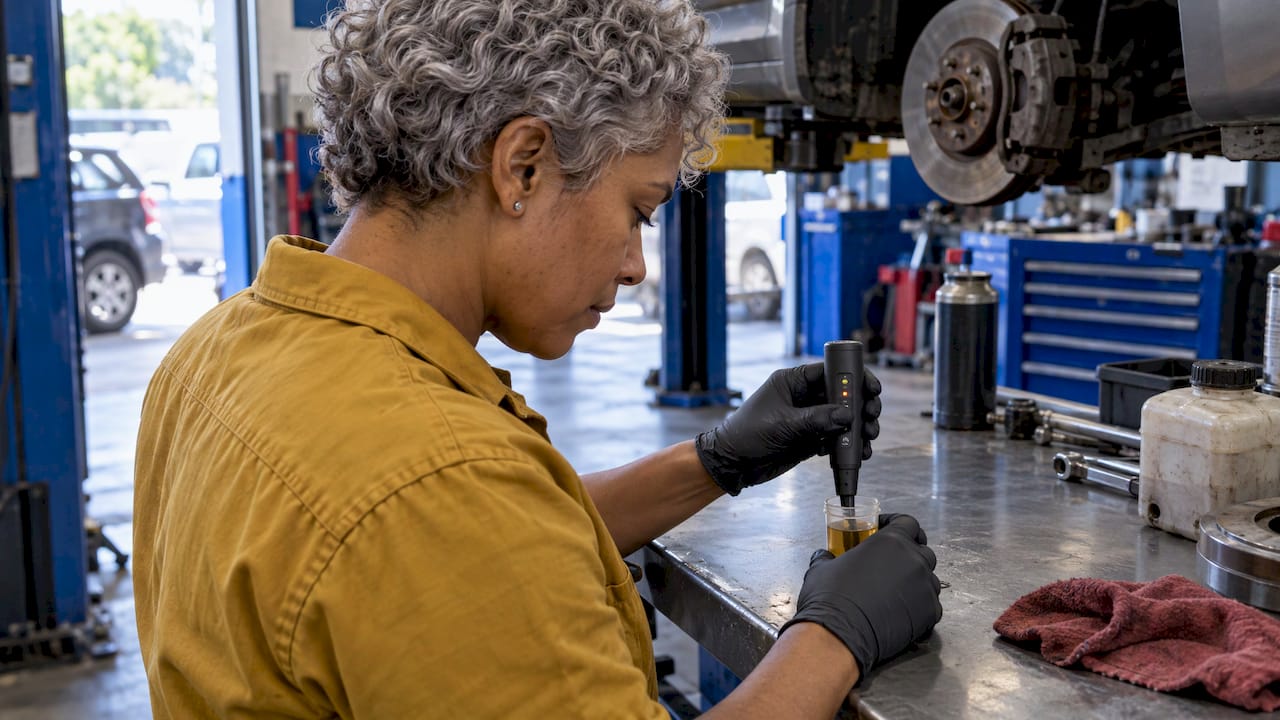
Color alone is a weak clue. Fresh fluid is typically clear to light amber and old fluid darkens, but dark fluid is not always bad and clear fluid can still hold moisture. Treat color as a prompt to get it tested, not as a verdict.
These symptoms mean you should have the brakes inspected promptly:
- A pedal that feels spongy, soft or slowly sinks
- A brake warning light on the dash
- Fluid level that is falling in the reservoir (this can point to a leak or to worn pads, and needs a professional look)
- Fluid that is very dark or has debris in it
A spongy pedal after long, hard braking is a classic sign of overheated fluid. Stop somewhere safe and let the brakes cool, then have the car checked before driving it normally.
Choosing the right fluid
Your manual or the cap on the reservoir states the type. The Honda manual, for example, specifies DOT 3 or DOT 4 from a sealed container and says DOT 5 is not compatible. That is a good rule for any car: match the specified DOT type, never use silicone-based DOT 5 in a system designed for glycol fluid, and do not use fluid from a bottle that has been open for a long time, since it has been absorbing moisture since the seal was broken.
Higher numbers do not mean better for your car. A fluid with a higher boiling point is only the right choice if the manufacturer allows it.
What to ask for at the shop
A fluid replacement should be a full exchange, not a top-up. The technician bleeds the system at each wheel until fresh fluid comes through. Ask that the service follow the manual’s procedure, that the fluid match the specification, and that the old fluid be disposed of properly. Brake fluid is a hazardous waste and should not go in household trash or drains.
DIY owners can do this with a helper or a one-person bleeding tool. If you have anti-lock brakes, check the service information for your vehicle, because some systems need a specific procedure. If you are unsure, hand it to a shop. A brake job should always leave the pedal firm.
Perspective
Fluid, pads, rotors and calipers age together.
We build brake parts around one idea: braking should feel the same on a wet commute, a salted January morning and a hot afternoon. Brake fluid is a big part of that story, because the same moisture that degrades fluid is working on every other component in the system.
That is why we treat a fluid change as the perfect moment to look at the rest of the system. The wheels are off, the calipers are accessible, and the pads and rotors are in plain view. In our experience, drivers who put in fresh fluid and leave tired hardware in place are only solving half of the problem.
Our range is designed for exactly that wet-and-cold reality. HydroAdaptive ceramic pads are designed for moisture management and stable friction. GEOMET-coated rotors are designed to protect against corrosion from moisture and road salt. ClimateFlex calipers are designed for smooth operation through winter cold and summer heat. We develop rotors and pads as a matched system, and that is why rotors are sold only as part of brake kits.
If you are already paying for labor on a fluid service, it makes sense to pair it with brakes designed for the same conditions.
AAA
When the pads and rotors are due too
A fluid service and a brake pad job often land in the same visit. If the technician measures your pads and rotors and finds them near their wear limit, or if you hear grinding, feel pulsation through the pedal, or see rust scoring on the rotor surface, it is cheaper to do everything in one appointment.
We sell pads, rotors and calipers matched to the vehicle. Our Type 07 brake pads and Type 03 brake pads are designed to hold steady friction in wet conditions, and our GC Type rotors carry a GEOMET coating intended to protect against corrosion from moisture and road salt. If you need a caliper, see our ClimateFlex brake calipers.
Order a matched brake kit
If you are replacing pads and rotors during your fluid service, a complete kit means everything is matched to your vehicle. Our kits pair HydroAdaptive ceramic pads with rotors designed to work with them, sold by vehicle year, make and model. For example, we offer a front and rear kit for the Nissan Maxima 2009-2023 and a front and rear kit for the INFINITI QX50 2019-2024.

Not sure which one fits your car? Start from the full range on our site and select your vehicle to see matching parts.
A simple schedule to follow
- Find your manual’s brake fluid line. Look for both mileage and months, and for a severe-use column.
- Pick the shorter interval if you drive hard. Towing, rideshare, delivery, short trips and salted roads all count.
- Put the date on the calendar, not the odometer. Note the month of your last service on the reservoir or in your phone.
- Inspect yearly. Check the level and the brakes’ feel, as Kia’s schedule does.
- Match the DOT type. Use the one printed on the reservoir cap or in the manual.
- Bundle the work. Do the fluid when you change pads and rotors so the system is fresh end to end.
FAQ
How often does brake fluid really need to be changed?
Follow your manual. Honda lists two years or 30,000 miles, and a Nissan schedule lists 24 months or 30,000 miles for standard use. If you drive under severe conditions, expect a shorter interval.
Is it necessary to change brake fluid every 2 years?
For many vehicles, yes, because two years is what the manual says. Some manufacturers allow longer, such as Kia’s 48 months for one model. Do not stretch past what your manual states, since moisture builds up with time whether or not you drive.
What happens if I don’t change brake fluid?
The fluid absorbs moisture, which lowers its boiling point and promotes corrosion inside the system. RAC explains that waterlogged fluid can boil under brake heat and lead to sudden brake failure. A spongy pedal or a warning light means you should have the brakes inspected right away.
Can brake fluid last 5 years?
It is not advised. The longest replacement interval we found in a current US manual is 48 months, and that manual calls for an inspection every 12 months. If yours is older than that, have it tested or replaced.
Sources
- Honda owner’s manual, brake fluid interval and DOT 3/DOT 4 specification
- Nissan 2024 Versa brake fluid service and maintenance guide
- Kia 2022 owner’s manual, maintenance schedule
- Kia 2026 EV guide, severe usage conditions
- Chevrolet scheduled maintenance services, severe conditions
- RAC Western Australia, brake fluid explained