


A light squeak or brief scrape during the first few stops of a cold or damp morning is usually normal. Moisture, a thin film of surface rust on the rotors and stiff pad material cause it, and it fades as the brakes warm up. A squeal that stays after the brakes are warm, a harsh grind, pulling or a soft pedal is different and needs an inspection. If you are replacing parts anyway, the way to cut cold-weather noise is to fit pads, rotors and calipers designed for moisture, salt and temperature swings. That is what our HydroAdaptive pads, GEOMET-coated rotors and ClimateFlex calipers are built for.
TL;DR
- A short squeak on the first stops of a cold, damp morning that disappears within a few ordinary stops is a common, normal condition.
- Noise that continues after the brakes are warm, comes from one wheel, turns into grinding, or comes with pulling, a soft pedal, a burning smell or a warning light needs a prompt inspection.
- Cold makes pad material harder, and overnight moisture forms a thin rust film on the rotors. Both explain most morning noise.
- Frozen or sticking brakes are a separate problem from squeaking. Do not force a frozen parking brake.
- For replacements in winter or variable climates, pads, coated rotors and calipers chosen as a matched set give you the most predictable braking.
Table of Contents
- Why brakes squeak when they are cold
- Normal or not: a quick way to sort the noise
- When the noise means stop and get it checked
- Why brakes can stick in cold or wet weather
- How to reduce morning squeaks without hiding a fault
- Choosing brake parts for cold weather and changing climates
- Our perspective
- Brake kits matched to your vehicle
- FAQ
- Sources
Why brakes squeak when they are cold
Three things happen at once on a cold start, and each adds a little noise.
Moisture and surface rust. Rain, snow, humidity and even overnight dew leave condensation on the rotors. Firestone Complete Auto Care explains that a thin film of surface rust builds up, and the brief scraping sound it causes typically disappears once the rotors are clean and warm. Meineke describes the same thing: the pads scrape that thin rust layer off on the first stops of the day. You do not need freezing weather for this. Damp air after a cool night is enough.
Cold, stiff pad material. Cold makes brake pads harder and less flexible, so they grip and flex less smoothly until they heat up. That is why the noise is loudest on the first drive and quiets down after a few minutes.
Ice and snow. When snow or ice sits on the pads and rotors, heat from braking melts it. Firestone notes the squeaking should subside as the ice melts and the system dries out. If the temperature dips below freezing, moisture on the brakes can also freeze overnight and cause a noisy first start.

Car makers know about this. A 2023 Nissan service bulletin filed with NHTSA, the US vehicle safety regulator, states that squeak when the brakes are cold usually occurs during the first few stops in the morning, is a normal condition and requires no service action. An earlier 2016 technical service bulletin documents front-brake squeal on the first brake application of the morning at speeds below 20 mph, temperatures below 40°F and high humidity. It also notes that rust, grooves or glazing on the rotor surface must be considered when pads are replaced.
So the rotor surface matters as much as the pad. A rotor that is rusted, grooved or glazed will keep making noise, no matter how good the new pads are. If you suspect that, our guide to glazed brake rotors shows the signs and the right fix.
What squeal actually is
Squeal is a high-frequency vibration. The pad repeatedly sticks to the rotor and slips instead of sliding smoothly, and that shakes the pad, rotor and hardware at a pitch your ear picks up. It is most common under light pressure, which is why gentle stops in a cold parking lot are the typical moment. This is also why sound alone cannot tell you the condition of your brakes. A quiet brake can still be worn, and a noisy one can be perfectly healthy.
Normal or not: a quick way to sort the noise
The most useful question is not how loud the noise is. It is whether the noise is gone once the brakes are warm. American Pride Automotive breaks cold-weather noise into four patterns, and they map neatly onto what you hear.
| What you hear | Usual cause | What to do |
|---|---|---|
| Brief squeak or light scrape that fades after a few stops | Moisture, overnight rust film, cold pad material | Normal. Note it and mention it at your next service. |
| Continuous high-pitched squeal that stays after the brakes warm | Often the pad wear indicator, a small tab that contacts the rotor when pads are thin | Have the pads measured soon. |
| Harsh metal-on-metal grinding | Friction material gone or a seized component | Stop driving and arrange a tow. |
| Pulsing pedal or buzzing during a hard stop on ice or snow | ABS (anti-lock braking system) working | Normal while it is active. |
Mavis describes a similar three-tier view. Normal is a light squeal after rain or an overnight sit that fades once warm. Worry is squealing that returns day after day or persists when warm, with causes such as glazed pads, a noisy compound, hardware that needs cleaning and lubrication, or a polished rotor face. Urgent is squeal at every stop drifting toward scraping, which means metal is touching metal.
A Nissan bulletin makes the same split. A loud, continuous squeal may be the wear indicator touching the rotor, which means the pads need replacing. For a closer look at telling worn pads from other causes, see our guide to brake pad wear signs.
A worked example
Imagine a commuter who parks outside. After a damp, 38°F night, the car squeaks lightly at the first stop sign and the first red light, then goes quiet. On the second morning the same thing happens, and again the noise is gone within two minutes. That is the normal pattern: tied to the cold start, short, and with no change in pedal feel.
Now imagine the same driver notices the squeal is still there on the highway exit forty minutes in. The brakes are warm, so moisture is no longer a good explanation. That is the point to look at pad thickness, rotor condition and hardware.
When the noise means stop and get it checked
A cold-start squeak is not a reason to park the car. These symptoms are, according to the sources above and the major automotive advice bodies:
- A squeal that continues after several stops or lasts the whole trip.
- Noise from one wheel only.
- Continuous grinding or scraping.
- Pulling to one side when you brake.
- A soft, sinking or unusually low pedal.
- A wheel that is unusually hot, a burning smell or smoke.
- A brake or ABS warning light.
The UK’s AA says grinding or scraping can mean the pad material is gone and metal is contacting the disc, and advises not driving further until the brakes have been checked. Mazda USA says grinding or a sudden loss of brake power warrants professional attention as soon as possible, and that persistent or worsening squeaking should be inspected. If you see a brake light on your dash, our page on why your brake light is on covers the common causes.
Vibration is its own clue. If the pedal pulses or the steering wheel shakes when you brake, a mobile mechanic’s explanation of steering wheel shake when braking walks through the checks a technician runs. If you are unsure whether your noise is the harmless kind, a write-up on when to stop driving and get brakes checked lays out the line between temporary noise and a real problem.
Treat any safety-critical symptom, such as a soft pedal, pulling, burning smell, smoke or a warning light, as a reason to have a qualified technician inspect the car before you keep driving. If the pedal sinks or braking power drops suddenly, stop driving and arrange a tow.
Why brakes can stick in cold or wet weather
Squealing and sticking are different. Squealing is noise. Sticking means a brake does not fully release, and the car feels sluggish, drags, pulls to one side or smells hot after a short drive.
Two things cause most cold-weather sticking.
A frozen parking brake. Moisture can collect in the parking brake cables and around the rear brakes. If the temperature falls below freezing, it can turn to ice and hold the brake on. If this happens, do not force the lever or drive hard to break it free. That can damage cables and caliper parts. Warm the car, let the ice melt and have it checked if the problem repeats. Leaving the car in Park rather than setting the parking brake on freezing nights is a common precaution, as long as you are on level ground and the car is secured.
Corrosion in the caliper. The caliper squeezes the pads onto the rotor, and it has to slide and release smoothly. Road salt, moisture and old, dried-out lubricant can make slide hardware stiff, which keeps a pad pressed lightly against the rotor. RAC lists sticking calipers and dry brake hardware among the causes of squeaky brakes. A caliper that drags tends to wear one pad faster, heat one wheel and cause pulling.
If one wheel is much hotter than the others after a drive, or the car pulls when you release the pedal, that is a safety symptom, not a cosmetic one. Have it inspected promptly. Our ClimateFlex calipers are designed for smooth operation through winter cold and summer heat, which is the specific problem a corroded or stiff caliper creates.
How to reduce morning squeaks without hiding a fault
Most of the advice that works is simple.
- Give it a few ordinary stops. Moisture-related noise usually goes away within the first few brake applications. The AAA Auto Club says moisture can form thin layers of rust on pad surfaces, and the squeak usually goes away after a few stops.
- Do not brake hard to test. American Pride Automotive advises against repeated hard braking to check the system, because it only adds wear to brakes that are working.
- Notice the pattern. Write down when it happens: only on the first stops, only after rain, only after a car wash, or all the time. A pattern that is tied to the cold start is the harmless kind.
- Check the hardware and surfaces at pad changes. Clips, shims and slide pins that are cleaned and lubricated, and rotors that are free of rust ridges and glazing, make for quieter brakes.
- Allow for bedding-in. New pads and rotors need roughly 50 to 200 miles for a uniform transfer film to form on the rotor, per Mavis. Light squeaks at low speed are expected, and humidity can exaggerate them for the first day or two. A loud, persistent squeal at every stop, harsh scraping or vibration is not part of normal bedding-in.
The point of all of this is not to silence the brakes at any price. A squeak that disappears after masking it with spray or grease on the wrong surface is still a fault. Our guide to brake pad squealing covers the fixes and the point at which to worry, and this comparison of pad and rotor noise helps you work out which one is making it.
Choosing brake parts for cold weather and changing climates
If you drive in winter or in a climate that swings between wet, cold and warm, the parts matter. The squeak is a symptom of how a pad, rotor and caliper behave when cold and wet. Here is what to look at.
Pad material. Some pad compounds are naturally noisier than others. Firestone notes that metallic pads, made with copper, iron or steel composites, are naturally noisier than other types. Tvetens Autoclinic adds that some compounds designed for heat can be louder for the first few stops. A ceramic pad is a typical choice for drivers who want quieter, steadier braking in cold and wet conditions. Our HydroAdaptive ceramic pads are designed for moisture management and stable friction. We offer them as Type 07 and Type 03 pad sets.
Rotor protection. Since overnight moisture and road salt rust the rotor surface, the rotor’s coating is part of the answer. Our GC Type rotors have a GEOMET coating that protects against corrosion from moisture and road salt, and we also make SC Type rotors.
Calipers. Sticking and uneven wear start here. ClimateFlex calipers are designed to keep operating smoothly through winter cold and summer heat.
A matched set. Rotors and pads are developed together as a system, and we sell rotors only as part of brake kits, matched to your vehicle, so the pair is engineered to work together. For a driver, that means no guessing about whether a pad suits the rotor it is meeting. Replace both pads on an axle together, and plan the rotors with them.
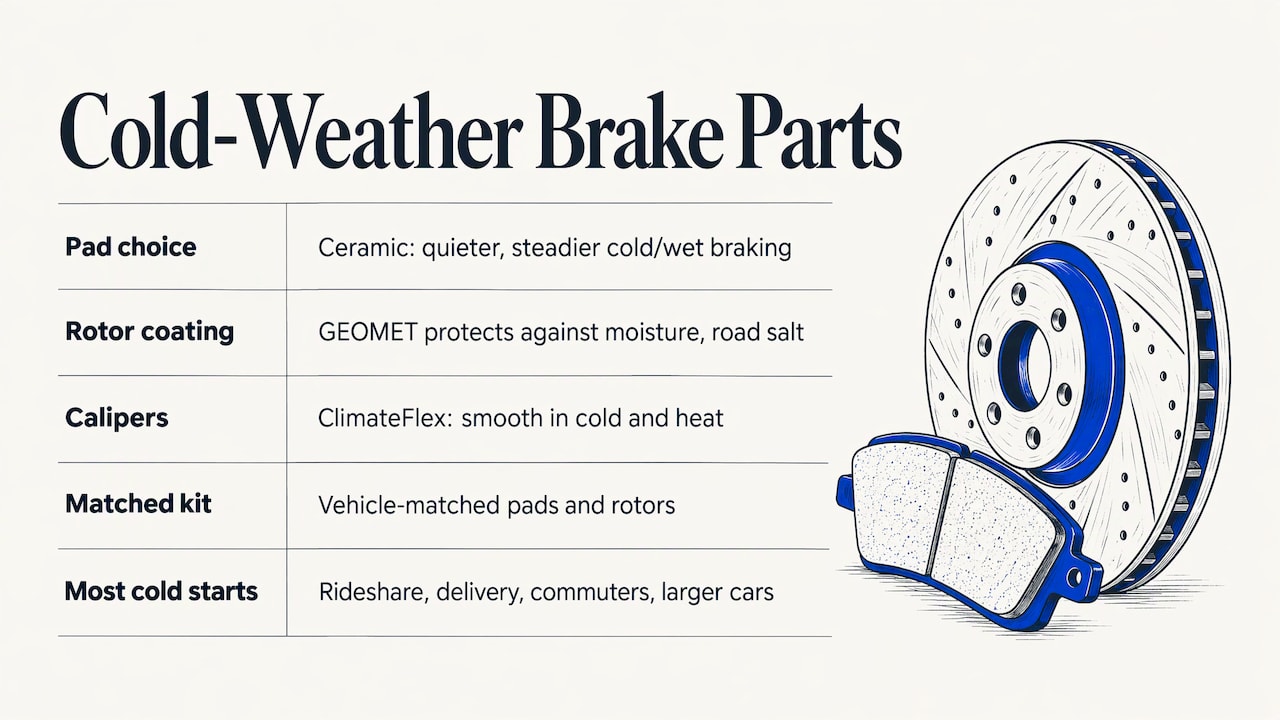
Your use. High-mileage drivers such as rideshare and delivery drivers, daily commuters and owners of larger cars and SUVs put the most cold-start stops on their brakes, so a matched, weather-focused set pays off most there. Mechanics get the same benefit: one kit, matched by vehicle, with no mixing of unrelated parts.
Our perspective
Most cold-weather brake noise is not a defect. It is what happens when metal, moisture and cold meet at the friction surface. The question is how well your braking system handles that meeting.
We design for it. Every engineering decision at AAA Frictions serves one purpose: keeping your braking consistent when the weather changes. Our HydroAdaptive pads address moisture and friction stability. Our GEOMET-coated rotors address corrosion from moisture and road salt. Our ClimateFlex calipers address operation in winter cold and summer heat. Each part takes on a different challenge the weather puts on your brakes.
That is also why we develop rotors and pads as a matched system, and why rotors come only in kits with compatible pads. Brakes work as a system, so we build and sell them as one.
The goal is a stop that feels the same on a freezing morning, a humid afternoon and a rainy commute.
AAA
Brake kits matched to your vehicle
If you have decided to replace worn pads or rotors before winter, start with a kit matched to your vehicle. Our front and rear kits pair Type 07 HydroAdaptive+ ceramic pads with GC Type GEOMET-coated rotors, for example the Subaru Outback kit, the Audi TT Quattro kit or the Scion xB kit.

To find parts for your own car, browse the AAA Frictions store and match by vehicle. Parts are sold individually or as complete front and rear kits.
FAQ
Why do my brakes squeak only on the first drive of the morning?
Overnight moisture forms a thin rust film on the rotors, and cold makes the pads harder and less flexible. The first stops scrape the film off and warm the pads, so the noise fades. Automakers describe this as a normal condition that needs no service.
Is it safe to drive with squeaky brakes?
A brief squeak on cold mornings that fades after a few stops is generally fine to drive with. Mention it at your next service. A squeal that persists once warm, grinding, a soft pedal, pulling, a burning smell or a warning light calls for an inspection, and a safety-critical symptom means stopping and arranging a tow.
Do brakes only squeak when it is freezing?
No. Damp air after a cool night is enough to cause surface rust and noise. The 2016 service bulletin above describes cases below 40°F with high humidity, which is not even freezing.
Can new brakes squeak in cold weather?
Yes. Fresh pads and rotors need a bedding-in period of roughly 50 to 200 miles, and light squeaks at low speed are expected during that time. A loud squeal at every stop, harsh scraping or vibration is not part of normal bedding-in.
What brake pads are best for cold weather?
Look for pads designed to manage moisture and keep friction stable, and fit them with rotors that resist corrosion and calipers that move freely in the cold. Our HydroAdaptive ceramic pads, GEOMET-coated rotors and ClimateFlex calipers are built around those needs.
Sources
- Nissan technical service bulletin, 2023 (NHTSA)
- Technical service bulletin, 2016 (NHTSA)
- Nissan service bulletin, 2021 (NHTSA)
- Firestone Complete Auto Care: why brakes squeak
- Meineke: why are my brakes squeaking
- American Pride Automotive: brakes squeaking in cold weather
- Mavis: what it means if your brakes are squeaking
- The AA: how to tell if your brakes need replacing
- Mazda USA: why are my brakes squeaking
- RAC Drive: squeaky brakes, causes and solutions
- AAA Auto Club: common reasons for squeaky brakes