

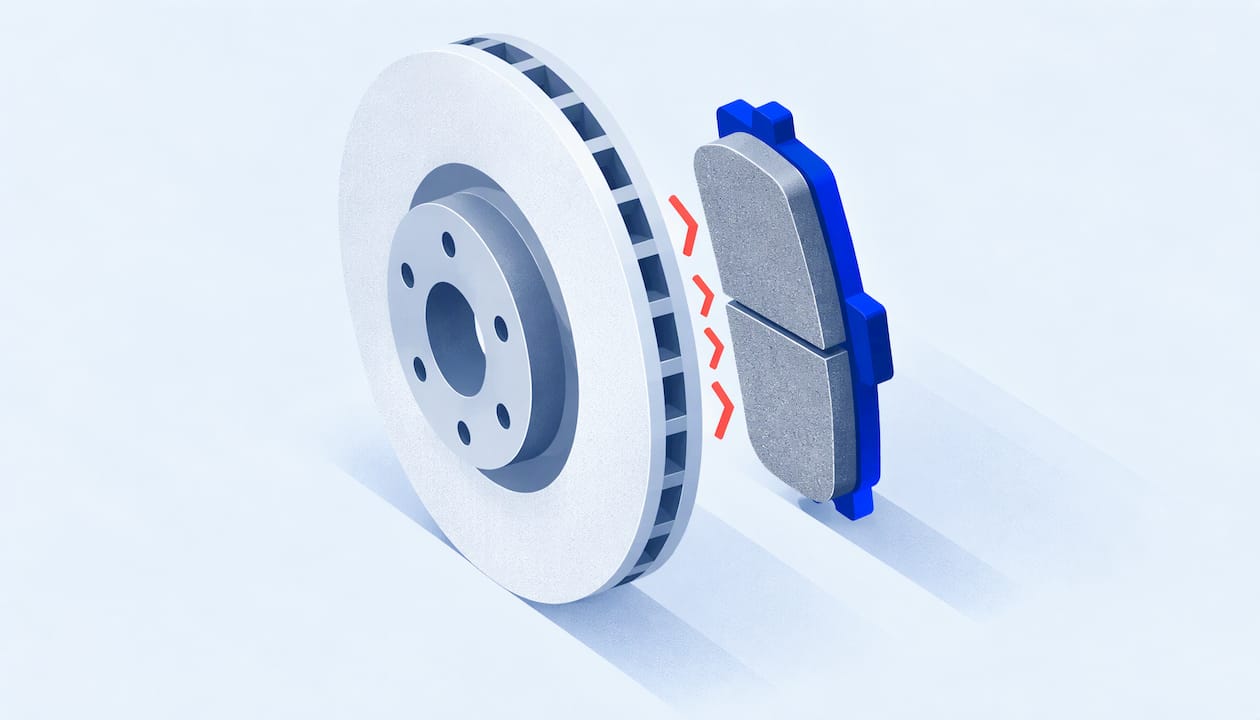
If your car shakes when you brake, the most likely cause is a brake rotor with uneven thickness, a sticking caliper or unevenly worn pads. Kelley Blue Book lists those three as the usual culprits and advises getting to a mechanic promptly, because putting off the repair is a safety risk. Where you feel the shake tells you a lot: the steering wheel points to the front, the brake pedal points to the rotors, and the whole car or your seat points to the rear or to tires and suspension. This guide shows you how to read the symptom, what you can safely check, and how to fix it so it stays fixed.
TL;DR
- A shake that appears only when you press the brake pedal almost always starts at the rotors, pads or calipers, not the engine or transmission.
- Steering wheel shake usually means the front brakes. Pedal pulsing usually means rotor thickness variation. A shake you feel in the seat usually means the rear.
- Replacing rotors alone can leave the vibration in place if the calipers, slide pins, hub surface or wheel installation are the real problem.
- Strong shaking, a soft pedal, grinding or a car that pulls hard under braking means stop driving and get help.
- Fresh pads and rotors that are engineered to work together, installed on clean hubs, are the lasting fix.
Table of Contents
- What the shake feels like and what it means
- Why rotors cause most brake shake
- Other brake causes: pads and calipers
- When it is not the brakes
- Is it safe to keep driving?
- How to diagnose it step by step
- Fixing it: resurface or replace?
- Why matched pads and rotors matter
- Get a matched kit for your vehicle
- FAQ
- Sources
What the shake feels like and what it means
Start with the sensation. It is the cheapest diagnostic tool you have, and it narrows the list quickly. A side-by-side:
| What you feel | Most likely area | Common causes |
|---|---|---|
| Steering wheel shakes when braking | Front brakes, or front suspension | Uneven front rotors, front pads, worn ball joints or tie rods, wheel bearings |
| Brake pedal pulses under your foot | Rotors | Rotor thickness variation, runout, uneven pad material on the rotor |
| Seat or whole car shudders | Rear brakes, tires, driveline | Rear rotors or drums, tire or wheel imbalance, worn suspension |
| Shake only after hard or long braking | Heat | Overheated pads and rotors, a sticking caliper |
| Shake that follows throttle, not braking | Not the brakes | Worn CV joint, driveshaft, engine mount |
This mapping matches what repair professionals report. A shop guide on braking vibration ties steering wheel shake to front rotors, suspension or wheel bearings, pedal pulse to rotor thickness variation, and a whole-vehicle shake to rear brakes, tires or suspension. An automotive technical editor puts the rule of thumb more simply: vibration in the steering wheel means front rotors, vibration in the seat means rear rotors or drums.
Why rotors cause most brake shake
A brake rotor is the steel disc that your pads clamp to slow the wheel. For smooth braking, its two faces must be flat and parallel. When they are not, the pads grab harder on the thick spots and lighter on the thin ones, many times per second. You feel that as a pulse in the pedal and a shake in the wheel.
“Warped” is usually a simplification
Most people say “warped rotors,” and the term is not wrong in effect. But in practice the problem often comes down to thickness variation, lateral runout (the rotor wobbling side to side as it spins) or uneven pad material on the surface, according to a Bellingham repair shop. The same shop warns that replacing rotors without checking the calipers, hub surfaces and installation may let the vibration come back.
Why does that matter to you? Because it changes the fix. If you cure the symptom but not the cause, you pay for the job twice.
How small the error is
The tolerances are tiny. Trade guidance from Vehicle Service Pros says braking vibration and pedal bounce point to a lateral runout issue. With the wheel off, a mechanic mounts a dial indicator, and if runout exceeds the manufacturer’s spec by roughly 0.002 to 0.003 inch, the rotor should be replaced or resurfaced. That is about the thickness of a sheet of paper, which is why you can feel a problem you cannot see.
Heat is the usual trigger
A manufacturer service bulletin filed with NHTSA names disc thickness variation as a common condition behind brake pulsation. It also states that overheated brake components can permanently damage discs and pads, and that blue-tempered or overheated discs should be replaced along with the pads.
Heat shows up in everyday driving more than people expect. A brake specialist quoted in the Los Angeles Times said almost any rotor can warp if it gets hot enough, and that lug nuts tightened unevenly can cause it too. Another expert in the same article said mountain driving, with long descents, puts braking systems through the most extreme service. That is why the shake often appears on the way down a long hill, or after you stop hard from highway speed and sit with your foot on the pedal.
Other brake causes: pads and calipers
Rotors get the blame, but they are part of a system. Two other components regularly start the problem.
Unevenly worn or glazed pads. Pads that wear unevenly, or that leave patchy material on a hot rotor, create the same uneven contact. If you are seeing a taper or one pad wearing faster than the others, our guide to uneven brake pad wear covers the causes and fixes.
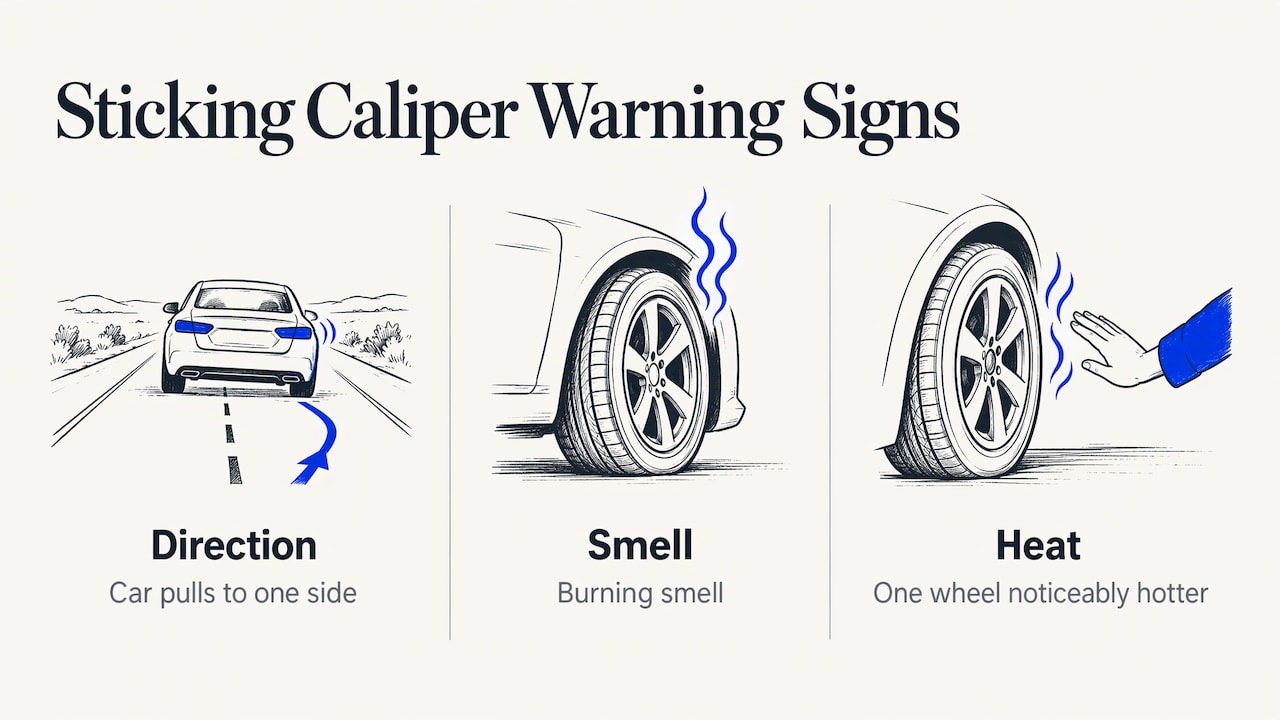
A sticking caliper or slide pin. The caliper squeezes the pads against the rotor and then must release cleanly. When a caliper or its slide pins stick, the pad drags, the rotor overheats, and the vibration appears after you have been driving for a while. Telltale signs are a car that pulls to one side, a burning smell, or one wheel noticeably hotter than the others. Rust and old grease are common reasons, which is also why caliper behavior in cold winters and hot summers matters.
If you have already traced the problem to the rear caliper, see rear brake caliper replacement for the steps, costs and pitfalls.
When it is not the brakes
Some shakes only show up when you brake because braking loads the car and exposes a weak part. NHTSA’s technical background says faulty, damaged or aftermarket suspension components such as ball joints, links, tie rods and bushings can significantly amplify vibration, and so can wheel or tire imbalance and radial runout.
The usual suspects:
- Tires and wheels. Imbalance, out-of-round tires, flat spots or bent wheels.
- Wheel bearings. Worn bearings may hum or grind, with a noise that changes with speed or when turning.
- Suspension joints. Worn ball joints, tie rods and control arm bushings let the wheel move when the brakes load it.
- Loose wheel fasteners. Improperly torqued lug nuts can also cause vibration.
What about CV joints and alignment?
Both are common questions. A bad CV joint can cause vibration, but it would not make the steering wheel shake only when you brake. A shake that appears only on the brake pedal is most likely rotors. CV shudder tends to follow throttle load rather than road speed or braking.
Alignment is an indirect cause. Poor alignment wears tires unevenly and stresses suspension parts, and that wear can become noticeable under braking. If a shake comes with a crooked steering wheel or visibly uneven tire wear, ask for an alignment check at the same visit as the brake inspection.
Is it safe to keep driving?
A mild pulse in the pedal on an otherwise normal car is a reason to book a repair this week, not to ignore it. A professional guide to Kelley Blue Book frames the delay itself as the risk. Braking performance is reduced when the rotor surface is uneven, and heat and wear tend to make it worse.
Stop driving and arrange a tow if you notice any of these:
- The brake pedal sinks toward the floor or feels spongy.
- Braking feels weak, or stopping distances are clearly longer.
- The car pulls hard to one side when you brake.
- You hear metal-on-metal grinding.
- The steering wheel shakes violently, or you do not feel in control.
If you have lost braking power before, read our guide on what to do when brakes fail so you know the steps before you need them.
A short, structured road test helps you describe the problem accurately to the person who works on your car. A test drive checklist is built for buyers, but the idea is the same: note what happens at low speed, at highway speed, on a straight road and on a hill, and when you brake gently versus hard.
How to diagnose it step by step
You can do the first stages yourself in a driveway. The measuring stages belong to a shop or an experienced DIYer with the right tools.
- Note the pattern. Steering wheel, pedal or seat? Speed range? Only after long braking? Write it down.
- Check tires and wheels. Look for uneven wear, bulges and missing wheel weights, and check the lug nut torque against your owner’s manual.
- Look at the rotors. With the wheel off, look for grooves, blue heat marks, scoring or a lip at the outer edge. Clean the wheel first so you can see the surfaces, and a brake dust removal method that keeps the dwell time short is gentle on wheel finishes.
- Check pads. Measure the remaining friction material and compare the inner and outer pad. A big difference means a sticking caliper or slide pin.
- Test the calipers and slide pins. They should move freely and release the pad. Stiff pins need cleaning and fresh high-temperature grease, or replacement.
- Measure runout and thickness. A dial indicator checks lateral runout, and a micrometer checks thickness variation at several points around the disc.
- Check suspension play. Shake the wheel top to bottom and side to side for play in bearings, ball joints and tie rods.
The measuring step is the one most guesswork skips. As noted above, replacing parts before you know the cause is how the shake returns.
Fixing it: resurface or replace?
The repair depends on what you find.
- Rotors slightly out of spec: resurfacing on a lathe can work if there is enough thickness left above the minimum stamped on the rotor.
- Rotors near or below minimum thickness, scored, or blue from heat: replace them, together with the pads.
- Sticking calipers or slide pins: clean and lubricate the pins, or replace the caliper if it will not release.
- Worn pads: replace them as an axle set so left and right wear stay matched.
- Suspension or bearing play: repair that first, otherwise new brakes will still shake.
Resurfacing is a stopgap on many rotors. New rotors paired with new pads give you a clean, flat starting point on both friction surfaces. If you are weighing the labor and parts, our breakdown of what replacing brake pads and rotors costs explains how the price is built up and what a fair quote looks like.
Do the installation details right
These details decide whether the vibration comes back:
- Clean the hub face of rust and scale so the rotor sits flat. Rust there creates runout even with a brand-new rotor.
- Tighten lug nuts in a star pattern to the torque in your owner’s manual. Uneven tightening can distort the rotor.
- Follow the pad break-in procedure so material transfers evenly to the rotor.
- Avoid holding the pedal down firmly at a standstill right after a hard, hot stop. Pad material can imprint on the hot disc.
Why matched pads and rotors matter
Pads and rotors wear together. A pad that is not suited to the rotor surface can leave uneven deposits, and a rotor that corrodes unevenly gives the pad an uneven surface to grip. This is a particular problem if you drive in rain, humidity, snow or on salted roads.
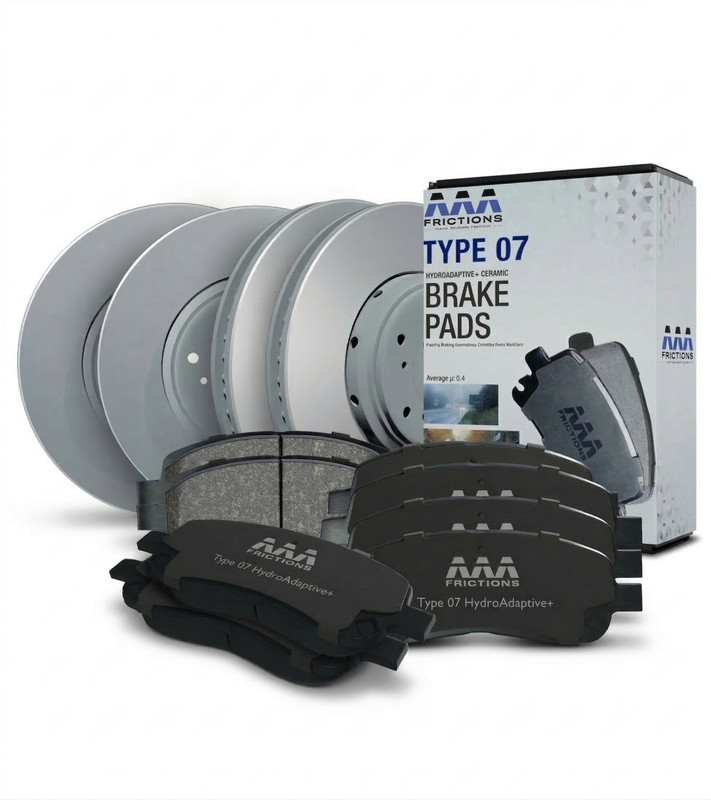
That is the thinking behind our range. Our HydroAdaptive ceramic pads are designed for moisture management and stable friction. Our GEOMET-coated rotors are designed to protect against corrosion from moisture and road salt. Our ClimateFlex calipers are designed for smooth operation through winter cold and summer heat. We develop rotors and pads as a matched system, which is why we sell rotors only as part of brake kits with compatible pads, and why parts are matched to your vehicle.
If you are comparing pad materials, see ceramic versus semi-metallic brake pads. If you are wondering about rotor styles, do drilled and slotted rotors make a difference covers it.
Our view: treat the brake as a system
Most brake shake complaints we hear about are described as a rotor problem. We see it a little differently: the rotor is often where the problem shows up, not where it starts. Moisture, road salt, heat cycles and a caliper that does not release cleanly all work on the same surface the pad has to grip.
That is why we build pads, rotors and calipers around the weather your car actually drives in. HydroAdaptive pads are designed to keep friction stable in wet conditions. GEOMET-coated rotors are designed to resist the corrosion that moisture and road salt cause. ClimateFlex calipers are designed to move smoothly in the cold of a January morning and the heat of a July traffic jam.
It is also why rotors are only sold in kits with compatible pads. If you are replacing parts because of a shake, you want the new surfaces to start as a matched pair. Our goal is predictable braking in any weather.
AAA
Get a matched kit for your vehicle
If your inspection confirms worn pads or rotors, replacing them as a set gives you a flat, matched starting point. Our brake kits pair HydroAdaptive ceramic pads with GEOMET-coated GC Type rotors and are matched to your vehicle. You can see the GC Type rotors or browse all-weather brake kits by vehicle.
Whether you are a daily commuter, a rideshare or delivery driver putting on high mileage, or a DIYer doing your own brakes, the principle is the same: fix the cause, then install parts that are designed to work together.
FAQ
Why does my steering wheel shake when I brake downhill?
Long descents build heat in the brakes, and hot rotors with uneven thickness or runout produce a pulse that you feel in the wheel. Experts quoted in the Los Angeles Times tie that downhill shimmy to the rotors. Use a lower gear on long grades so the engine shares the work, and have the brakes inspected if it keeps happening.
How much does it cost to fix shaking brakes?
It depends on the cause: pads, rotors, calipers or a suspension part each cost differently, and prices vary by vehicle and region. Our guide to pad and rotor replacement costs explains what goes into a quote. Ask for a written estimate that lists the measurements behind the diagnosis.
Can a bad CV joint cause shaking when I brake?
A worn CV joint can cause vibration, but it would not make the steering wheel shake only when the brakes are applied, according to HowStuffWorks. CV shudder follows throttle load. If the shake appears only when you press the brake pedal, start with the rotors.
Can wheel alignment cause vibration when braking?
Not directly, in most cases. Poor alignment wears tires unevenly and stresses suspension parts, and that wear can then show up as vibration under braking. If your tires wear on one edge or the car drifts, get the alignment checked along with the brakes.
Is it safe to drive with shaking brakes?
A mild pulse means you should have the brakes inspected soon, and avoid long or steep descents until you do. A soft pedal, grinding, hard pulling or violent shaking means stop driving and get a tow. Delaying the repair is a safety risk, as Kelley Blue Book notes.
Sources
- Why Does My Car Shake When I Brake? Kelley Blue Book
- Technical Background, NHTSA service bulletin
- Blame that shimmy on a warped brake rotor, Los Angeles Times
- Detecting noise, vibration and harshness, Vehicle Service Pros
- Why Does Your Steering Wheel Shake When Braking? HowStuffWorks
- Car Shakes When Braking, Bellingham
- Why Does My Car Shake When Braking? Causes and Fixes
- Use Your Senses: Sense of Touch, AllData
- Remove brake dust safely
- Test drive checklist