

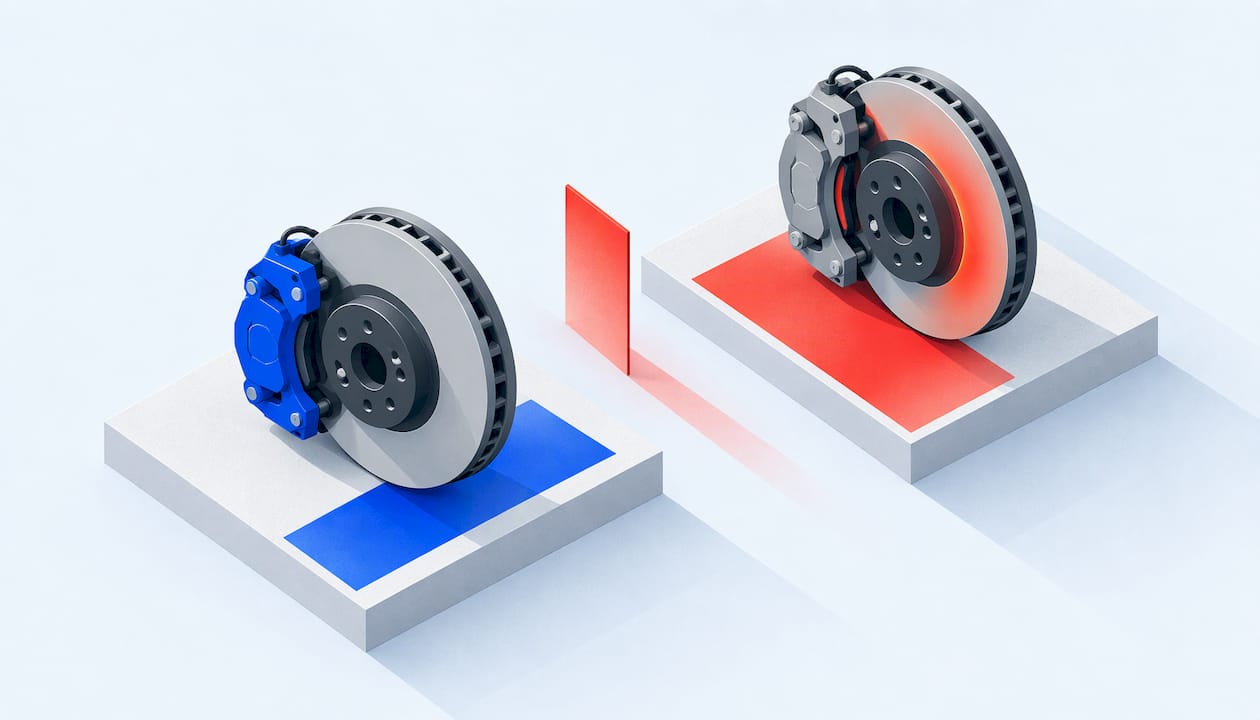
Every caliper gets hot when you brake, because braking turns motion into heat. A caliper that stays hot after you stop, or one that is much hotter than the same part on the other side of the car, is a different matter: it usually means the caliper is not releasing. The pattern matters more than the number. Two or three hot wheels after a long descent are normal. One hot wheel after an easy commute is a fault. Our ClimateFlex calipers are built for smooth operation through winter cold and summer heat, which is the conditions where release problems tend to start.
TL;DR
- Normal braking heat is expected and fades as the brakes cool. Heat that stays at one wheel points to a caliper that is not letting go.
- Calipers run cooler than rotors because the pads insulate the caliper body. Street driving keeps them in a moderate range, and long descents, towing and heavy loads push them much higher.
- The usual culprits are a sticking piston, seized slide pins, a swollen brake hose or old, moisture-laden brake fluid. Road salt and moisture speed up every one of them.
- Stop and let the brakes cool if you smell burning or see smoke. Do not keep driving on a caliper that is dragging.
- Replacing a worn caliper with one made for cold and heat cycles, together with a matched pad and rotor set, removes the most common sources of drag.
Table of Contents
- Why calipers get hot in the first place
- How hot is too hot
- Front or rear: which runs hotter
- What makes a caliper overheat
- Normal heat or a fault: the simple test
- What to do when brakes are overheating
- How to keep calipers from running hot in the first place
- Perspective
- Replacing the caliper, and the parts around it
- Ready to fix it for good
- FAQ
- Sources
Why calipers get hot in the first place
A brake pad pressed against a spinning rotor creates friction, and friction creates heat. Most of that heat goes into the rotor and the pad. The caliper, the housing that holds the pads and the hydraulic piston, picks up its share through the piston and brake fluid and by radiation from the rotor.
The pads act as a thermal barrier between the rotor and the caliper body. One technical guide on caliper finishes puts the caliper body 100 to 200°C cooler than the rotor for that reason. The same guide gives about 100 to 200°C as the typical range for calipers on street-driven cars, 250 to 350°C for spirited mountain driving, towing or occasional track use, and 400°C or more on dedicated track cars.
Those are guide figures, not limits stamped on your car. The point is the shape: heat builds when you brake hard and often, and it should drain away when you stop or ease off. If it does not drain away, something is holding the pad against the rotor.
How hot is too hot
For pads and rotors, Jalopnik reports roughly 250 to 300°F (121 to 149°C) in normal driving. Riding the brakes down a long hill or driving aggressively can push braking temperatures to 600 to 700°F (315 to 371°C), enough to crystallize or glaze pad material.
The temperature of the caliper matters for a different reason: what is inside it. The piston seal, the dust boot and the brake fluid are the parts that suffer.
Brake fluid is the real limit
Brake fluid is the hydraulic link between your foot and the caliper, and it has a boiling point. A Chalmers University of Technology report on brake temperature modelling notes that DOT 3 and DOT 4 fluids start with dry boiling points of 205°C and 230°C. After a few years of absorbing moisture, their wet boiling points fall to about 140°C and 155°C.
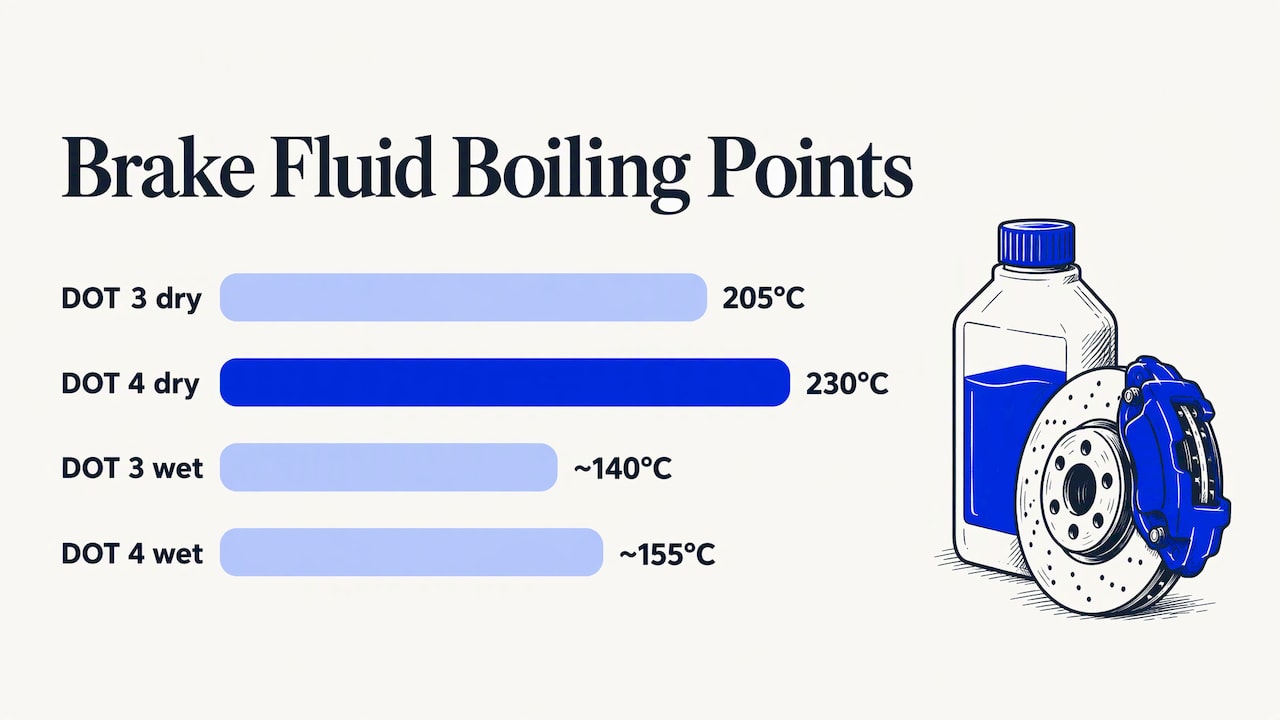
That is why a caliper that is merely hot can still become a problem. Fluid that has aged and absorbed water can vaporize near a hot caliper, and vapor compresses where fluid does not. The pedal then feels soft or sinks. Our guide to brake fade and why hot brakes lose stopping power covers what that feels like and how it differs from a mechanical fault.
A rough reading guide
| Situation | What to expect | What it means |
|---|---|---|
| Easy commuting, gentle stops | Wheels warm, all four fairly similar | Normal |
| Long downhill, towing, loaded vehicle | Wheels very hot, all of them, smell possible | Normal heavy use. Let the brakes cool and ease off the pedal next time |
| One wheel clearly hotter after ordinary driving | A big gap between sides of the car | Probable sticking caliper, slide pin or hose |
| Smoke from one wheel | Heavy smoke from a single front wheel | Stop. The Car Buzz calls this almost always a stuck caliper |
The Car Buzz adds that healthy rotors hover around 200 to 300°C in heavy braking, while a seized caliper can push temperatures past 550°C. At that level fluid can boil, a rotor can warp and grease in the wheel hub can ignite.
Front or rear: which runs hotter
The front brakes do most of the stopping, because weight shifts forward when you brake. So the fronts normally run hotter than the rears. A 2020 simulation of a passenger car found rotor temperatures rising with vehicle load, with maximum values of 201°C at the front and 188°C at the rear.
What matters is left against right on the same axle. Front-to-rear differences are built into the car. A left-to-right difference on one axle is not.
What makes a caliper overheat
A caliper runs too hot when something keeps it applied or slows its release. Almost every cause comes down to a part that should move freely and no longer does.
A sticking piston
The piston pushes the pad into the rotor and then retracts slightly when you lift your foot. Brake & Frontend, in an article by an ASE-certified technician, explains that a torn piston boot can admit dirt and moisture. Corrosion can then make the piston stick in the applied position, which shows up as excessive or uneven pad wear.
Seized slide pins
Most passenger cars use a floating caliper that slides on guide pins. If those pins corrode or dry out, the caliper cannot center itself and one pad keeps dragging on the rotor. The same article notes that road salt can seize floating-caliper guide pins. That is why winter driving and salted roads are the usual setting for this fault.
Pads stuck or jammed
Haynes lists three ways a brake stays applied: a sticking piston, pads stuck to the disc and seized slide pins. It also says a car left unused for long periods is a common trigger, and corrosion can build up in exposed brake parts. Hardware that jams a pad in its bracket gives the same result.
A collapsed brake hose
A flexible brake hose can fail from the inside. It lets pressure through when you press the pedal but does not let it back out, so the caliper stays clamped. If one wheel runs hot and you have already found the pins and piston free, inspect the brake hose.
Old fluid
Fluid that has absorbed moisture corrodes from the inside and can form sludge that impairs piston movement. The fluid itself is also what carries the heat, which ties back to the boiling points above.
Parking brake drag
On many cars with rear disc brakes, the parking brake acts on the rear caliper or a small drum inside the rotor. If the cable or mechanism does not fully release, that wheel drags and heats up. Check this first when the hot wheel is at the rear.
Not a brake problem at all
A failing wheel bearing creates heat at the hub and can feel like a brake fault. If the brake parts turn out to be free and the hub is still hot, have the bearing checked.
Normal heat or a fault: the simple test
The logic is straightforward. Normal friction heat is expected and fades as the brakes cool. Abnormal heat points to a release problem, and a pattern of one wheel hotter than its partner tells you more than a burning smell alone.
What to notice while driving
- The car pulls to one side, or the steering wheel drifts when you lift off the brakes.
- The car feels like it is dragging, with weaker acceleration or lower fuel economy than usual.
- A sharp, acrid burning smell after a normal drive. A chemical or oily smell can mean fluid or grease has reached hot metal.
- Pads worn much more on one side of one wheel than the other.
What to check once you have parked
Park the car and wait a few minutes before you touch anything, as a hot wheel can burn you. Then wait until the wheels are cool enough to check safely.
- Drive a normal, gentle route. Ten or fifteen minutes without hard braking gives a fair comparison.
- Compare left and right. A non-contact infrared thermometer pointed at each rotor face and caliper gives numbers you can compare. A large gap between the two fronts or the two rears is the clue. If you do not have one, hold your hand near, not on, each wheel.
- Look at the wheel. Brake dust on the rim can hide rust streaks and fluid leaks, so it helps to remove brake dust safely before you look at the caliper and the area around the piston boot.
- Check the pad wear. When you have the wheel off, look for one pad worn much lower than the other. The signs of a bad brake caliper are worth reading alongside this check.
- Spin the wheel by hand with the car safely supported. A wheel that is stiff and drags compared with its twin has a release problem.
Blue or dark discoloration on a rotor, and a glassy shine on pads, are signs the brake has already been overheated. Our page on glazed brake rotors explains what to do about it.
What to do when brakes are overheating
If you smell burning or see smoke: pull over somewhere safe and stop. Do not park with the parking brake on over a hot rear brake. Leave the car and let the wheels cool for a good while. Do not spray cold water on hot rotors or calipers: sudden, uneven cooling is hard on the metal.
If the heat comes from a long descent: shift to a lower gear so the engine does the holding, and use short firm brake applications rather than constant light pressure. Riding the brake keeps heat building continuously, which is the way to cook pads and fluid.
If one wheel is hot again after cooling: do not keep driving on it, and do not wait for the smell to get worse. A dragging caliper wears pads and rotor fast, can overheat a wheel bearing and, in the worst cases, boils fluid and weakens the brake you need most. Have the car inspected by a qualified technician if you are not set up to take the wheel off yourself. For smoke, a pedal that sinks, or a hot wheel you cannot explain, call roadside assistance rather than driving on.
When the cause is a worn-out caliper, the fix is a new one, not more grease on an old part. Seals and pistons that have spent years in salt and moisture rarely recover.
How to keep calipers from running hot in the first place
Most heat problems are slow corrosion problems. These habits keep the caliper moving freely.
- Replace brake fluid on the interval in your owner’s manual. Because fluid absorbs moisture, its boiling point drops with age, as the Chalmers figures above show.
- Service the slide pins whenever you change pads. Clean, inspect and re-lubricate with a brake-rated lubricant, and replace any that are rusted or scored.
- Replace torn dust boots and old hoses early. A cheap rubber part is how dirt and water get into a piston bore.
- Drive the car. Vehicles that sit for weeks are prone to stuck pads and seized pins, as the Haynes guide points out.
- Match your parts. Pads and rotors that are made to work together wear evenly and shed heat in a predictable way. Our guide to how long brake rotors last shows what shortens their life.
- Use the engine on long descents, especially if you tow or carry a load.
If you drive in a region with snow and road salt, or in damp, humid weather, the hardware does the most work against corrosion. That is the case for parts designed around weather rather than a dry-road average.
Perspective
Brakes fail in ways that look like heat problems but start as weather problems. Salt, slush and humidity get into the places where a caliper is meant to slide, and a slide that no longer slides is how most one-wheel heat begins.
That is why we do not design a pad, a rotor and a caliper as three separate parts. Our HydroAdaptive pads are engineered to manage moisture and keep friction stable. Our GEOMET-coated rotors are built to protect against corrosion from moisture and road salt. Our ClimateFlex calipers are designed for smooth operation through winter cold and summer heat. Each one answers a different challenge that weather puts on the braking system, and together they aim at one thing: braking that stays consistent when the weather changes.
We develop rotors and pads as a matched system, and that is also why rotors are sold only as part of brake kits with compatible pads. A caliper that releases cleanly, a pad that works with the rotor it sits against and a surface that does not rust in a week of salt: that is the setup that gives heat somewhere to go and keeps it from staying where it should not.
AAA
Replacing the caliper, and the parts around it
A hot caliper is rarely only a caliper problem. If a stuck piston has dragged a pad for weeks, the pad and rotor on that wheel are usually worn unevenly or glazed, and replacing the caliper alone leaves a worn pair to be run against a fresh part.
Our ClimateFlex brake calipers are made for smooth operation in cold winters and hot summers. For the surfaces around them, we offer Type 07 brake pads and Type 03 brake pads, and GC Type GEOMET-coated rotors for protection against salt and moisture. Rotors come as part of a brake kit, with pads matched to them, and parts are chosen by vehicle. If you are not sure which pad compound suits your driving, read our comparison of ceramic and semi-metallic brake pads.
To see what to budget for the whole job, our guide to what replacing pads and rotors costs lays it out.
Ready to fix it for good
When one wheel runs hot, you want the repair to last through the next winter, not only to the next stop light. We make HydroAdaptive ceramic pads, GEOMET-coated rotors and ClimateFlex calipers for drivers who deal with rain, humidity, snow and swings in temperature, sold as single parts or as complete front and rear kits.
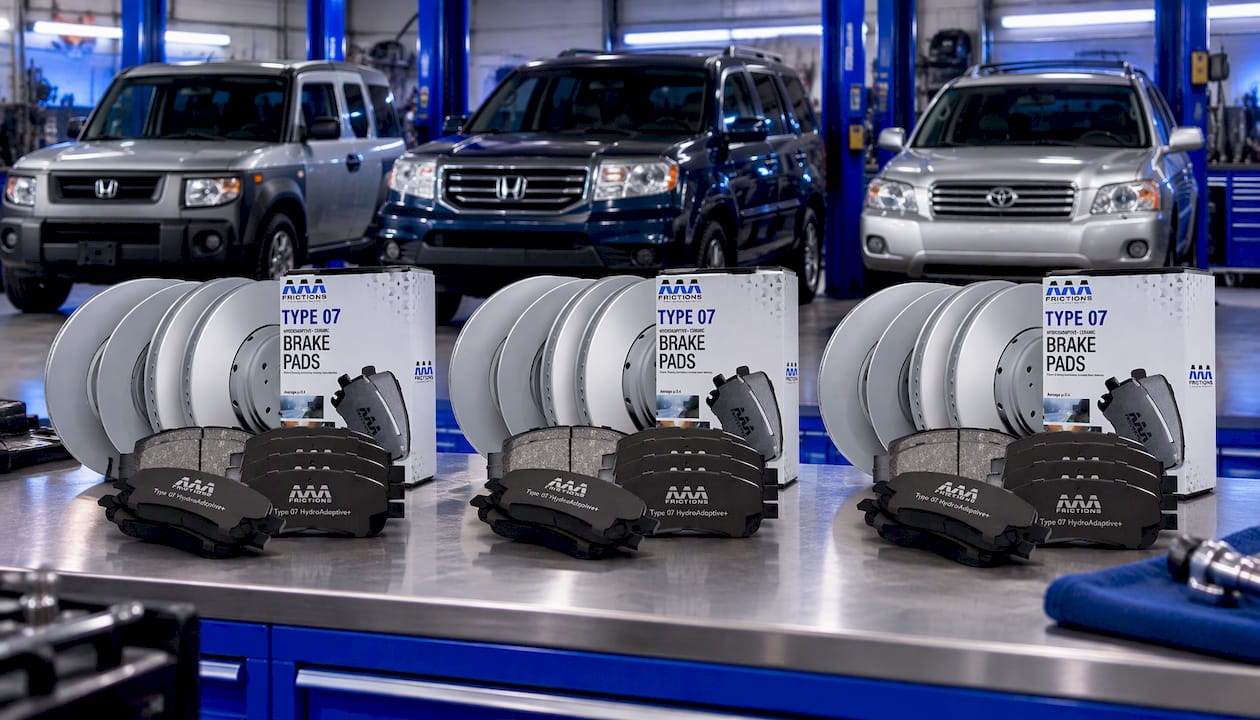
Pick your vehicle on aaafrictions.com to see the parts matched to it. Kits such as the Honda Pilot 2003 to 2008 front and rear brake kit pair Type 07 HydroAdaptive+ ceramic pads with GC Type GEOMET-coated rotors.
FAQ
What causes a brake caliper to heat up?
Friction between the pad and the rotor creates normal heat, and it fades when you stop braking. Abnormal heat comes from a caliper that holds the pad against the rotor: a sticking piston, seized slide pins, a collapsed brake hose, or a parking brake that does not release. Long downhill braking, towing and heavy loads also raise heat, and old fluid lowers the temperature at which trouble starts.
How hot do brake calipers actually get?
On street-driven cars, one technical guide puts caliper bodies at roughly 100 to 200°C, about 212 to 392°F. Spirited mountain driving, towing and track use can push them to 250 to 350°C. Because the pads insulate the caliper, it runs well below the rotor temperature. Those are typical ranges, not limits, so compare your wheels with each other rather than to a single number.
How hot is too hot for rotors?
Jalopnik reports normal driving keeps pads and rotors around 250 to 300°F, while riding the brakes down a hill can send them to 600 to 700°F, which is enough to glaze pads. A rotor that runs far hotter than its partner on the other side of the car points to a dragging brake even if the absolute number looks ordinary.
Do front or rear brakes get hotter?
The front brakes normally run hotter, because braking shifts weight forward and the fronts do most of the work. A simulation of a passenger car found maximum rotor temperatures of 201°C at the front and 188°C at the rear. The gap between left and right on the same axle is the number that signals a fault.
Can I keep driving with an overheating caliper?
No. A dragging caliper keeps heating, which wears the pad and rotor, can boil brake fluid and can damage the wheel bearing and tire. If you smell burning or see smoke, stop safely and let the wheels cool. Have a qualified technician inspect the car, or call roadside assistance if the pedal feels soft.
Sources
- Can You Powder Coat Brake Calipers? Guide
- What Causes Brakes To Overheat (And What To Do When It Happens), Jalopnik
- Why Are My Brakes Smoking? Normal vs. Dangerous, The Car Buzz
- Report Release 1609, Chalmers University of Technology
- Study the brake performance of a passenger car, AIP Conference Proceedings
- Caliper Science Friction, Brake & Frontend
- Seized brake caliper: How to fix it, Haynes Manuals
- Remove brake dust safely