


A glazed rotor is one whose friction surface has turned smooth and shiny, usually because heat has baked pad material onto it. The result is less bite, a squeal at low speed and sometimes a vibration. Light glazing can be cleaned up. Deep glazing, grooves, lips or heat discoloration usually mean the pads and rotors should be replaced together, as a matched set, which is the approach we build our kits around.
Below you will find how to recognize glazing, how it differs from ordinary wear, what causes it, and how to decide between deglazing, resurfacing and replacement.
TL;DR
- Glazing is a hard, glossy film on the pad or rotor face. It cuts friction and often shows up as squealing, a longer stop or a hot, burning smell.
- It comes from overheating, light-footed or slow-speed driving, poor bedding-in, and contamination such as road salt and grime.
- Light glazing can be sanded or honed off with the pads. Grooves, heavy lips, bluish heat marks or cracks call for replacement.
- Soft pedal, pulling, exposed pad backing plates or cracks are stop-driving signs. Get the car inspected before you drive on.
- When you replace, fit pads and rotors together so the new surfaces wear in as a pair.
Table of Contents
- What glazed brake rotors are, and how they differ from normal ones
- What glazed rotors look like and sound like
- Glazed brake pad symptoms you can feel while driving
- What causes glazing
- Glazing versus other rotor wear: a quick comparison
- How to tell if your rotors are worn out
- Can you fix glazed brake pads and rotors?
- Should glazed rotors be replaced or resurfaced?
- Replacing glazed brakes with a matched set
- Our view: a glazed rotor is a system problem
- After you fix it: confirm the brakes are safe
- Preventing glazing next time
- FAQ
- Sources
What glazed brake rotors are, and how they differ from normal ones
Brakes work by pressing a pad against a spinning rotor. A healthy rotor face has a fine, slightly gritty, matte texture that grips the pad. Pad material also transfers onto the rotor in a thin, even film, and that film is part of how the system works. A Subaru service bulletin explains that changing rotors for certain brake-noise concerns removes the pad-film transfer, which tells you that some transfer is normal.
Glazing is what happens when that surface goes too far. Heat hardens the transferred material, or the pad face itself, into a smooth, glassy layer. Instead of biting, the pad slides over a surface that offers less friction. A normal rotor looks evenly brushed or lightly scored. A glazed rotor looks polished, like a mirror, often with darker or bluish areas where it has been very hot.
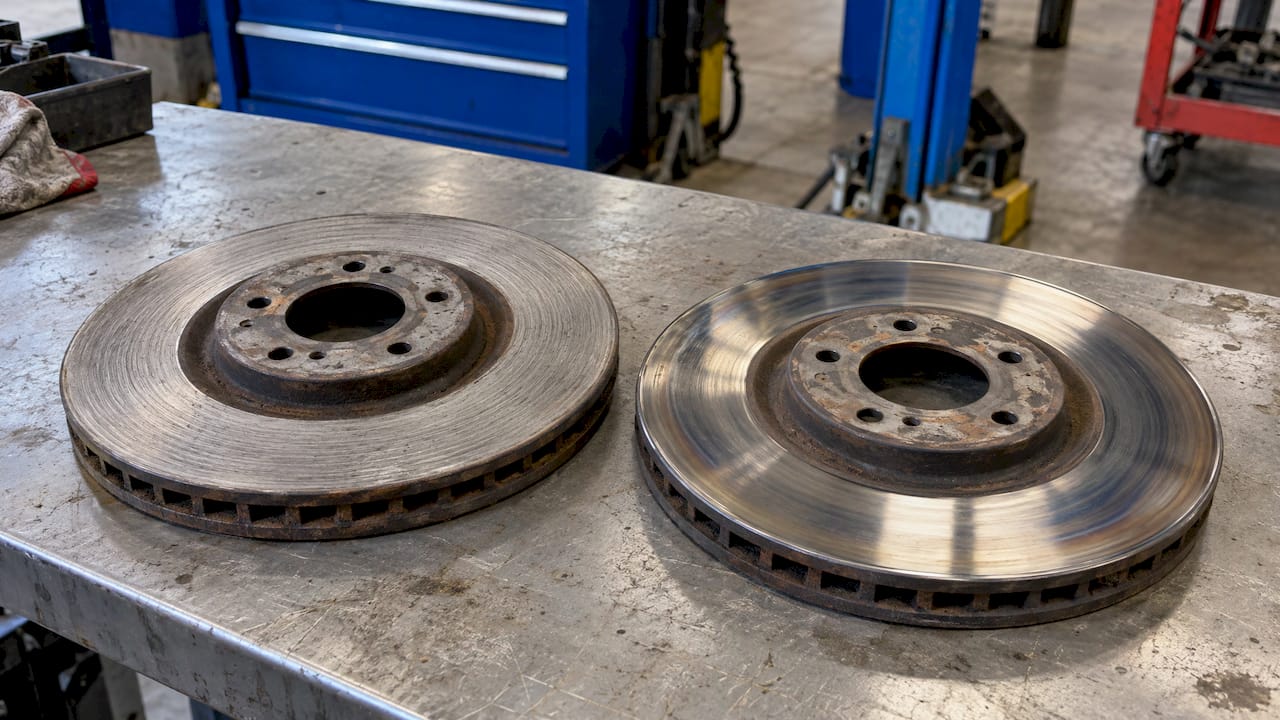
The terms “glazed brake discs” and “glazed rotors” mean the same thing: “disc” is the term used in many other countries, “rotor” is the American one.
What glazed rotors look like and sound like
Take the wheel off and look at the swept face of the rotor, the ring where the pad rubs.
- Appearance: a shiny, mirror-like or glassy finish, sometimes with a blue or brownish tint from overheating. Run a clean, dry fingertip across it (only on a cold rotor) and it feels smooth, without the fine grit of a healthy surface.
- Pad face: a glazed pad shows a hard, glossy, sometimes darkened surface instead of a dull, uniform one.
- Sound: a high squeal or squeak at low speed and light pedal pressure is the classic complaint. A Porsche technical bulletin describes glazed pads and rotors as characteristic of normal, light-footed, slow-speed brake squeal. A Nissan bulletin links a groan during stopping to rotor-surface glazing from heavy or frequent braking.
If your noise is not clearly glazing, our guide on whether squeaking is coming from the pads or the rotors walks through the other usual suspects, and our page on brake pad squealing covers when a squeal is harmless and when it is not.
Glazed brake pad symptoms you can feel while driving
Glazing is felt before it is seen. Watch for:
- Squealing or squeaking when braking gently, especially after the car has warmed up.
- A longer stopping distance or a pedal that needs more effort for the same braking.
- Vibration under braking, most noticeable from higher speeds.
- A burning smell after repeated hard stops, such as a long downhill.
- A soft or spongy pedal.
Most of these also have other causes. A soft pedal in particular is not something to diagnose by guesswork: if it is new, sinking toward the floor or paired with a warning light, read this explanation of what causes a soft brake pedal and the safety steps, and have the car inspected before you keep driving it.
What causes glazing
Three things do most of the damage.
Heat. Repeated hard braking, towing, mountain descents, track days or a heavy vehicle on small brakes can push temperatures beyond what the pad material tolerates. The surface hardens and polishes. Drivers who describe losing stopping power a few laps into a track day on stock pads are describing this.
Light, slow braking habits. Gentle, short stops never get the pad and rotor hot enough to keep the surfaces clean, so a thin film builds and polishes. This is why the Porsche bulletin ties the squeal to light-footed, slow-speed braking.
Contamination and corrosion. The same bulletin lists contamination by sprays, fluids, road salt, grime and small particles embedded between the pad and rotor as a cause of brake noise, and lists corrosion among the rotor conditions. In wet or salted climates, a rotor that sits wet overnight develops surface rust that the pads then burnish. Some of that is cosmetic. Our article on why rotors rust after rain explains which rust is normal and which is not.
A fourth factor is a bad bed-in. New pads need to lay down an even transfer film. If they are overheated early, before that film forms, the surface can glaze from day one.
Glazing versus other rotor wear: a quick comparison
Glazing is only one of several conditions a rotor can show. The Porsche bulletin lists a glazed surface, lips at the outer and inner edges of the pad contact area, and corrosion as separate rotor conditions. A BMW bulletin adds grooves, which form when debris is trapped between the pad and disc.
| What you see or feel | Likely condition | Typical direction |
|---|---|---|
| Shiny, smooth, glassy face; squeal at low speed | Glazing | Deglaze lightly, or replace pads and rotors if severe |
| Raised ridge at the edge of the swept area | Lip from wear | Measure thickness; replace if near minimum |
| Concentric grooves you can catch a fingernail in | Debris scoring | Judge depth; deep grooves mean replacement |
| Orange rust on the face that wipes off after a few stops | Surface corrosion | Usually cosmetic if it clears; pitting does not |
| Pulsing pedal or steering wheel shake | Thickness variation or heat spots | Measure and resurface or replace |
| Blue or dark patches, cracks | Severe overheating | Replace and have the system inspected |
The BMW bulletin says the depth of grooves must be evaluated to decide whether replacement is necessary, and that for brake-induced vibration the maximum thickness difference it allows is 0.030 mm at the specified radii. Readings above that limit mean the discs should be replaced. That is a precision measurement for that vehicle, so use your own vehicle’s manual for specifications. A micrometer, not a ruler, is the tool.
How to tell if your rotors are worn out
Glazing and wear often travel together on a high-mileage car. Check these in order:
- Thickness. Every rotor has a minimum thickness, usually stamped on the hat or edge. Measure the swept face with a micrometer and compare. At or under the minimum, replace it.
- Lip. Feel the outer edge. A pronounced ridge means the swept area has worn down.
- Grooves and scoring. Light lines are normal. Deep grooves are not.
- Cracks and heat spots. Fine cracks at the edge or blue and dark patches mean heat damage.
- Pad condition. Uneven pad wear, or pads worn to the backing plate, means the rotor has been run hard.
If you would rather not take the measurements yourself, a guide to when to change your brake pads and tires explains what inspectors look for in groove depth and minimum thickness.
Can you fix glazed brake pads and rotors?
Sometimes. Manufacturers’ own bulletins show the range of responses, and they differ by vehicle.
- Clean and re-bed. An Audi bulletin says that glazed or very dirty pad friction surfaces can be worked on or cleaned with workshop materials such as sandpaper and brake cleaner, then bedded in again, with no part replacement required.
- Sand or hone the rotor. Porsche recommends sanding the rotor to create a non-directional finish, remove corrosion and reduce the lip, and says a rotor hone can create that finish.
- Resurface rotors and replace pads. For certain Acura RLX models with warm, slow-speed front squeal possibly caused by glazing, the bulletin directs technicians to resurface the rotors and replace the front pads and shims. Nissan’s bulletin similarly replaces the pads, then resurfaces the rotors and finishes them with sandpaper.
The pattern is consistent: the pads and the rotor face have to be treated together. A glazed pad on a fresh rotor, or a new pad on a glazed rotor, tends to bring the problem back.
A cautious deglazing routine
Use this only when the rotor is within thickness limits, has no cracks and the pads have plenty of material left.
- Lift the car securely on stands and remove the wheel. Never work under a car held only by a jack.
- Inspect for the stop-driving signs: cracks, pad backing plates showing, leaking fluid or heavy wear. If you find any, stop here.
- Clean the rotor and pad faces with brake cleaner and a clean rag. Avoid breathing brake dust.
- Scuff the pad face flat with medium-grit sandpaper on a flat surface. On the rotor, finish with a hone or sandpaper to leave a cross-hatch, non-directional pattern, as the bulletins describe. A guide to removing brake dust safely is useful for cleanup before and after.
- Rinse with brake cleaner, let it dry, reassemble and torque the wheel to specification.
- Bed the brakes in following the pad maker’s procedure, without overheating them.
This is a temporary correction when the glaze is shallow. It cannot take out grooves, pitting or thickness loss.
Should glazed rotors be replaced or resurfaced?
The honest answer depends on what is underneath the glaze.
Replace when: the rotor is at or near minimum thickness, has deep grooves, cracks, blue heat marks, heavy lips or corrosion pitting, or when resurfacing would take it under the limit. A Subaru bulletin for judder, pulsation or heavy ridge buildup says to resurface or replace as conditions dictate, and to replace rotors only when resurfacing is not viable.
Resurface or hone when: the rotor has plenty of thickness left and only a glossy film or light lip.
Be careful with resurfacing for noise alone. A trade magazine for technicians notes that rotors are not to be resurfaced to correct noise or squeal, cosmetic corrosion, or routine pad replacement, and that GM discourages it unless a service bulletin directs it. Resurfacing removes metal, and a rotor has only so much to give.
For most daily drivers, the simpler path is to replace pads and rotors together. You get a fresh friction surface, no thickness arithmetic and a bed-in that starts clean. With high-mileage use, such as rideshare or delivery, rotors reach their limits quickly and resurfacing rarely buys much.

Replacing glazed brakes with a matched set
If your rotors are glazed, the cleanest fix is a new set of pads and rotors that were designed to work together. That is how we sell them: our rotors are offered only as part of brake kits, matched by vehicle, so the pad and the rotor have been developed as a system.
Our HydroAdaptive ceramic pads are designed for moisture management and stable friction, and our GEOMET-coated rotors are designed to protect against corrosion from moisture and road salt, two of the contamination sources that make a glazed or noisy brake more likely. Pick the pad and rotor kit for your vehicle:
- Type 03 brake pads with SC type rotors kit
- Type 07 brake pads with SC type rotors kit
- Type 03 brake pads with GC rotors kit
You can also browse the GC type rotors or the Type 07 pads directly, or start from the AAA Frictions home page to match parts to your car. Our ClimateFlex calipers are designed for smooth operation in winter cold and summer heat, which is worth a thought if the old caliper is sticking.

Our view: a glazed rotor is a system problem
Most glazing stories we hear about start with a good rotor and a mismatched or poorly settled pad, or the reverse. Brakes are a pair. One surface transfers material onto the other, and the result is only as even as the two parts are compatible.
That is why we develop rotors and pads as a matched system and sell rotors only with compatible pads. It is also why we design around weather. Moisture, road salt and temperature swings are what put rust, film and contamination on friction surfaces, so our HydroAdaptive pads, GEOMET-coated rotors and ClimateFlex calipers each address a different challenge the weather places on braking.
If your rotors are glazed, we would rather you fix the whole pair once than patch one side and come back to the noise in a month.
AAA
After you fix it: confirm the brakes are safe
Whether you deglazed or replaced parts, finish with a short check.
- Pedal feel. It should be firm and consistent. Anything soft, sinking or spongy needs professional inspection before driving.
- Low-speed test. In an empty lot or quiet street, brake gently from a slow speed and listen for squeal, then brake more firmly. The car should stop straight.
- After a short drive, stop and smell near each wheel. A strong burning smell from one corner is a warning.
- Heat check. Carefully feel the wheels’ temperature from a distance, never touching the rotor. One wheel much hotter than the others suggests a sticking caliper or dragging brake.
- Re-inspect after the first week for new noise or vibration.
Stop driving and see a qualified technician if you find cracks in a rotor, pad backing plates exposed, a fluid leak or a pedal that goes to the floor.
Preventing glazing next time
- Bed in new brakes properly and avoid hard stops until the transfer film has formed.
- Mix in some firm braking on a safe road so the pads and rotors get hot enough to stay clean, rather than only creeping to stops.
- Downshift on long descents to spare the brakes, particularly if you tow or carry heavy loads.
- Watch the weather’s effect. After wet or salty conditions, the first few stops often scrub off light surface rust. Rust that does not clear, or pitting, is wear.
- Replace pads and rotors together when the rotors are near their limit, rather than putting new pads on a worn surface.
FAQ
Should glazed rotors be replaced?
It depends on severity. Rotors with only a thin glossy film and plenty of thickness can sometimes be sanded, honed or resurfaced. Rotors with deep grooves, cracks, blue heat marks, heavy lips or a thickness near the minimum should be replaced, ideally with the pads, as a matched set.
What do glazed rotors sound like?
Usually a high squeal or squeak at low speed and light pedal pressure. Some vehicles groan while stopping. The noise is often worst when the brakes are warm. A grinding sound is different and usually means pad material is gone.
How do I know if my pads are glazed?
The pad face looks hard, shiny and smooth rather than dull and even. You may also notice squealing, longer stopping distances, vibration or a burning smell after hard braking. Remove the wheel to check the pad and rotor surfaces.
Can I just sand glazed brake pads and keep driving?
Light glazing on pads with plenty of material left can be cleaned with sandpaper and brake cleaner and then re-bedded, as one automaker bulletin describes. If the rotor is glazed, grooved or worn, the problem will usually return, so treat the pair together.
Sources
- Porsche technical bulletin on brake squeal, glazing and deglazing (NHTSA)
- BMW bulletin on grooves and disc thickness (NHTSA)
- Acura service bulletin on front brake squeal (NHTSA)
- Nissan bulletin on groan and rotor glazing (NHTSA)
- Audi technical service bulletin on cleaning glazed pads (NHTSA)
- Subaru service bulletin on rotor replacement and resurfacing (NHTSA)
- Motor magazine, Brake Rotors
- Removing brake dust safely
- Soft brake pedal causes and safety steps
- When to change your tires and brake pads